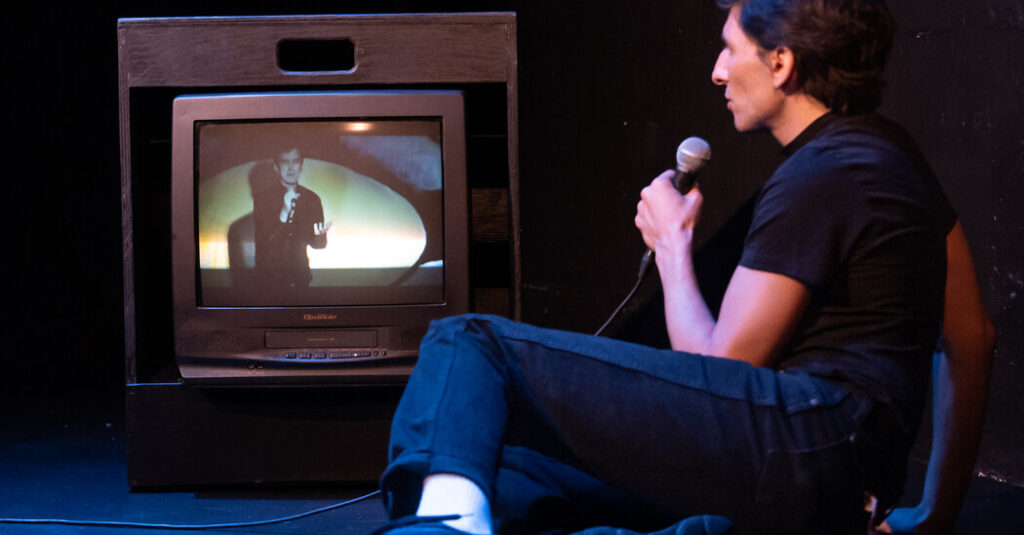
On the tiny stage, standing in front of a painting of a black-and-white life preserver, there’s a gangly, dark-haired, shouting comedian gripping the stand-up microphone. The room is shadowy, and the amplified voice echoes, as if it’s calling all the way from one world to another. “Liberace! Liberace! Can you hear me, Liberace? You died! And you lied. You died of AIDS, and you lied!”
That singsong voice belongs to Morgan Bassichis, the performance artist and comedian who has won an Obie award for their solo show “Can I Be Frank?,” which is back for another run at SoHo Playhouse. Squint your eyes, though, and the performer could as easily be the Frank of the title, Frank Maya. The blistering rant about the closeted Liberace is from “Frank Maya Talks,” Maya’s 1987 stand-up monologue, and Bassichis recreates the nearly 40-year-old bit several times — false starts are Bassichis’s most reliable gag — over the course of this funny, devastated, angry show.
Maya died in 1995 of AIDS-related heart failure, and he has been largely forgotten outside of his downtown circle. Maya never had the chance to be a gay elder — Bassichis only learned about him after meeting Maya’s brother by chance. Yet Maya was one of the first openly gay comedians to go mainstream: He was a guest on Dick Cavett’s talk show; he was out and loud on MTV; he even had his own special on the Ha! Comedy Network in 1990.
Maya’s story-yelling cadence was a Queens hurry-up, the sound of New York machismo propelling jokes about queer life. He also knew the comic value of dropping his pitch. The first time he made out with his lover, Maya says in his special, he was impressed. “I said, ‘God, where’d you learn to kiss like that?’ And he just looked at me, and he said [in a basso rumble], ‘Nam.’”
While the structure of “Can I Be Frank?,” directed by Sam Pinkleton, is pure tribute, Bassichis’s deliciously vain stage persona is consumed with their own career. “It’s 2026, I’ve never been on TV, and I do think some of that is the … antisemitism.” Show-Morgan is horny as a primed bull and fake-humble about our presumed adoration. The vibe is part Jane Krakowski on “30 Rock,” part swan attacking you in a park. Morgan would love to hear our feedback about this piece — “positive or appreciative.”
There’s a sensibility overlap here with Cole Escola’s narcissistic virago in “Oh, Mary!,” which is also directed by Pinkleton. And really everything about Bassichis’s hilarious, hyper-modern delivery runs counter to Maya’s macho adrenaline. The two use their bodies differently — Bassichis has elegant, multi-octave hands, which dance their own spidery choreography — and the performers diverge too in their political attitudes. A friend of Maya’s fondly explains to Bassichis that “Frank wanted the world to be safe for Frank,” referring to Maya’s call for sexual disinhibition, even in the face of AIDS. Bassichis makes their own points through contrast, dropping their many disarming ironies to reveal a galvanizing activist’s rage. (A spoonful of acid helps the medicine go down.)
And Bassichis does transform to become Maya, when, after a million interruptions, they finally deliver his long-ago material, including a posthumous “letter” from Frank and two hypnotic songs. Maya’s original sequences are, interestingly, not always funny, and you might be tempted to skip past them on video. But in person (and in Bassichis) the old rhythms become something like liturgy. The ritual aspect of “Can I Be Frank?” creates a strange tension, as the lost comic’s voice reshapes the living artist’s mouth. Bassichis gives themself over to a man they never met; there’s a quality of sacrifice, of channeling, of transubstantiation.
It struck me that this is not the first reconstruction-as-wake that I’ve seen this year, nor the first of a specifically downtown New York artist. I saw Tony Torn re-create Michael McClure’s bizarre 1971 solo “Spider Rabbit” at La MaMa in March, a piece most often performed by the poet and Warhol acolyte Taylor Mead, who died in 2013. Dressed as a white zombie rabbit, Torn ripped into the head of a soldier mannequin, chanting in a childish voice about pacifism. “I HATE war!” Spider Rabbit assured us. “GOSH! I won’t do it again,” he whined, when it seemed like he might get into trouble for eating brains.
“Spider Rabbit” was one of McClure’s “Gargoyle Cartoons” — swift, wild clown-dramas, or “dream beams” — that McClure dedicated to James Rector, an observer at a protest who was killed by police in 1969. Torn saw Mead perform “Spider Rabbit” in New York in 1980, and so this year’s “Spider Rabbit,” directed by Dan Safer, became a nesting doll of elegy: Torn paying homage to Mead paying homage to Rector. (I also thought of Maya joking about his lover being a Vietnam veteran — the shadow of that war cast itself over everything.)
This impulse to re-perform also gave us another of the finest productions I saw this year: the remounting of Michael Gordon and Richard Foreman’s 2006 opera “What to Wear” at Brooklyn Academy of Music. The directors Annie-B Parson and Paul Lazar had been asked by Foreman himself to stage it, though they had not worked with him; he then died in 2025. Instead of placing their stamp on it, the directors chose to surrender their own artistic ideas and hew as closely to the original as they could. “At the end of the day, we’re not changing anything. It’s perfect,” Parson explained.
It’s one thing to acknowledge that you’re standing on the shoulders of giants; it’s another to think about standing in the place of the dead. That debt, mixed with a kind of free-floating grief, seems unpayable. Bassichis and Torn and Lazar and Parson all found the same solution: to imitate the absent artist as faithfully as possible, to re-create his costumes, to copy everything that anyone — or the grainy old video — can remember. It’s collaboration through the veil.
Does it work? Does the audience who didn’t know Maya or Mead or Foreman get some inkling of the lost artist’s magic? Possibly that’s the wrong question.
At the very end of “Can I Be Frank?,” Bassichis performs their own musical setting of Douglas Crimp’s 1989 essay “Mourning and Militancy.” They sing Crimp’s text about the insufficiency of one without the other: “If we understand that violence is able to reap its horrible rewards through the very psychic mechanisms that make us part of this society, then we may also be able to recognize — along with our rage — our terror, our guilt, and our profound sadness.” Expressing sorrow, Crimp insisted, isn’t mere melancholy; it’s a component of action that we cannot safely do without.
So mourning is in itself life-giving. I know I’ve certainly felt more exhilarated and activated during these productions than in nearly anything else this year. Bassichis has recreated the backdrop from “Frank Maya Talks,” a black-and-white life preserver painted on a yellow field. It could be the crest for all such efforts at retrieval. The ocean is vast, and it washes away almost everything anyone ever made. But you can toss this little buoyant ring into the waves. It might be the thing that saves you.
Helen Shaw is the chief theater critic for The Times.
The post For This Performer, Imitation Is the Sincerest Form of Tragedy appeared first on New York Times.