This is an edited transcript of “The Ezra Klein Show.” You can listen to the episode wherever you get your podcasts.
If you travel deep into the New Right, what you find at the moment is a constant yearning for something very old. Not just a time when America was great but also a time when men were great, when men were men. You hear it in Costin Vlad Alamariu, who’s better known as Bronze Age Pervert, and his longing for the Bronze Age.
Archival clip of Costin Vlad Alamariu: I am here just to spread the political views of the ancient Hittite Empire or the ancient Mitanni Empire
You hear it when the pastor Doug Wilson yearns for the time before the 19th Amendment.
Archival clip of Doug Wilson: The net effect of women’s suffrage was not an advance in women’s rights but rather part of a push to replace covenanted entities like families with raw individualism.
You hear it in the increasingly constant idealization of 1950s America.
Archival clip
Tucker Carlson: Why wouldn’t you design a system consistent with nature?
Chris Williamson: What would that look like to you?
Carlson: It would look like what we had before Betty Friedan wrote “The Feminine Mystique,” before lifestyle feminism dominated every institution in the West.
There was a time when all this could be dismissed as a fringe movement on the fever swamps of the internet. But Bronze Age Pervert is a favorite of young Trump staff members. Defense Secretary Pete Hegseth invited Wilson to preach at the Pentagon. And Tucker Carlson is, well, Tucker Carlson.
These are not all fringe figures. And it’s not just them. It’s a much broader thing on the New Right, which increasingly wants a return and is theorizing for how to create a return to very old ideas of how men should be, to very old policies that centralize the power they wield and the way society is ordered.
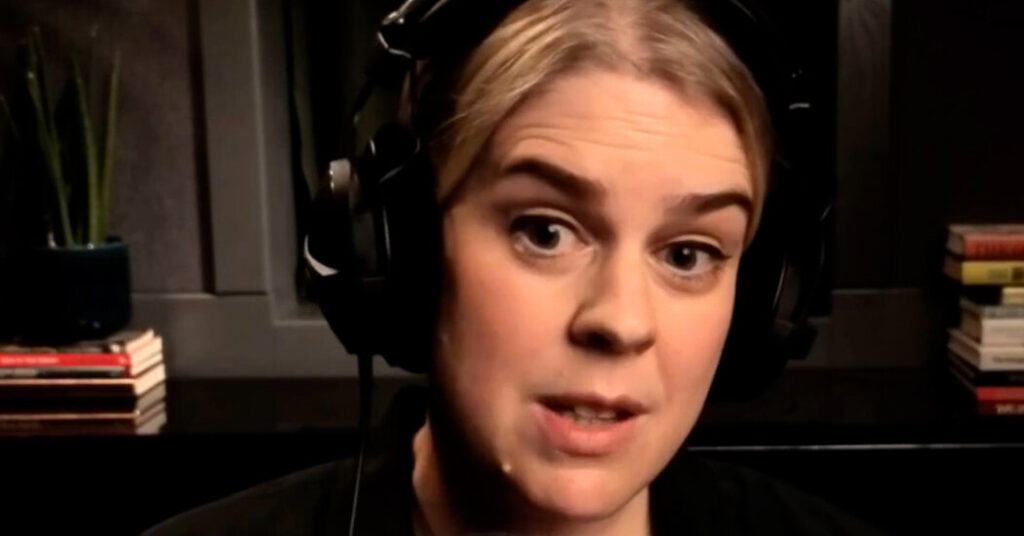
Helen Lewis is a staff writer at The Atlantic and the author of “Difficult Women: A History of Feminism in 11 Fights” and “The Genius Myth: A Curious History of a Dangerous Idea.”
She has just written a great cover story for The Atlantic mapping this world, which she calls “masculinism,” talking to many of its key figures and trying to understand its core ideas.
Ezra Klein: Helen Lewis, welcome to the show.
Helen Lewis: Thank you.
I want to start with a clip from Scott Yenor, a professor at Boise State University, that I think is a good place to start.
Archival clip of Scott Yenor: Our independent women seek their purpose in life in midlevel bureaucratic jobs like human resource management, environmental protection and marketing.
They are more medicated, meddlesome and quarrelsome than women need to be. Without connections to eternity delivered through their family, such medicated, quarrelsome and meddlesome women gain their meaning through the seeming participation in the global project.
They are agents of the new world but not new life. Such women are now the backbone of every left-wing cosmopolitan party in the Western world.
I thought that was as concise a description of this masculinism that you’ve been reporting on as I’ve heard from any of its subjects. Tell me about him and the view of society you understand him to be spinning out here.
Well, as you heard, it’s one that’s not afraid to be offensive.
But the essential thesis is that it’s women’s role in life to have children and modern women have been deluded instead into pursuing careers that aren’t real jobs and that they’re not doing anything of any merit anyway, and therefore, their lives will essentially be empty and pointless.
But I like my job, and I also feel that my job is of equal social worth to Yenor being in a think tank, right? He’s hardly a cancer surgeon. Calm down, son.
I find it intriguingly repellent, and I think a lot of people do as well.
One of the things I heard in that clip is an echo of the JD Vance miserable-cat-ladies clip that went around in the 2024 campaign.
Archival clip of JD Vance: We are effectively run, in this country, via the Democrats, via our corporate oligarchs, by a bunch of childless cat ladies who are miserable at their own lives and the choices that they’ve made, and so they want to make the rest of the country miserable, too.
I mention that because it can be easy to look at Yenor and some of the people we talk about and think, “Oh, this is a fever swamp right-wing movement. This is when you’ve clicked on too many posts on X and the algorithm has found something out about you that you wish it didn’t know.”
But one of the arguments you make in this piece is that masculinism has become a unifying theory on a MAGA right that in other ways is coming apart. Defend that.
You can see the splits of MAGA very obviously at the moment over the war in Iran, American support for Israel as a military ally, protectionism versus free trade. There are all these interesting currents that are going on.
However, if you asked, “Do you think feminism has gone too far?” how many people in the MAGA coalition are going to push back on that and say, “Actually, I think we should give more jobs and opportunities to women”?
It is this one thing that basically everybody can agree with: Traditional gender roles are better. Equality has been a failed pursuit. It’s maybe even an illegitimate pursuit. Empathy, which is feminine by nature, has been misused and is ruining our politics because women and their parties that represent them — the Democrats — feel sorry for all these underdogs who aren’t really underdogs; they’re kind of cancers on our society, like violent criminals or illegal immigrants.
So this is a very coherent ideology. And the reason that I wanted to write the piece is I think people are now quite familiar with the idea of the manosphere and the Andrew Tate type of provocateurs who are creatures of the algorithm.
And I wanted to say: Well, hang on a minute. Actually, there is a really serious ideological and political project here behind this. It has got people in think tanks, it’s got people who are working in politics, and it has got its intellectual outriders.
But this isn’t just some oversteroided guys in tight T-shirts parading around in nightclubs for Instagram. These are people who want to completely restructure American life into a way that they find more agreeable, and they want to use legal instruments and political instruments to do so.
What does that vision look like?
The simplest way to say it is that men would be the breadwinners and women would be homemakers.
The reference point always tends to be the 1950s, but it’s a very fake, Pleasantville, black-and-white, picket-fence version of the 1950s. Lots of families did not, in fact, live in that way.
For example, one of Yenor’s most controversial proposals is this idea of the family wage, the idea that you would restore discrimination in the job market by saying it’s OK to preferentially hire men, married men, that it’s OK to promote them more, to pay them higher salaries. What we want to do is essentially restore a traditional way of life, in which men are the ones who go out and earn money and women’s money, if anything, is back to being pin money. It’s secondary.
It’s worth it for you to expand on that. The core critique and the core politics here is that modernity has thwarted masculinity.
The arguments here shift between this 1950s nostalgia for when you had the single breadwinner family. In some cases it’s very Christian, and in some cases it’s very pagan, but this spiritual level of politics seems, to me, to have this dimension of “Modernity is hollow.”
People are working — as you mentioned, particularly women — these [expletive] jobs in human resource management and in marketing and environmental protection, and men are caged in these little offices and doing retail work that is beneath them.
Yenor in his quote says, “Agents of the new world but not new life.” There’s all this emphasis on what life is — the good, the beautiful, vitality, vitalism. Can you talk about that dimension of the spiritual sell being made?
Yeah, I think that is part of it, because another thing that often comes up is the idea that women are on a huge amount of anxiety medication and antidepressants.
You have this situation in which women having anything that they feel is wrong in their lives is taken as proof that they’ve picked the wrong course in life, and if only they would pick this alternative vision of femininity, they would be happy.
This is part of the exchange that I had with Doug Wilson, the evangelical pastor — that this is not a new phenomenon. It was something that Betty Friedan was writing about in “The Feminine Mystique” when she was talking specifically about the unhappiness of stay-at-home housewives. She said they’re taking medication like cough drops.
The bit that I struggle with, as somebody who loves reading historical novels, historical fiction, historical biographies, is: Are we absolutely sure that women in 1700 were living these incredibly blissful lives?
That’s not what you get from the literature of the period. In my first book, which is a history of feminism, I wrote about some of the women who wrote to Marie Stopes, who was our version of Margaret Sanger, a contraceptive pioneer. They were describing lives of despair, where they had far more children than they can afford and they didn’t know how to stop having any more. They were exhausted by their late 30s from this relentless tide of childbearing.
But that era has now passed into memory long enough that it is susceptible to being revitalized into this tradwife vision that is sold to people on Instagram because no one can really remember what it was like to live in those conditions anymore.
Let me try to think about how to do this, because when I get into a literature, I’m usually a generous reader and I leave with more sympathy for it than I came in. I read your piece, and then I read “The Last Men” by Charles Cornish-Dale, Raw Egg Nationalist. I read “Bronze Age Mindset,” and it’s one of the first times I can really remember coming out of something like this and thinking, “Oh, there was so much less there than I thought.” Like, I just assumed people were making some reasonable arguments.
But I want to try to be generous before I get into that reaction. So let me ask it this way: As you were talking to these people, as you immersed yourself in this literature, which parts of the critique or the diagnosis of modernity and its ills and ailments did you find recognizable or find yourself responding to?
I do find the battery cage idea of humanity to be quite compelling. I’m sure my life would be better if I took more exercise, got outside more, took a screen break, didn’t doomscroll. I think all of those things are reasonable.
I think the American diet is hideous, particularly for lower-income Americans. So I don’t think all of those things are ridiculous. That’s something that comes up a lot in “The Last Men” — the idea that elites are keeping you fat, that they’re keeping your testosterone low if you don’t eat enough meat, that vegans are oppressing you ——
That vegetarianism is a tool of social control to sap our vitality and make us easier and more obedient as subjects.
But it’s very interesting. Clearly, that has caught on, because Arnold Schwarzenegger was an executive producer for a documentary about being vegetarian, except he’d rebranded it as plant-based. It was all about how you could be an incredibly good weight lifter if you were on a plant-based diet. You could have incredibly strong erections on a plant-based diet.
So clearly it has seeped into that discourse that there is something unmanly about not eating meat.
But I think I like that book more than you did. Maybe my expectations are lower, but the thing that I found interesting about it was that it moved from saying it is impossible to be a man fully in a liberal democracy — there’s a line in there that says essentially that — because of the fact that you’re being kept in these rubbish jobs and you have low testosterone, all this kind of stuff.
Then you get to the end, and you ask, “What are we doing, then?” And there’s a bit, like: Well, you should chuck out your plastic chopping board. And I was just like, “Oh, I was sort of expecting you to advocate fascism at the end. But you’ve kept it lower. You’ve kept it more achievable.”
That was the bit where I slightly parted company from it.
[Laughs.] That’s where you parted company?
Let me describe the argument of this book, because it gets at something that I want to try to do here, which is it brings up some things really worth talking about and then goes in some really wild directions. You can correct me if you feel I am being unfair in any part of this.
“The Last Men” is an argument that begins by saying what we need is a hormonal theory of politics, and the hormonal theory of politics is this, and this part is real: There has been, over the decades, a measurable and sustained drop in testosterone in men across a number of countries, in sperm quality and count among men across a number of countries.
There’s also — and this is a big topic of discussion on this side and an important one that I wish the left would take more seriously — been a sustained drop in fertility rates across many, many different countries.
Relatively few liberal democracies are now at replacement rate or above, if any of them are. I think Israel is. Although whether Israel’s a liberal democracy is its own question.
He starts there and says: Look, the core of masculinity, the Greek word “thymos,” is testosterone. This thing that Francis Fukuyama’s talking about in “The End of History and the Last Man,” this thing that Nietzsche is talking about — it’s just testosterone.
We are destroying testosterone, and we’re destroying it with endocrine-disrupting chemicals that are in all the things we buy, destroying it with bad diet, destroying it with chemicals in the water.
And it is creating and is maybe an effort to create — and this is where things begin to go a bit off the rails — a docile form of man who is suited for the longhouse of liberal democracy and not suited for the displays of dominance and hierarchy and the conquest and excellence that has driven civilization forward and defined man forever.
Then, as you say, it ends with a stirring call to throw out your plastic cutting boards and filter your water.
But this is the argument. There’s some stuff I agree with on chemicals, some stuff I’m generally worried about, like hormonal changes, and then the sense that what’s really happening here is the destruction of what it means to be a man — literally the vital fluids that make men manly.
That’s the book.
Right. But there is an obvious overlaid political valence on this, which is this idea that if you’re high T, you’re risk-taking, you’re possibly violent, and you don’t mind about inequality. It’s about the strong dominating the weak.
Therefore, liberal democracy is inherently feminine because it’s more concerned with making sure that the weak don’t suffer too much, that there are equal rights for all. It’s very easy to see how that vision of masculinity maps onto MAGA rightism. Definitely.
When I start drilling down into the examples, I find it tricky. Young men, for example, have much higher testosterone than old men. So if women shouldn’t be in leadership positions, maybe old men shouldn’t be in leadership positions because they don’t have the requisite thymos, either.
Oh, you’re not saying that? So, actually, you’re just making very large, sweeping claims that men are one thing and women are another thing. That kind of stuff falls apart in your hands.
But don’t you think it does speak to some people? I think it speaks to people who have a female boss and they resent it and they find it slightly emasculating. The kind of people who, if a woman upset them, the word “bitch” would be pretty close to their lips, right?
Like, “How dare you speak to me like that? You’re just a woman.” And I think that’s closer to the surface in men, even men who are otherwise impeccably liberal, than perhaps we sometimes like to acknowledge. So I can see why this stuff does have a relatively wide appeal.
And the person of Donald Trump in the 2024 election became a vehicle for this feeling.
This guy who stood up and pumped his fist, covered in blood, after an assassination attempt, instead of cowering behind his Secret Service guards or a lectern or staying on the floor. This guy who would say anything he wanted to say, no matter who it offended, who did not play by the rules of feminized society.
This man who kept driving forward through adversity — lawsuits and electoral losses — and made his own reality around him.
Trump, for all his sedentary lifestyle and obesity and the fact that he’s advanced in age — and I haven’t measured his testosterone, but it’s probably not that high anymore — represents what masculinity is supposed to be, which is an effort to dominate other people in a bid to achieve greatness for yourself, your kin, your country.
Liberal democracy had thwarted that until he came back and busted through and showed you could still do this.
It’s an incredible cherry-pick, isn’t it, about Trump as the ultimate alpha male?
This is what I find very difficult about all of this literature — is that it just implies that everybody is a Ken doll or a Princess Sparkle.
Trump is at the same time a man who wears more makeup than I do most days, a man who loves “Sunset Boulevard,” you know? The man loves a musical. It’s one of his better qualities.
You know what I mean? Those aren’t the things that they’re emphasizing.
Interior decorating.
Exactly. [Laughs.]
Which I like about Trump. I’m not dissing him here. But so much of these people are engaged in a very Judith Butlerian level of gender performance. It is the most cisgender performance of heteromasculinity you could possibly imagine.
Trump, in some ways what makes him appealing — he’s got some of that, but then he’s got the other thing, too, because he’s actually not, at his core, an insecure, thwarted, little goblin.
Yeah. I personally find that much more appealing than I do the very pompous “We’re all going to have a sauna together, us guys, but it’s definitely not gay” kind of very terrified homophobia that sometimes comes out of some of those communities.
I want to try to run through some of these ideas. One of the founding fathers of this in the New Right is Bronze Age Pervert. Can you describe who that is?
He is a thinker whose real name is Costin Alamariu. He’s Romanian American, and he has a whole persona about bodybuilding and eugenics and Nietzsche.
Those are maybe his three favorite things. There’s almost an “I am Dracula” level to hamming up the accent. Once again, this is somebody who’s playing a character on the internet.
The way I describe the book — which is aesthetically interesting, even if, intellectually, it becomes a bit tedious — is that it has this really Nietzsche-for-gooners quality. It’s very Romantic poetry but filtered through 4chan lingo.
I want to play a clip of this interview he did with Michael Malice in 2024, talking about the problems of modernity.
Archival clip
Bronze Age Pervert: Why is it disgusting? It’s because it privileges safety and mere life, the preservation of life, at the expense of things that are exciting and great and free, you know?
When I wrote this book in 2018 — sorry to keep talking, Mike, if I may go on.
Michael Malice: No, this is why you’re here.
Bronze Age Pervert: When I wrote this book in 2018, some people liked it because I expressed myself directly and with humor and so on, and they said, “OK, BAP, this is very nice, but is it really true?”
And then what happened — people will say now I planned it. No, I didn’t plan it. The pandemic happened, which basically, I think, demonstrated the truth of what I’m saying. And the pandemic, in my view, was a mass sacrifice of the world’s youth to the desires of disgusting old people who sacrificed the youth and also to women, frankly, especially the middle-aged, sterile woman who made the pandemic procedures her whole life. It gave meaning to her life. I saw it in action, you know?
Malice: I can’t tell you how much joy it brings me to hear you with your accent say the phrase “these middle-aged, sterile women.” It’s just — mwah.
This book, “Bronze Age Mindset,” got written up in The Claremont Review of Books. There are reports that most young staff members in the Trump administration had read it. It had become a piece of code passed back and forth — samizdat.
The reason I think that clip is interesting is it combines the two things the book does, which is this sense that there is something more than mere life — he says, “The preservation of life at the expense of things that are exciting, great and free” — with the campy provocateurism, like: Oh, it makes me so excited to hear you say “middle-aged, sterile women.”
What’s this idea about privileging safety and mere life over things that are exciting and great and free?
Well, this is the idea that women, because of their lack of comparative thymus and testosterone, are weak and empathetic and they don’t want to put themselves in situations of danger. This is the idea that essentially the whole world has one giant H.R. department telling you that you’re not allowed to do the things you want to do anymore, particularly the kind of things that young men want to do.
I can understand why people feel like that, but I also think a huge amount of complacency has driven it. I don’t think people would be talking like that in a time when they had lost three of their eight children to a preventable disease before the age of 2.
I don’t think they would’ve been talking about that immediately after World War I, when you could quite easily have lost four of your sons in a completely pointless advance two miles across France.
This is an ideology that is born out of fat modernity itself. The luxury that they have to play with these ever so spicy ideas are because they’ve never lived these lives.
If you went over to somewhere that is currently in the middle of a conflict and you said to them, “Are you all enjoying this incredibly dangerous masculine experience that you’re having?” I think they’d actually like a stable food supply and peace.
It’s ironic that they talk about Fukuyama, because this is what he predicted in “The End of History and the Last Man.” He said that you’re going to end up with people who are just bored, full of ennui, and they’re going to have to find things to now entertain themselves because they don’t have the material deprivations and challenges that previous generations had.
That’s what I hear when I hear that. I hear, “Oh, we’re all having a go at Karens on a podcast. Isn’t it so spicy?” What has this got to do with the Spartans? This is just the fake, cosplay version of masculinity that everybody’s indulging in.
These people could sign up to the Army. They could go and serve in a war, and they’ve not chosen to do that. They’ve chosen to become podcasters. Interesting.
The LARPing point of that is very important because it is a bunch of intellectuals in elite competition with other intellectuals, a bunch of humanities academics. I mean, Bronze Age Pervert went to Yale, was it?
He’s definitely spent a few terms teaching, I think at Emory. And that’s the same with Jonathan Keeperman — L0m3z — who was an academic. Cornish-Dale has a Ph.D.
Many of my friends are academics. I can see how it slightly deranges people.
This is an elite overproduction problem.
As soon as I was thinking about this, I started thinking about Peter Turchin’s idea of surplus elites. Some of these people, perhaps they didn’t fit in socially at universities and colleges, perhaps they didn’t fit in politically, but they had that same kind of yearning in them to be intellectuals and to be taken seriously, and this provides an outlet for that.
One thing that I find interesting about the modern right is it can’t seem to decide on when its nostalgia is for.
There’s a dimension of it that’s for the 1950s. I think of that as more where Trump has based his remembrance of politics, and he was around for that, so fair enough.
But then you have people who seem to be looking back to earlier in the country’s history. But it has stretched way beyond that now, all the way to a premodern, much more directly pagan view.
There’s a lot of primitivism in all of this, a lot of “Society is filled with chemicals and endocrine disrupters.” It connects to the MAHA movement in that way.
But this question of: When were human beings human? When were men men? When were women women? There actually isn’t agreement on it.
No, you’re right.
Somebody like Wilson, Pete Hegseth’s congregation founder, basically wants to live in Salem circa 1650, as far as I can see.
Archival clip of Wilson: The liberation of women was a false flag operation. The true goal was the liberation of libertine men. And in our day this was a goal that has largely been achieved. These were men who wanted the benefits for themselves that would come from easy divorce, widespread abortion, mainstream pornography and a promiscuous dating culture. The early 20th century was characterized by the Christian wife. The early 21st century is characterized by the tattooed concubine. And these sons of Belial all have the chutzpah to call it progress for women.
That’s his vision. Other people have that vision of 1950s suburbia. Other people look to the Romans or the Greeks or the Spartans, even. There’s a big excitement about the Spartans.
Others take inspiration from Nietzsche, which is interesting to me. Nietzsche is writing these critiques of modernity at the end of the 19th century, at which point, he’s making all the same criticisms about his society that they’re making now.
And you think: Well, hang on a minute. This is a vastly less industrialized society. This is before the invention of antibiotics — all of this kind of stuff. So how can this be exactly the same criticism now?
And it goes in the other direction, too. One of the things I read for the piece was this very famous essay on the longhouse by L0m3z, which is constantly referred to. His idea is that there were these matriarchal societies or there were these communal dining halls that were overseen by a den mother and they were ruled by petty bitching and backbiting and ostracism, while the men were going out doing manly things.
One of the things I thought was, “Oh, that’s interesting. I wonder what society he’s referring to then? I should go out and read a bit more about what these places were actually like.”
And he’s not referring to anything. He says there’s no specific historical referent, and he says, in any case, one can’t really define the longhouse, lest it lose its force to lampoon the vast constellation of social forces it imagines.
I thought, well, that’s extremely convenient, isn’t it? You’re invoking this terrible thing that happened in history, except it didn’t happen in history in any way that you can concretely describe, and in any case, you don’t want to define it, because it’s more a vibe, really.
But this is the grammar of a lot of this, this constant “Are we joking, or are we serious?”
When you talk about almost any of these people, almost any of these books, it’s all the ethos of the troll, where the real argument is being smuggled in, gift-wrapped in irony and imagery and jokes and “Oh, I’m only kidding” and “Are you really offended?” such that to argue with it has a little bit of the quality of arguing with smoke.
And in some ways that is its point. One of the things many of these screeds say explicitly is that they’re a reaction to empiricized, bloodlessly technocratic modernity. There’s an idea that to cohere things into that fact-based form is to force yourself into a form of argumentation that by its very nature misses deeper truths about life.
Right. But that does get on my nerves because as somebody who spent a decade writing about feminism, the thing that you constantly got assailed with was: Why? You’re just talking about feelings. You’re not talking about facts. If you look at the facts, they’re against you. And so it’s quite odd to have pivoted into an era in which apparently, no, actually, we’re not that interested in facts. We’re just interested in vibes again. [Laughs.]
But yeah, I think that’s exactly right.
I thought a lot about what the point of the offensiveness of the language is, and clearly part of it is to signal: We’re all guys in here. You’re cool with this.
Like an initiation rite, essentially. If you don’t blanch at somebody using the N-word in the group chat, that’s it; you’re allowed in the club.
The other thing is about this idea that you just trip up liberals. Essentially you say, “I want to sterilize retards,” and then everybody goes, “How dare you say the word ‘retards’?” But what you’ve done is you’ve invoked a very old idea about sterilization of the unfit for breeding, and the idea would be just as abhorrent if you used extremely clinical language about it as your deliberately offensive, firework language.
But you’ve trapped your opponents at the level of going, “Uh, uh, uh,” about the exact words in which you’re wrapping it.
I will say I had a really quite negative reaction to a bunch of this. The part of it that I could recognize and the part of it that I do understand why it connects to people is that it is an effort to pull up ideas of the Romantics, ideas from Nietzsche, into a modernity that often feels very hollow.
You talked about this, I think, as battery cage modernity. When he’s talking about more than mere life and probably what he’s talking about in the book, the thing that he is often getting at and articulating in a way that is 4chan poetic is: There has to be something more than this. There has to be a way that is more authentic to be a human being, more authentic to expressing the energy of life that moves within us, that we don’t know how to talk about but we do feel and that modernity has very little language for, particularly disenchanted modernity, than this.
The place where the book has genuine moments of appeal and inspiration is in the channeling of that sense, which is a very old sense, that there is some form of immediate experience that industrial society alienates us from.
I think that’s probably why Nietzsche is such a reference point, because you have the sense of an intellectual who is not appreciated or known in his own time. As the story goes, Nietzsche goes mad after seeing a horse being beaten in the street and spends the last decade of his life just sitting in a corner, his mind completely broken.
An icon of masculinity if there ever was one. [Laughs.]
An icon of masculinity. Massive mustache, to be fair. He did have a very impressive mustache.
But he also had these delusions of grandeur, right? He’s got a book that’s, I believe, called “Why I Am So Wise.” The idea of the Übermensch is that everybody around you is essentially cattle and you’re not.
That is every member of the intellectual dark web’s theory of the universe: Oh, there are sheeple, and everybody else is them, but I alone have seen through it.
There is this inherent narcissism about the idea of being an Übermensch that doesn’t surprise me that that’s a reference point there.
The Christianity I struggle with more. I’m not religious myself, but I was raised in a very religious household. My parents are Catholic. My dad was a deacon in the Catholic Church. My mom was a religious studies teacher.
Their practice of Christianity was, I think, an incredibly positive one. They would go and give the sacrament to the sick, and they’d go and visit nursing homes, people who didn’t have anyone else to visit them. They would volunteer in soup kitchens, for example. Their idea of Christianity was the one that was based around service to other people.
I don’t really see a great deal of link between that and this version. Even in the persona of Jesus in the Gospels, he says, “Blessed are the meek.” He is, in some ways, an incredibly feminine figure, a passive one. He lets things happen to him. He doesn’t storm into Pontius Pilate’s front room with an AK-47 and gun everyone down. He lets himself be killed to die for our sins.
Therefore, there’s this interesting sense that Jesus is slightly an embarrassment to some of these people. In this American Christianity, particularly evangelical Christianity, they’ve had to retcon him as a much more masculine figure than the biblical record suggests.
I raised this with someone, one of the pastors in Wilson’s church who I interviewed, and I said, “It’s really hard to match up your idea of this masculine, patriarchal Christianity with the Bible.”
And he said: Oh, yeah, but remember when Jesus overturned the tables in the temple, the money lenders? So there has been an attempt to go back through the Christian tradition and find the bits you like.
Often these guys are more keen on St. Paul than they are on Jesus, because St. Paul was a preacher. He was a controversialist. He was someone who had a divine revelation. And then he was also somebody who was patriarchal. There are lines from there saying: Godly women should be quiet. Women shouldn’t be preaching.
So the relationship with Christianity is also very tense, I think.
Well, there’s a desire for the order or the perceived order of the Catholic or Greek Orthodox Church. Not for the social radicalism of Jesus Christ.
Well, it’s also very funny because successive popes just turn out to be a terrible disappointment to them, which is just, as somebody who was raised Catholic, very funny.
Like: Have we got another pope? Does he agree with —? No, no, no. He also keeps saying things about the poor. Ugh, gross.
[Laughs.] Yeah, this is a particular problem.
But there’s a split — I heard Louise Perry talk about this, and it helped me think about this connection — between the pagan side of the New Right and the Christian side of the New Right.
Bronze Age Pervert is on the pagan side. I want to go back to what you were saying about hierarchy and the Übermensch and Nietzsche. This is a quote from his book. He writes that Nietzsche:
never forgot that the fundamental fact of nature is inequality, and this is something these people, the followers of Heidegger, and Heidegger himself to a great degree, all forget. It is madness to ask the common prefab run of man to fashion his own way, his own “religion” — the many find solace and meaning only in submission. It is good that this is so, and they shouldn’t be made to feel ashamed for it. So much of the modern idiocy is based on shaming those who would find true pleasure in submission! The long chain of being is held together by command and obedience.
This is really the core politics of this book and a lot of these, which is that we have ended up in this Christianized liberal democracy that believes in equality and in doing so are subverting and denying the hierarchical dominance and obedience structures of nature.
Right. But when you read some of that stuff, don’t you think it’s a bit like how people who regress to their past lives always end up thinking that they would’ve been Cleopatra? They would never have been some guy who died as a toothless peasant at the age of 12. There is a belief that if they lived in these ancient hierarchical societies, they would be one of life’s winners.
I went back through my notes from when I was reading “The Last Men,” and I had written, “Do we want to return to a civil service run by eunuchs?” Is Elon Musk ready to make the ultimate sacrifice? Because that’s much better if you have a professional eunuch class, who are looking after democracy.
No, there’s loads of stuff from this period that they don’t want to take back, and all of it is really predicated on the idea that if you want to go back to Roman times, you’re going to be a Roman citizen, not a slave. You’re one of life’s winners, so that’s inevitably what you would have ended up as.
The thing I kept coming back to was this thought experiment by the philosopher John Rawls, the veil of ignorance: You should make decisions not knowing which side of the outcome you’d end up on.
If I said to you, “Do you honestly want to take your chances if you could be any citizen in the Roman Empire at any time or any citizen in America today?” — I think almost everybody would take their chances being born in contemporary America rather than thinking that you were going to end up as Caligula.
Probably not. You’re probably going to end up as a 12-year-old girl who got raped by her master every night. But then I think this comes back to this idea that they are special people and therefore they don’t live in a society where they’re able to exercise that specialness anymore.
Sure. This will start getting into this real discussion of masculinity.
I guess the argument they would make is — let me try to steelman this — of course they don’t like Rawls because we don’t live behind the veil of ignorance, and acting as if we did and ordering society as if we did turns out to have this fundamental problem.
It subverts the natural way men are supposed to be, which is the expression of these competitive, aggressive, ambitious, even violent instincts, which maybe we didn’t realize it at the time, but we now know are a potent driver of civilizational progress, and we fall into stagnation and decadence when they are thwarted.
That’s what I understand them to be saying. When you talk to them, is that what you hear, or is that a misread?
No, I think that’s reasonable. There is a light side version of that, which is that here in the developed world, we live in aging societies, and that has profoundly shaped how decisions are made, in ways that we’re only really just beginning to reckon with now.
I’m not sure if that’s so much about gender as it is about an aging society. If you live in a much younger society, then the young people are the dominant force, and they set the rules.
Well, at the moment, we live by the baby boomers and the social conditions that they find most amenable to them.
But the other bit that I think is worth taking away from this — I don’t want to dismiss all this stuff out of hand — is: I do think that there is a place in society for male spaces. I made a program for the BBC about gurus. “New Gurus,” it was called. And one of things I did was I went to a Brazilian jiujitsu gym, and I talked to older guys who had lived a life, and they were teaching younger men about controlling their aggression and how to channel that into positive ways.
I’ve written in “Difficult Women” about the problems of boys in school, which again, I think are real. I think there are lots of boys who find it really difficult to sit still for eight hours a day, and they are not encouraged to burn off their energy, and the whole school model has been framed around this idea of the good girl who sits there passively and just digests information in a way that doesn’t suit lots of boys.
The New York Times had a really interesting report a couple of months ago about A.D.H.D. diagnoses in teenagers, and one of the things I took away from that is that in adulthood lots of them don’t end up on medication that they start as teenagers, because they find a job that suits them better than being cooped up in school, put into this box that is particularly restrictive for boys.
If we’re going to take some of this ideology, perhaps we do say that girls and boys, on average — maybe there are some differences between them and that we need to be more attentive to the ways in which some bits of modern society aren’t set up well for boys.
It’s worth dwelling on this for a minute. I’ve had Richard Reeves on the show, who’s written a lot and done a lot of work on this.
One place a lot of these ideas have magnetized toward, because it acts as a genuine, true justification for the idea of something being wrong, is that there is something going wrong for men and boys.
We talked about falls in testosterone and sperm quality. That’s measurable and strange, and it’s been going on for many decades, and we should think about it and worry about it.
But you also have men’s wages not doing great. You have girls performing much better than boys in high school, much more likely to enroll in college. Men today are five times as likely as in the ’90s to say they don’t have any close friends. They are almost four times as likely to die by suicide.
Sometimes this can all get framed as a competitive race with girls — as if it would be fine if both genders were dying by suicide at the same rate. But that’s not the way I think about it. Boys are not doing great on their own terms, and the sense that perhaps society’s evolved in a way — whether that is in terms of the chemical soup and the microplastics that we’re all exposed to from childhood now all the way up to the structure of school, the structure of the workplace — the idea that these spaces have not developed in ways that are good for boys and men is not a crazy thought. And it’s something worth, when you look at this data, taking seriously.
It’s not a crazy thought. I think of it differently to that. I think that there are girl-specific problems and there are boy-specific problems. And then there are some problems that affect all young people, like screen usage.
But you break that down, and it affects boys and girls in different ways. Again, these are averages, with huge amounts of exceptions. We’re always talking about very broad brushstrokes here. But there is some evidence that things like comparing yourself to other bodies and faces on Instagram hits girls particularly harder. Social contagions of particular things hit girls harder.
And then at the same time, you get boys who are funneled toward crypto, gambling, day trading. Those things are more heavily peddled to men. We know that a majority of problem gamblers are men.
But we’re still steeped in this idea that everything is a neat oppressor-oppressed binary.
In the case of gender, there are still things and ways in which — sexual violence being a very obvious example — women are oppressed by men. But I think we can also get to this stage where we say it’s not actually a competition.
A lot of the time, capitalism is doing unpleasant things to both boys and girls. In the service of social media companies making a profit, girls are being shown huge amounts of very filtered images of what faces can look like.
I think we just probably need to find a slightly new way of talking. I try to discourage feminists from framing everything in a “Men are doing this to us” kind of way.
The real downfall of a lot of this discussion is it’s almost impossible to have a conversation about men on its own terms in lots of these parts of the right without it having to be, at some point, women’s fault.
If we could just break that chain, those conversations would be a lot healthier, and I think liberals would be a lot happier to participate in them.
If it can be, “Actually, maybe we got some bits of the Covid response wrong; schools should have opened earlier in California,” that’s a conversation people are going to be much happier to have if it’s not done as, “Some childless cow did this to you.”
Because at that point, I’m like, “I’m out. I’m not interested in what else you have to say at that point. If you can’t keep a civil tongue in your head, then we won’t have this argument.”
There’s this interesting dimension in a bunch of these books and in culture broadly where it feels as if you’re watching men import what has more traditionally been a huge problem for women and girls really quite rapidly, which is this obsession with unrealizable body aesthetics.
Bronze Age Pervert, true to the name, is known for constantly posting pictures of tanned and muscled male bodies.
Cornish-Dale, or Raw Egg Nationalist, is a weight lifter and talks a lot about that in his book. There’s this whole idea of the pursuit of beauty as a way of aligning yourself to higher good.
This is from the “Bronze Age Mindset” in its weird internet grammar:
In same way see from all this that aesthetic physique has the most cosmic significance, and it is because of what I have said so far that aesthetic bodies are a “window to the other side,” because they are the pinnacle of nature.
The book is full of hatred for the obese. He keeps calling them yeasty physiques.
You now see Clavicular, who is one of the biggest streamer of the moment, who is this looksmaxxer who has, I think, become deranged and is clearly in a very unhealthy spiral — appearing in court, reportedly overdosing on a livestream. He has this crazy stack of testosterone and other things that have made him infertile. You’re watching a mass social body dysmorphia emerge very rapidly among men.
One thing I see in the stuff in the New Right — this is the one place where they seem to have an idea of self-mastery or discipline for men, but it’s all this homosocial weight-lifting competition.
That’s the interesting thing about it — is that it’s all done for other men. You used to find people on the men’s-rights internet talking about women as intrasocial, intrasexual competition and the fact that they were all doing these things for each other.
I just think about that a lot — that a lot of this is done to impress other men at the same time as having this intense anxiety about homosexuality.
That quote you brought out has this deep eugenic quality to it. If you go back and read Buck v. Bell, the famous eugenic judgment by the Supreme Court, this idea of the unfit, the morons, the imbeciles and then the physically handicapped and the degenerate — that Nazi language.
There is the idea that there are life’s winners, who are physically perfect and mentally acute, and then there are life’s losers, and you can even read in their features that they are subhuman.
That’s got such a long, dark history, even in America, on the left as well as the right. In California there were thousands of people sterilized for mental and physical disabilities in the 20th century.
These are ideas that were in circulation, and they could be again. We like to think that all of these things just got ruled out completely after World War II. Why? So many other things that you would never have thought would come back have come back.
This idea that there are subhumans — you find all that so often in the right-wing discourse on things like X.
You see it all over these books, too. There’s an explicit passage in “Bronze Age Mindset” where he talks about the problem of the Jews and they’re pallid and nerdy. They’ve made everybody want to be intellectual, conceptual, not connected to the real vital forces of being alive.
I mean, this is very old-fashioned antisemitism. And he tries to soften it by saying: Well, when I say the Jews, I’m not saying just the Jews or all the Jews.
But it’s straightforward. He uses the term directly, which is maybe to say all this is very old. This is all very old, and it expresses itself as old. It’s Bronze Age. It’s going back into Christian nationalism. It is all making this argument that modernity has taken a wrong turn.
It has taken a wrong turn in all of this equality among men and women, among people of different races and ethnic backgrounds — the idea that people in different countries have equal worth.
A lot of it is framed as a debate about gender roles or sexual facts, but a huge amount of it is just about the past versus the present and whether our modern values are a betrayal of our baser and more fundamental instincts.
That’s why it’s appealing. Because it’s saying: If you are alive today and unhappy, it’s because of modernity. And it may be any other number of other things, but it specifically addresses itself to people who are alienated by society in whatever way it might be and latches onto that.
To go back to the broader manosphere, who does someone like Andrew Tate appeal to? It’s young teenage boys. It’s at that period of age when you’re getting all these messages about how men are patriarchs and toxic masculinity and blah, blah, blah. But you are maybe small and frightened and you don’t really know if you’re going to have any friends or girls who are going to want to date you. It preys on people at the most insecure moments of their life.
For a long time, the men’s-rights internet was specifically aimed at recent divorcés, who are also absolutely primed to hear some thoughts about how women are pretty awful. And I think that is really sad because that’s the bit where I find these people quite predatory, if they are taking people who have got genuine personal problems and supplying a ready-made bad guy for them to fixate onto, which is probably not going to go anywhere.
Like, what can you do about these things? If you think that the world is rigged against you — and this is funny because they all believe very much in having agency — but if you feel that the world is this gynocracy, then how are you supposed to navigate that? You just keep consuming more of their content and wallowing in your own stew.
We’ve been talking here about various essays and books written by the men of this. But one of the most influential essays in the space that is also framed as more of an actionable set of policy ideas is by Helen Andrews in her essay “The Great Feminization.”
Who is Helen Andrews, and what was the argument of that piece?
Helen Andrews writes for Compact magazine, and the argument it starts with is Larry Summers being ousted from president of Harvard in the 2000s.
This is the first moment when there were so many women in academia that they had a hysterical overreaction to his public comments that maybe there weren’t so many women in STEM because of the innate lack of aptitude or interest, essentially.
And this is portrayed as a warning sign of the feminist freak-outs that are going to dominate the next two decades.
Then Andrews goes on to make the case that you have far more female lawyers, far more female doctors, far more female academics, and they are not interested in the pursuit of truth and justice and rigor; they are driven by feelings.
In the law, that will translate to the fact that they will just feel quite bad for criminals and not want to discipline them and punish them appropriately.
In academia, it means that you stop asking hard questions with uncomfortable answers and you instead end up having a hippie, Kumbaya drum circle where everybody talks about their positionality.
And there is obviously something there that spoke to a lot of people. I mean, the reason that I wrote about it is that, again, I had this sense of smoke and sand, and then I tried to go through the specific evidential claims that were being made and see whether or not they stack up.
There’s this incredible quote: “Wokeness is simply an epiphenomenon of demographic feminization.” The idea essentially is that if you get too many women in an organization, it will collapse into bitching and backbiting and all the things that characterized that period of — whatever you want to call it — peak woke of 2020.
It was an incredibly viral essay. I wrote a lot of articles taking issue with some of the things that happened in that period. I don’t know if you can separate out correlation and causation in all of those times. I don’t think you can ever draw a neat line that shows when women in an organization get above 60 percent, then the organization collapses.
That’s the claim that, basically, Andrews makes, which is that these bureaucracies run by women become just self-perpetuating and squalid.
Well, go and read “The Government Inspector” or something like that. Kafka was onto this when it was all men. This is just a quality of bureaucracy. It’s just now that we have moved into a situation in which a majority of people in things like H.R. and university administration are female, that it’s become yet another sign of creeping, evil feminization.
The other one that got to me was, I looked into the Summers thing. First of all, his reported comments were very much skimming the surface of what his private emails to Jeffrey Epstein reveal his views on gender to be, and I’m not entirely confident that I want to say that his colleagues, who obviously knew him a lot better, didn’t think: This is a very good chance to get rid of somebody who we think might be a liability to us. Often, in cancellations that I’ve covered, there has been something else going on — something office-politics-y going on.
The other thing that I found out was 2006, the year that happened, four-fifths of Harvard’s tenured faculty were men. So the claim is that there was a feminist backlash to the things he said, but it took place within an organization that was still, at that point, ruled and run by men. It’s not as simple as: Suddenly Harvard became a citadel of women and therefore, at that point, it didn’t tolerate anybody saying anything it disagreed with. There’s much more complicated things going on.
I found that essay so strange and maddening. She was on Ross Douthat’s show debating that, which is an episode worth watching.
Exactly the same problem. In that episode of Ross’s show, she was on with Leah Libresco Sargeant, and they bring up a discrimination case, which she frames as being: Some women objected to a slightly porny poster. And it turns out to have been a pretty explicitly pornographic poster. The woman in a very male-dominated workplace experienced that as sexually aggressive.
Once you get to that stage with an essayist where you go: I’m going to have to go and follow your every single citation down the rabbit hole to find out if you’ve really represented this or have you come to a conclusion first and just have this chain of stuff that lines up?
That, to me, is fatal. Like you, I try to read things with an open mind. I think she captured something important that many people felt; otherwise there wouldn’t have been such a reaction to it. But I became increasingly annoyed at the vibesiness of it.
Well, there’s just this reality that the essay avoids confronting in any way.
Her basic argument, among other things, is: Cancellation is an explicitly female way of meting out punishment. Cancellation is a feminine punishment, whereas getting punched in the face is a male punishment. So this age of cancellation has just reflected the tipping point of women taking over work forces.
Among just other completely obvious questions about this: Is cancellation an exclusively female way of doing things? Or when the Trump administration went around getting people fired for saying a bad thing about Charlie Kirk after his murder or when they went around firing anybody who had used the term “diversity” in a grant application, was that cancellation being done by a very male-dominated structure?
It’s constant to watch what she is describing as an outcome of female domination and to say: No, this is quite obviously what social media makes possible and that the period in which she’s talking is a period of algorithmic social media taking over as the primary communication platforms — in this period you also had Slack coming into workplaces — and it creates this capacity for individual instances to be raised up to ricochet everywhere.
But you can just look around. Look on the right, as you’re noting. I mean, did the Communists not cancel people? Did they handle everything by having an upfront, direct discussion about their differences in which the men hashed it out and got to a truth outcome?
Was Senator McCarthy actually secretly a woman?
[Laughs.]
This is a really big thing we should know. But even the word “ostracism” comes from the ancient Greek practice of writing down people’s names on a stone or pottery tablet, and then they are banished from the city.
That is done in a society in which women were explicitly second-class citizens. You can take all the women out, and people will still decide that there are sometimes ways that you settle disputes that don’t involve violence.
But you’re right. This is a correlation-causation question. Yes, obviously things like cancellations and indirect conflict have increased, but is that just part of a wider social shift away from violence?
Someone like Steven Pinker would argue that’s just true. We live in a less violent society than our equivalent countries were in 1800, when people were dueling.
Is that about women’s entry into the public square? Maybe it is, but maybe it’s also about a bunch of other things, too.
Here’s the other thing that I found very strange in a bunch of these different books, and what you just said gets at it. They don’t really try to argue normatively that the changes have been bad.
So, I think dueling was bad.
Big strong. You heard it here first.
The way we have gotten — maybe until the very recent past but over time — better and better and better at living in complex societies without falling into civil war with one another has been a human advance.
The self-mastery we have developed and the virtues of liberal democracy that often became taken for granted, even if not always followed, reflected progress.
One thing I found strange about BAP, about “The Last Men,” which particularly I found this flaw in, is that he has this thing about how if you rub testosterone gel on men and then put them in a dominance game, they’re more comfortable with hierarchy.
Is that good? Like, am I supposed to prefer that they don’t look for more win-win outcomes?
I mean, I don’t want to be slathered in testosterone and become worse at cooperation. I have enough trouble limiting my own competitive instincts as it is.
[Laughs.]
It’s in Andrews’s piece, too, which — if I’m going to be maximally generous — is talking about the H.R.-ification of modernity. And yes, in modernity, you have a lot of big institutions, and as institutions get bigger, they bureaucratize, and this can be a problem. I’ve written a book, “Abundance,” in part about the problems of institutional incentives taking over.
But nevertheless, there is a dynamic here where you are trying to make complexity and scale work at a very high level, and that does require you to have rules, procedures, approaches to managing difference that are not dueling.
And I bring this up because I think it’s a weakness in the piece but also because I think it gets to something that is significant, which is: The implicit vision and sometimes the explicit vision of masculinity in these books I found deeply depressing, almost repellent.
It’s funny you say that because it made me think, “None of these things are the things that I love about men.”
I’m someone who’s always had loads of male friends. I’ve been happily married for a decade, and some of the things I love about men are, for example, their ability to become completely, nerdily obsessed with very stupid things — just that level of intensity of focus. I absolutely love my dad’s terrible jokes that have passed into family lore that we all repeat back to him.
There are just so many different models of masculinity that are just — I think the word I would put is “comfortable.” That idea of the great thing — that you become a dad or you follow your interests and you become comfortable with the person you are and you just radiate that.
Maybe you are a bit weird. Maybe you’re into model trains, whatever it might be. That’s all good. You like to read a lot of books about World War II. All of these things are very true of many of my friends.
I was just having a conversation about it with somebody who said, “Oh, yeah, my friend’s boyfriend got really into all this stuff,” and of course they’re not together anymore.
Women don’t want to be with anxious, controlling men, and as a result of the fact that they can earn their own wages and we have divorce, they don’t have to be. So you have to find some way in which they have to put up with it.
But I just think if you really want a successful relationship with a woman, probably looksmaxxing is less good than being thoughtful, sending a gift occasionally. [Laughs.]
I think if you asked a bunch — I mean, I’m speaking on behalf of all women here, always a good idea.
But if you said, “Do you want a 10 out of 10, incredibly chiseled-ab boyfriend, or do you want one who will have dinner ready for you when you’ve had a really long day out?” Almost all of them, I think, would probably pick the small thoughtful acts of kindness over the stone cold hottie. I just think that’s how it works.
A big part of this political project is very difficult to accomplish if women don’t have to put up with it.
But what I find so unsettling about the visions of masculinity in lots of these books is they seem so anxious at the same time as calling women anxious. They seem so unsettled, so on edge. They don’t feel happy. They feel stressful to me.
That’s me reading them, as a woman. I don’t know if you had that same experience as a man.
I’ll go maybe further than you, as a man who loves being nerdily obsessed with issues.
I think it is fair to say that a vision of masculinity has to begin, at some level, with recognizing that biologically men are stronger, more aggressive — just physically. And as such, masculinity in its healthy spaces and its healthy development has tended to insist on self-mastery and discipline.
It is a way of channeling strength and competitiveness and aggression — and yes, testosterone and thymos — in a direction that is prosocial, in a direction that is committed to its obligations to others, to children.
I am amazed at how little there is about fatherhood in these books.
As with many eugenicist fans, lots of these people don’t have kids themselves while making lots of attacks on childless cat ladies. Lots of these people also don’t have children.
Yes. As I read more of this and I read some of the people you had written about — this is what I mean that I came out less sympathetic to all this than I went into it.
I had assumed that all this talk about virtue, somewhere somebody was going to talk about what I understood to be virtues. But no, they just like the word “virtues” because it sounds old, and they like old things because they think it was better before.
There are no virtues anywhere here.
And the way you see that is in the people who are now the leading voices. You have Trump, this virtueless, disinhibited, incredibly corrupt man with his multiple wives, his endless amount of sexual harassment, his inability to control himself and be decent to other people.
You have Nick Fuentes, this incel in a basement railing against women. He’s unmarried, has no children, does not connect himself in obligations to others, to community, to any of the things that build the kind of civilization he claims to want.
Wilson, a Christian nationalist pastor who, as you mentioned, is a founder of the sect Hegseth is in. Hegseth has tweeted Wilson’s attacks on women voting. Wilson, who has severed his Christianity from all of the humility and care and compassion and radicalism that you just read in the words of the Bible. I mean, where is the Sermon of the Mount in any of his work?
I find it appalling. This was the part that I found myself having a more emotional reaction to. Where are any good men here?
I’m not against the critique that the left did not create space for a healthy vision of masculinity. I agree with that critique. But this is so [expletive] warped, where these people have ended up.
This is a terrible vision of what it means for you to be a man, what it means to be an adult.
Yeah, I don’t want to live in the world that they envision.
I think it’s also a recipe for anxiety. This idea that you have to have a woman that you control and if she does things, if she’s disobedient, that’s a bad reflection on you and it’s humiliating to you, I think, is a recipe for both violence in relationships but also deep insecurity and unhappiness.
For me, the vision of equal partnerships is just that it’s so much more relaxing. You have freely chosen each other, and every day you make that commitment to stay together. It’s not like if one of you leaves, you’ll be destitute or you’re living in fear all the time. You have freely made this commitment.
To me, that is a much more positive vision for a heterosexual relationship than the kind of thing that I’m seeing in this, which is about capturing a woman and holding on tight to her and having these kids that are there because essentially they’re miniature versions of you that perpetuate your empire.
You see that in Musk’s belief that he wants to use surrogates to make himself the modern Genghis Khan.
Archival clip of Elon Musk: So many friends I know have zero or one kid. That’s why I’m always banging the baby drum. Because I’m like, “Man, civilization’s going to collapse.” I’m like, “Where do you think people come from? Like, some magical [expletive] people factory?”
Where’s the bit in that about how joyful it is to be raising children? The idea that these are their own, independent human beings, that they’re not really the carriers of your glorious surname into eternity?
I didn’t have a particularly emotional reaction to it, and I think I’ve just burned out my circuits after 15 years of writing about feminism, because I just feel like misogyny is so deep a bigotry, it’s so casually indulged, it’s not treated seriously.
If these guys were going around saying, “I don’t think Black people should vote. I don’t think Jews should vote,” it wouldn’t be seen as, “Oh, aren’t they kind of cute? And they’re putting some edgy things in them.” Has even Fuentes not gone that far?
Whereas you can say it about women because there’s an assumption that it’s a part of a continuum that starts with stand-up comics doing stuff about how their girlfriend is annoying. This is all good, rambunctious, battle-of-the-sexes fun.
I know that these people despise me and everything about my life, and I sort of don’t care because I like my life and I think it’s a pretty good life. There is service involved to other people, and I try to think about other people more than I think about myself. And all of those things I do find a bit missing in this literature.
I think also why it’s so popular now is that a lot of it is essentially self-help, and that is the dominant literary genre of the age and the dominant social media genre of the age.
This is what I want to say about it, because this is where I feel very strongly about it: I care about it because it is actually popular. Not necessarily some of the individual people we’re talking about here, but Tate clips, Fuentes clips — these things are exerting a real cultural pull.
It is self-help, and it is self-help that has been cleaved from any kind of genuine prosociality. It is self-deformation. And that is really dangerous.
I see this in a weird way with Clavicular, this looksmaxxer. Here’s somebody who has cleaved the desire to become maximally attractive from all the things that desire is supposed to do for you.
He has talked about how it has made him infertile. He has talked about how he couldn’t possibly have a girlfriend because of the lifestyle he now leads. It’s as if we have taken the urge and severed it from the purpose, and so we have turned it pathological.
I watch him, and I don’t think what he’s doing is good for him. I don’t think it’s what attractiveness means, and I worry about all these young boys who are now growing up in an online environment where they’re being told this is what it means to be attractive. I don’t think this is what women find attractive. But it’s cleaved off from all these other things that make somebody a compelling person — their warmth, their imperfections also.
I will say this: Liberalism broadly had so little of value to say about what it meant to be a man or a boy for so long, and we created this social media world and often partnered with the people running it — Mark Zuckerberg, a liberal in good standing for many years — and abandoned kids into this farm of extremism and created a space where any of this could thrive, where there wasn’t a better competitor to it.
There’s a lot going on in society. None of it’s monocausal. But I really worry about this world in which this is what is passing for self-help, because if you followed it, you would not help yourself. You would make yourself into someone much worse, and many people are.
And that is a failure not of these trolls but a failure of the mainstream to have a vision of human flourishing and self-improvement that feels vital to people.
Yeah, I think about this a lot. It’s a cliché to say at this point, but for people who have lost religion, you have lost a lot of community and regularity to your life and a rhythm of your life, too.
The church in which I grew up, we had Palm Sunday and then Easter and then the harvest festival and then Advent and Christmas. There is a sense of life’s occasions being marked. There are baptisms and funerals. There is confession. There’s a chance to offload your sins. There are rituals within that that are probably deeply helpful to people as anchors within their lives.
And while I can’t say I have personal faith anymore, I think that it is a shame to have lost those structures in life, and I don’t know if there is a way to recreate them.
And I don’t think any of this would be happening if we weren’t all essentially spending six hours a day staring at a tiny little portal into madness. I wish I could give it up. I feel like one of those people who goes, “Well, of course eating meat is terrible.” And they’re like, “Do you still like burgers?” I do, and that’s probably also true.
But with the digital world, we have essentially hooked everybody up to a little dopamine drip, and I think that the effects of that are, particularly on young people, who are still forming their opinions — if you look now at young men and women’s political attitudes, you find this replication of young women are more left wing and young men are more right wing in lots and lots of countries now. It’s a really interesting finding.
Part of it, I think, has to do with sex-segregated algorithmic feeds and people spending more time in segregated online spaces than they do in the playground or the local youth center or the pool hall or wherever it might be. Those are really unhealthy things.
Alice Evans, the sociologist, has this theory about young people deradicalizing each other if they can just spend enough time together.
I think you’re right to continue to bring this back to an almost spiritual discussion because these ideas wouldn’t be so popular if they weren’t filling up a lack and a feeling of ennui and alienation. I would like those to be filled in a better way. But the starting point for that is recognizing that those feelings exist.
One thing this whole movement takes very seriously is aesthetics. And at every level of it, from Trump himself — who is very concerned with how the people around him look, how the spaces around him look, concerned in his own way with beauty — all the way down to these people like BAP, who at least put a certain conception of beauty, the physical form at the center of their politics.
One of the things I do think they’re onto is that aesthetics has been almost an empty ground of politics for a long time. I do think there’s a hunger for more beauty in our lives, for politics to have aesthetic opinions.
I’m curious how you weigh that, the constant performance and camp of this movement but also the consistent belief that one of the problems with modernity is we’ve abandoned having sufficient views and emphasis on the beauty of our surroundings, our spaces, our culture.
That’s so interesting. I hadn’t ever really thought about it like that, but you’re right. I think every political party now has to pay such attention to aesthetics. It’s just that MAGA has an aesthetic — if someone said to you, “What’s the Kamala Harris aesthetic?” I’m not sure you could really sum it up. Or “What’s the Democratic aesthetic?”
For a while, it was “Nevertheless, she persisted” or “I’m with her.” Again, these are very female-focused slogans. Lightweight, corporate you-go-girl-ism. But I wouldn’t say that I think that the left has got a consistent aesthetic.
I mean, the far left does. This is why you get all these mean jokes about people with blue fringes and whatever it might be and Palestine plushies and stuff like that. But the mainstream Democratic Party does not have a consistent aesthetic in the way that MAGA does.
To the extent that MAGA women often look a particular way and MAGA men look a particular way.
I think about this a lot, and I’ve wanted to try to figure out how to do something about it. It does seem to me that the left has done too little thinking about its own aesthetic.
The Zohran Mamdani campaign had a real aesthetic. It had colors. He dresses in a very certain way everywhere. Obama, of course — you go back to the famous “Hope” and “Change” posters. That movement had, in its own way, an aesthetic.
But one reason you see a much more thoroughgoing one in MAGA — an aesthetic that runs through not just the candidates and their graphic design but also the things they put on Twitter about architecture, the executive orders about classical architecture and beauty, what should be in a museum — is that it’s fundamentally a movement about the past. It gives you the capacity to choose an aesthetic from the past you prefer and say, “That is beauty.”
And when you’re dealing with liberalism or other forms of left ideology or more left ideology in the American context, it’s harder because you can’t reach backward as naturally. If you’re so focused on critiques of the past, then endlessly you have to modernize it.
“Hamilton” by Lin-Manuel Miranda has a real aesthetic, and what it does is it combines an aesthetic of the past into this multicultural update, so it’s simultaneously honoring it and critiquing it. But that’s actually hard to do.
So one of the reasons that the left has more trouble answering the question of “What is beautiful?” is that the past is not a safe place for it to go.
That’s also related to optimism versus pessimism, because there is a version of that. Andy Burnham in England is now running in a by-election from which he hopes is a springboard to then run for the Labour leadership and become prime minister.
He put out an advert. Now, the soundtrack is Oasis, so there’s a ’90s nostalgia. But a lot of the shots were of new skyscrapers that have gone up in Manchester, and his point there is: We are building stuff. Here is the place the future’s being built — which I always thought would be the centerpiece of any kind of Gavin Newsom presidential run, right?
It would be like, “California, the place of the future.” There’s a bit of a problem with that, though, which is that — and again, this maybe comes back to the aging society — how many people in America are excited about the future versus how many of them think it’s a vale of joblessness, declining living standards, a heating planet?
Who hates Waymos — which I think are awesome, having been to San Francisco recently, I felt like I was sitting in the future — but who hates them more than taxi drivers’ unions? Who hates driverless trains more than train drivers’ unions?
If they want to reclaim the idea that they’re going to have futuristic aesthetics, that could be kind of awesome. But they would have to also deal with the fact that many people do not look forward to the future with a desperation to get there.
The difficulty for that aesthetic is that the left is very skeptical of technology, and A.I., in particular, has widened that skepticism.
If you can’t have an aesthetic of the future that is in some ways sci-fi and a little technopunk, then you’re not left with very much. You don’t like the past. You’re not comfortable with the future. Trump is president in the present, and I think it’s hard.
But I will say this is one of the places where I’m most sympathetic to a thing happening in the New Right, even if I don’t like where they take it, which is that culture is very powerful and the aesthetics of culture are very powerful. Trump’s version of it is very specific, with U.F.C. on the lawn for the 250th and Hulk Hogan at the Republican National Convention.
His aesthetics, in a funny way, are very camp, but they’re at least very central to him and his vision of politics, and we’re in a much more visual culture. The way the platforms have moved is much more visual.
And I don’t think political movements that do not have both a visual identity and a visual perspective, a perspective on what is beautiful and what is to be culturally prized, are going to compete well in this era.
But that’s also about the left tastemakers’ hatred of the middlebrow.
Just to take architecture. You have to show that you are a refined person by liking Brutalism, and if you just preferred a nice Doric column and a nice whitewashed whatever it might be, that’s kind of basic. That’s what normal people who don’t know anything about architecture like.
The problem is that there are far more normal people than there are people who know a lot about architecture, and I think Trump has got that. Trump just has the tastes of a normie person. He has the taste of a normal person who’s got a lot of money rather than elite taste.
I think there was a piece about this at the time of the 2016 election. Everything he owns is covered in gold, which is what you’d think: If I suddenly had loads of money, why wouldn’t I cover everything in gold?
Whereas if you’re a high-net-worth person who flies on private jets and reads Condé Nast Traveler magazine, everything should be muted earth tones.
So his exact lack of taste, in an elite sense, is read by normal, everyday people as: He likes basic things that are easy to appreciate and nice. He presumably wants that ballroom to look like the Roman Forum that people might have seen on their holiday in Italy.
This is a bit about the left’s hatred of the middlebrow and the popular and the mainstream.
The best politics are always cringe.
You mentioned “Hamilton.” I love “Hamilton” as much as a white liberal millennial could, but I went back to see it a couple of years ago, and I was like, “Oh, this is Obama-era cringe.”
It’s so earnest and sweet, and now everything is so cynical and jaded that it’s quite hard to put yourself back into the state to be able to appreciate someone who’s just straightforwardly hopeful about the upward progress of America. So it does kind of read as cringe.
But again, just in the same way that having no shame is a very useful asset in American politics, having no sense of cringe is probably also quite good.
I wish you could tell that to all the Democratic consultants.
[Both laugh.]
We’ve been talking about what these ideas mean for men — for their formation, for their possibilities, what kinds of grievances they emerge from, but what do they mean for women?
One element of your piece is really looking at what people who are at the vanguard of this movement are saying should be done and how the world should work. What are these people proposing?
Well, there’s a suite of ideas. The rollback of no-fault divorce. Take it back to the idea that someone in the couple is to blame for divorce and they therefore get penalized.
One of the reasons that the feminist movement was very against that is that it was used to punish women, essentially to say, “You have been adulterous and disobedient, and therefore, your kids should be taken away.”
I’ve written in support of no-fault divorce — we only got it in Britain within the last decade — because I think that the one thing you need when you’re trying to get through a relationship if you have kids is: Yes, this is a divorce, but this is also a co-parenting negotiation and turning that into an adversarial fight from the very start is unlikely to end well. But that doesn’t fit this kind of masculinist paradigm.
The Heritage Foundation put out a report in January that said they wanted a Manhattan Project to support families. They are against dating apps, day care, single-parent benefits ——
Supporting a certain kind of family.
Right, exactly. They want marriage tax breaks. They want the American economic system and tax system to be regeared toward being friendlier to the types of families that they think are the best ones.
It’s perfectly legitimate for them to make that argument. The reason that we have a situation that we do is that people didn’t like the idea that the children of a single mother were kind of starving over a principle. So I think they have an uphill argument on that.
And then you get the wilder fringes. Doug Wilson — we have mentioned him a couple of times — has an aspiration in 200 years that he wants household voting.
Archival clip
Sam Harris: In the fullness of time, a single woman would still be able to vote, but once she married, then her husband would vote for her? Is that ——
Wilson: Yeah. Well, her husband wouldn’t vote instead of her. Her husband would cast the vote that she and her husband and household that he was representing the whole household.
Harris: But presumably he would have the power to simply decide what the household should be voting. I mean, isn’t he in the leadership position there?
Wilson: Yes, he would have — if they disagreed, he would break the tie, and he might break the tie by going with her desires, or he might break the tie his way.
More pressingly, he also thinks women shouldn’t serve in combat roles in the military.
Archival clip of Wilson: Women are created by God to be life givers, nurturers. That’s how they’re created. That’s their function. That’s their form. That’s their creational identity. God gave them to be life for us. And you shall not take a woman who is given for the nurturing of life and turn her into a death agent.
And now, if I had to put my hand on my heart, I think that is also what Hegseth believes.
Archival clip of Pete Hegseth: Because I’m straight-up just saying we should not have women in combat roles. It hasn’t made us more effective, hasn’t made us more lethal, has made fighting more complicated.
And he has an aesthetic demand for his Army. He wants an Army of people without beards. He’s very clear about this.
And I think Trump has that, too, right? There was that famous reporting about Trump not wanting disabled veterans in his parade. He’s got a vision of what he thinks an army should look like.
All of that stuff is already happening. You’ve got the chair of the Equal Employment Opportunity Commission, who has basically put out an ambulance-chasing lawyer’s ad saying:
Archival clip from commercial: Are you a white male who’s experienced discrimination at work based on your race or sex? You may have a claim to recover money under federal civil rights laws. Contact the E.E.O.C. as soon as possible.
There is also a hunger for using the instruments of the pro-D.E.I. bureaucracy in the other direction and saying: Well, we think now it’s white men’s turn to get treated to some of this, to be treated as a protected group and get some special latitude in some of these hiring decisions.
Scott Yenor wants to, for example, reinstitute male-only military colleges.
He thinks that having women in military training colleges, again, affects these very manly, vigorous, slightly bullying standards and they make everything a bit of an H.R. bureaucratic nightmare.
There’s also, obviously, the Dobbs decision a couple of years back, which is worth thinking about here.
Some of these things feel as if they’re just not on the table, like repealing the 19th Amendment. Wilson can talk about that all he wants, but it’s not going to be a demand of the Republican Party anytime soon.
On the other hand, things make their way in in weird ways. One question I have had is: Does this become a real agenda? Particularly after Trump, because one way he’s able to hold this very strange coalition together is giving everybody a little bit, and then he’ll also happily represent the opposite.
He has such individual power over the Republican Party that what he says goes. The people behind him, the Vances and Hegseths and Robert F. Kennedy Jr.s — nobody has that kind of power. So actually, they are often more true believers than he is. I don’t think Trump is reading Bronze Age Pervert or any of this stuff.
And on the other hand, they have to promise more, and they will have to promise more to try to pull these influencers and institutions and churches and so on into their orbit.
If this was to start getting traction as ideas, what would that look like?
But I think you’ve got to think about it equivalent to the campaign to end Roe v. Wade. It was a stretch goal of the religious right for decades, and in the interim, what they did was make it much, much harder to have an abortion in the states where they controlled the statehouses — imposing regulation and legislation.
There’s stuff in Project 2025, for example, about making it harder to produce and distribute abortion pills. You just find ways that are small tweaks, by imposing burdens on people that you just nudge and nudge and nudge toward your desired end state.
But as you say, I think it’s relatively unlikely that JD Vance is going to go in front of the American people in 2028 and say, “Guys, vote for me. Well, half of you.” Or “Women, enjoy voting for the last time. You won’t get to again,” because it’s wildly unpopular, in the same way that complete and total abortion bans are unpopular.
But the one thing you would say about the American political system is, unfortunately, it is very friendly to minoritarian ideas. It is easy to capture and for people who have got things that wouldn’t pass a referendum to nonetheless smuggle them through by controlling bits of government bureaucracy that no one pays attention to, by controlling statehouses, for example.
That’s how I see this agenda going forward. It will be through little, tiny tweaks to the tax code or things like that.
I guess it will also be through culture and through how we treat one another and what is proposed. I don’t know if you read this piece in New York magazine by Sam Adler-Bell about the women leaving the MAGA right. I found it to be a very moving and very sad piece.
It’s all these women who were influencers or involved in right-wing politics. Maybe they didn’t like what they felt to be the schoolmarmishness of the left, or maybe they had more Christian and conservative views, and they sort of nodded along and played along and even harnessed and argued for a lot of this.
Then they woke up one day and realized that the men around them were treating them like [expletive] and that they were being cruel to them. And what was promised to them as a return to a traditionalism where they were cherished and respected and would not have to be medicated and working a useless job was actually just a way of justifying not being treated with any respect or consideration at all.
That piece really reminded me of a book from the 2000s by Ariel Levy called “Female Chauvinist Pigs,” and it’s about the way that women coped with working in really male-dominated work forces, where they were like, “Hell yeah, I love going to the strip club with the guys.”
The implicit promise was: Yes, there are women up onstage who we think are whores and whatever, but I’m an honorary guy. And then there comes a moment when you find out you’re not an honorary guy. Actually, oh, no, they think this way about all women.
And I think it was the philosopher Kate Manne, her theory of misogyny was that it promised an exemption for good girls. If you do things right as a woman, then you kind of get exempted from it. And then you’ve crossed one of those invisible tripwires, and you discover that you’re on the outside now.
I read that piece, and I oscillated between sympathy and “What did you think was happening here?”
And I guess that’s the point about the semi-jokey, semi-ironic sexism because we live in this incredibly feminized gynocracy, and then you find out, actually, it’s extremely unironic sexism.
But also, I think the interesting thing is: What is the left doing wrong that all of these things happen and people have direct experience of misogyny, and yet they still don’t feel that the left is for them?
That gets into the macropolitics of this. One, I do think there’s genuine challenges for the left here on how to sense some of the underlying alienation, grievance and upset and find a way to meet it with something healthy, something more virtuous and something more ambitious than this.
But there’s also this reality that this might all be a huge political disaster brewing for the right. I have this basic theory that whichever side controls Twitter pays for it.
[Laughs.] Yeah.
I feel this very, very strongly.
It’s because they just can’t stay normal. They just have to let themselves go and let their unchained id all over the place.
And you’re right. In the 2010s it was liberals going, “You’ve worn a traditional Chinese dress while being Katy Perry. Kill her.” Then now it’s just, “Oh, let’s do some open racism of the type that is actually extremely unpopular with the American public at large, like right out there in the open.”
Yeah. So you have maximum liberal dominance of Twitter around 2020. Trump is banned from the platform after the effort to overturn the election.
And Democrats convince themselves in that period of a lot of things that the public doesn’t believe, and they lose touch with where a lot of voters are. By 2024, they pay for that, and it gets thrown back in their faces in these ads where Kamala Harris is talking about gender reassignment surgery for immigrants in prisons.
This all came out of a very certain culture, and it led, in part — it’s not the only thing; there was inflation and a lot of other causal factors. But it led, in part, to a pretty devastating loss.
But now the fever swamp that matters is on the right, and they control X. I’ve had people on the right say to me that Musk has created a huge problem for them because he didn’t realize it — or maybe didn’t care — but it was actually the liberal moderators who were solving the right wing’s misogyny and neo-Nazi problem for the right.
And now all those people are out, and Fuentes and everybody else is out in public.
If the left can find an appealing politics for itself, it does have this opportunity of facing a right that has driven itself somewhat crazy and has many of the key people associated with it, who are quite influential, just offering an incredible and almost endless series of terrible things they’ve said or terrible people they’ve associated with, who — normie voters in Ohio and Colorado, that’s not what they were looking for.
One of the most interesting things that anyone said to me during my reporting for this piece was when I asked Wilson about Fuentes, and he just condemned his language, even though Wilson has called women “small-breasted biddies” and “Jezebels” and all this kind of stuff.
But he said the way that Fuentes talks about women is very disrespectful. And then he said: I think he’s a fed. I think he’s a federal agent.
This is a conspiracy theory that Fuentes is actually a stealth mole for the left just to sow dissent.
Does he know who runs the federal government right now, Doug Wilson? Like, Trump and DOGE just didn’t manage to fire Fuentes’s paymaster? [Both laugh.]
They didn’t find him. Well, yeah.
Oh, well, nevertheless.
But it is kind of fascinating, right? The Fuentes appearance on Tucker Carlson crystallized this. You have a whole movement that has built itself on basically the idea that nannying women will tell you not to say the bad words, and we’re the guys who don’t agree with that.
Fuentes — I quote him in the story — said: I think women should be put in gulags. Like Hitler put his enemies in gulags, we should do that with women.
And now no one can say anything against that, because that would mean you were a cuck. Like, you were just a pantywaist H.R. department.
And it didn’t matter for Fuentes on sexism. It mattered for him over antisemitism, because there were enough powerful people in that coalition who just went: This is our line.
That was fascinating to me, that you’ve made your whole politics about having no line, so how the hell is anybody supposed to now ever go back and enforce anything?
I think about the culture war ads. You mentioned the sex-change stuff — “Kamala is for they/them,” which is an incredibly influential ad. I think that worked because it tapped into a sense that Democrats are focused on irrelevant issues for tiny minority groups.
However, I think that the Republicans should be very mindful of the other side of that, which is Trump in the middle of a huge inflation shock oncoming, gas price rising, going: I actually don’t care about any of that.
If you try, in that context, to rerun your culture war playbook, people are going to say, “Why are you talking about the Jews? Could we hear a bit more about gas prices, please, and a little bit less about this kind of stuff?”
I think that’s a good place to end.
Always, our final question: What are a few books you’d recommend to the audience?
I was trying to think about what novel would be interesting and resonant with this discussion. So I have “Christie Malry’s Own Double-Entry” by B.S. Johnson, an English writer from the 20th century. It is about a young alienated guy who discovers double-entry bookkeeping, the idea that for every debit, there’s a credit.
He decides that for every slight that’s been done to him, he gets now to enact one on society. So someone brushes past him, and then he gets to do something bad. I think it really captures some of that sense of an uncaring world and that kind of alienation. That’s my first book recommendation.
My second recommendation is very exotic, and I’m very sorry, I can’t think of a less Ezra Klein book, but I’m going to try to sell you on it anyway. Nancy Mitford’s biography of Madame de Pompadour, the mistress of Louis XV of France.
Nope?
No, I’m not arguing. I’m listening.
How much do you like French royal history? I’ve never had you down as someone who’s massively into it, but try it.
Mitford was a brilliant historical biographer. She wrote biographies of Frederick the Great and of Louis XIV, the Sun King.
But I think this one is extraordinary. Louis XV is the king before the revolution — that was Louis XVI. And this is a portrait of Versailles during that period, which is where all these French nobles were cooped up. They didn’t go and visit their lands, and they had no idea of what it was like to live in the rest of the country.
It is this sparkling anthropological study of an elite that has no idea that the shadow of the guillotine is creeping up on them.
And then my final choice: When I was researching my book on genius, one of the most insane stories that I found was about the genius sperm bank. So I brought “The Genius Factory” by David Plotz, which is the story of one mad eugenicist millionaire who decides that the way to solve all of America’s problems is to get lots of Nobel Prize winners to donate their sperm and give it to couples to make babies.
Let me just shock you: It doesn’t go well. A lot of the people turn out not to be Nobel Prize winners. A lot of the people involved in it are very odd indeed, and then when the press finds out, the whole thing kind of melts down.
One of the only people we know who was involved with that is William Shockley, who won the Nobel Prize for his role in the invention of the transistor and later became an enthusiastic proponent of racial theories of I.Q.
It’s a California story, let me shock you. How about that? It’s a classic California tale of sperm and entrepreneurship and eugenics.
Those are my three.
I can’t believe you did that to California here at the end of the show.
Helen Lewis, thank you very much.
Thank you.
You can listen to this conversation by following “The Ezra Klein Show” on the NYTimes app, Apple, Spotify, Amazon Music, YouTube, iHeartRadio or wherever you get your podcasts. View a list of book recommendations from our guests here.
This episode of “The Ezra Klein Show” was produced by Annie Galvin. Fact-checking by Michelle Harris and Julie Beer. Our senior engineer is Jeff Geld, with additional mixing by Isaac Jones and Johnny Simon. Our recording engineer is Kyle Grandillo. Our executive producer is Claire Gordon. The show’s production team also includes Marie Cascione, Rollin Hu, Kristin Lin, Emma Kehlbeck, Jack McCordick, Marina King and Jan Kobal. Original music by Pat McCusker. Audience strategy by Shannon Busta. The director of New York Times Opinion Shows is Annie-Rose Strasser. Transcript editing by Sarah Murphy and Jose Fidelino.
The Times is committed to publishing a diversity of letters to the editor. We’d like to hear what you think about this or any of our articles. Here are some tips. And here’s our email: [email protected].
Follow the New York Times Opinion section on Facebook, Instagram, TikTok, Bluesky, WhatsApp and Threads.
The post The New Right’s Very Old Vision of Men appeared first on New York Times.