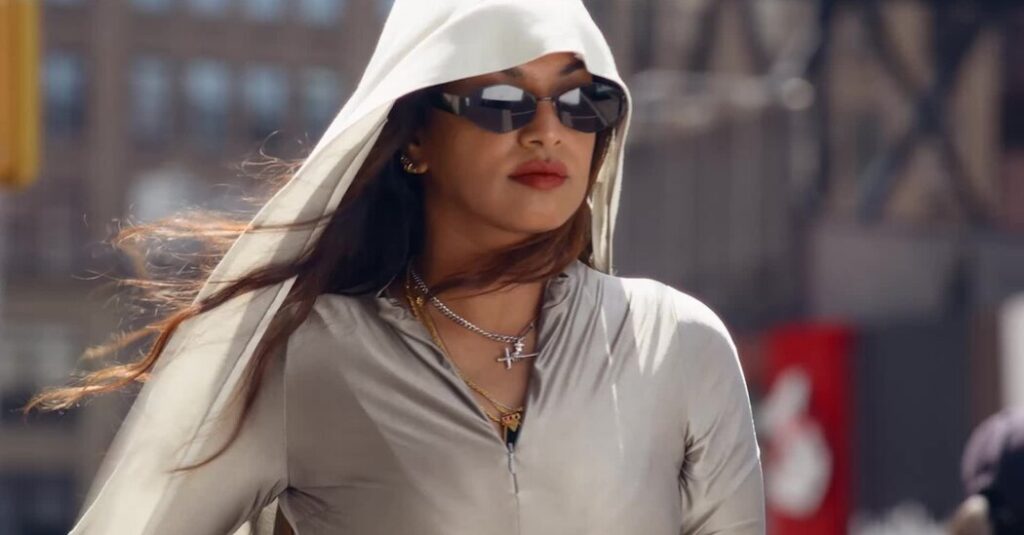
It was supposed to be a moment of redemption for M.I.A.
Two decades on from the ecstatic electronic pop and rap that made her one of the most significant, ear-opening stars in music, the Sri Lankan-British singer returned in April with “M.I.7,” her seventh album and first in four years, documenting her latest swerve, this time toward born-again Christianity.
Soon after, M.I.A. set out on tour with the rapper Kid Cudi, a fellow survivor from the hipster blog era of the mid-2000s. But her comeback was quickly overshadowed by a familiar sort of M.I.A. conflagration — for “being M.I.A.,” as she put it recently on Popcast, The New York Times culture show, in an exclusive interview.
After only four dates as Cudi’s opener, videos of M.I.A.’s between-song banter — most notably on the subject of “illegal” immigrants — began to circulate online; the combination of unclear sloganeering and audience hostility toward an artist notorious for political provocation led to her removal from the tour.
Kid Cudi wrote in a statement that his fans “were upset by her rants,” adding that he “won’t have someone on my tour making offensive remarks.”
Right away, M.I.A., 50, began pushing back via social media, claiming that she had been misinterpreted and received in bad faith because of past misunderstandings about her supposed support for the Trump Administration.
Last week, after her interview with Popcast, M.I.A. (born Mathangi Arulpragasam) sued Kid Cudi in California for breach of contract, arguing that her $2.8 million agreement for the tour allowed her to “say whatever she wanted onstage” and that her comments were “consistent with her public persona and prior performances.” (According to the lawsuit, in addition to invoking her own “illegal” status, M.I.A. had questioned why she had been “canceled” as a “Republican-voting American” when she is neither.)
Representatives for Kid Cudi declined to comment on the lawsuit, pointing to his earlier statement about the tour.
The events raised a question that has chased M.I.A. for the full run of her varied, improbable career: Is she a knowing button-pusher or just chronically misunderstood?
Either way, she has carved out a signature, if fraught, legacy. Acknowledged as a pioneer in gathering influences from across the world under the umbrella of progressive hip-hop and club music, she created an indelible millennial anthem in “Paper Planes” and performed alongside Jay-Z, Lil Wayne, T.I. and Kanye West while nine months pregnant at the Grammys.
M.I.A. has also been a reliable self-saboteur and lightning rod for controversy, from the middle finger she extended at the Super Bowl halftime show alongside Madonna in 2012 to her comments about the Covid vaccine and Health Secretary Robert F. Kennedy Jr. At times, she has seemed to delight in attempts to determine the outer boundary of public embrace.
“It’s not my thing — it’s God’s thing,” she insisted on Popcast, in a winding interview where she proved equally game and difficult to pin down. “Why has God given me this card? I don’t know. I don’t want it. Obviously, I’d much rather be, like, chilling somewhere, just having it easy like everybody else.”
In conversation with Popcast’s Jon Caramanica and Joe Coscarelli, M.I.A. discussed whether her legacy of incitement has been an obstacle to her legacy of art, how she’s been both welcomed and rejected by either side of the American political spectrum and her recent spiritual awakenings.
JOE COSCARELLI What can you tell us about what was happening on the Kid Cudi tour in the lead up to the moment that went viral, which was you talking about your song, “Illygirl” [pronounced illegal]?
M.I.A. I’m in a country where everyone’s a freaking immigrant. I think that Cudi fans didn’t know my songs. I designed a new show where I’m in control of the songs, so I could just play through them, sort of like a DJ. So I was skipping through them, sort of playing them 10 seconds each, because there was a timer on the side of the stage and I only had time to do “Paper Planes.”
But when I got to “Illygirl” — which is my favorite song, by the way, no matter if illegal is a controversial word now in America — I think people thought [I said], “we can’t do illegals.” [M.I.A. added “though some of you could be in the audience,” according to her lawsuit.] But the whole song’s chorus is saying, I’m illegal.
COSCARELLI From the fan videos, the crowd immediately starts booing. I think in part that comes from, whether right or wrong, some baggage that they have with you. Maybe they don’t know the songs, but maybe they know your reputation. And part of your reputation in recent months and years has been support for the current administration.
M.I.A. It’s not really.
COSCARELLI I just want to get to the perception of it, which is that if people think that you are pro-Trump, or pro-Robert Kennedy Jr., his health secretary —
M.I.A. Let’s not forget he was a Democrat, by the way.
JON CARAMANICA They both were. Political affiliation is more slippery than ever these days.
COSCARELLI Certainly once that moment made its way to the internet and people are seeing you have this interaction with the crowd that’s a little bit heated, I think you’re bringing a lot of political baggage. So when those fans react in that way and say, Oh, that’s a MAGA artist and she’s invoking illegal immigration —
M.I.A. Yeah, but I’m not — I get all of that. That is not what’s going on. That is what the media wrote as what’s going on. That was the perception that was generated and fanned and algorithmized to cement a narrative. But the narrative is way more complex than that. That is a brown woman who is an immigrant. And no matter what Americans think about that, they can never remove that. That is not an identity given to me by Americans. And they don’t have the right to take it away. Because the concept of immigration and refugees and all of this belongs to everyone in the word. It’s a timeless concept.
You know, I’m Sri Lankan, and I feel like when I first came, everyone’s like, the Republicans hate you, you know? And so I spent 10 years on the left, not by choice, that’s just who embraced me. I didn’t plant myself on a side politically.
CARAMANICA But did it align with your value set at the time?
M.I.A. I don’t know because, you know, really, the war machine is both sides. It’s neither Republican or Democrat. And maybe you have to edit this part out of the interview, but that is fact, that’s the reality. I have some insight into it.
My dad was like, “You came out of the womb like a bullet and you shot to fame like a bullet.” And it was true — it happened so fast, but it happened because it was the Bush era. Someone needed to come up and say all this kind of crazy [expletive]. I’m not good at doing dance routines. I’m not a trained singer. What I had was my ideas. I had freedom of thought and freedom of speech and I wanted to exercise it in a land that promotes that.
Then I made one tweet — because God forbid, in my 40s, that I evolve — because I have been an artist from day one who calls things before they happen. It’s something I own and I own it because it’s true. I feel like I am an ancient person, and that unseen knowledge is accessible to me.
COSCARELLI And that’s what we want out of our artists.
M.I.A. You’re processing your emotions, you’re processing things that cannot be expressed. You’re processing ideas, thoughts, current affairs, social stuff and the ethereal things and you’re just putting it together. So me saying yes, Trump’s going to win a month before Trump won is not support for Trump. It’s me calling it.
COSCARELLI That’s the tweet you’re referring to?
M.I.A. That’s the tweet they all refer to.
COSCARELLI Is that, to you, the turning point?
M.I.A. Because show me where I’m at a Trump rally, or show me where I go, Gooo Trump, and wear his T-shirt. There isn’t anything.
COSCARELLI This is what you wrote at the time: “Trump is going to ride America through the most challenging 4 years coming pulling out weed, and RFK will inherit America when God is ready to replant and rebuild it righteously.” Similarly to what happened onstage with Cudi, there’s room for interpretation. So what did you mean by that — other than Trump is going to win?
M.I.A. Trump’s gonna win, and what he’s gonna — OK, I see what they think, they mean the “weed” is illegal immigrants, but it’s not. Because I have a visa, I’m here. My crew doesn’t have a visa, by the way, which I clarified onstage. So I’m here not getting involved politically. I’m not interested. In my head, where I am, in my spirit and everything, it’s more vast than that.
CARAMANICA Do you feel that the message that you were communicating onstage in your mind is consistent with how it was received? Or do you think what happened was a result of a misunderstanding?
M.I.A. 100 percent a misunderstanding, but I get it. It’s a very difficult time for America, which I said in the tweet. And so I did all this time on the left, say from 2012 when I got sued [for violating her Super Bowl contract with the obscene gesture], to about 2016, ’17, when the left started canceling me.
It’s like the Super Bowl. You didn’t know that that’s uncomfortable until it happens, you know, and then you go, Oh, there is an edge. There’s a limit.
CARAMANICA And you didn’t know what it was before you did that?
M.I.A. How could you know it beforehand?
CARAMANICA Other people might have intuited it.
M.I.A. Just like you don’t know that the word illegal is going to be controversial in 2026. It’s a big, expansive conversation for me, the concept of immigrants and migrants and the word illegal. I’ve been singing about it for 20 years.
COSCARELLI So you feel like you’re stepping on rhetorical land mines, not throwing bombs, per se.
M.I.A. 100 percent. That’s a good way of seeing it. You don’t know there’s one until you step on it.
COSCARELLI And so it’s not your desire to be …
M.I.A. Not my desire, but I guess you’re the one that’s supposed to expose that there’s land mines on that ground. This shows me that in 10 years freedom of speech is going to be even worse.
COSCARELLI What does cancellation mean to you?
M.I.A. I don’t know, it’s like taking a shower. It’s something that just happens.
CARAMANICA Did it affect your day-to-day life?
M.I.A. If you want to talk about legacy, I don’t think there’s another musician in the history of music that has been canceled 25 times in 20 years.
COSCARELLI Depends what you mean by cancel — Madonna?
CARAMANICA Kanye?
M.I.A. Kanye’s cancellation is one big epic one. So he’s about like 10 in. I’m definitely like 30 in.
COSCARELLI I want to just define our terms here. So when you say cancellation, you mean a momentary — perhaps temporary, if it can happen over and over again — backlash to a comment that results in what, the stripping of business opportunity?
M.I.A. It’s a cultural amnesia. At the time, they’re all emotional and heightened. But I see it now that I’m not a problem, I’m a target. And whatever they can find, they will find it and twist it and they will make that a moment. And I’ve been targeted from day one, but then I realized I’ve actually been targeted from the minute I was born. This is just a continuation of the life I’ve lived.
Being born a Tamil in the family I was born in, I used to be shot at for being a Tamil. Then I came to England and I was called a Paki and everybody spits at you. And so every moment, you’ve been canceled for many, many things. None of the teachers believed in me. None of my family members ever thought I was gonna amount to stuff. This is why I think spirituality is the key because it puts things like this into perspective. I think society is supposed to learn something about knowledge and wisdom and words and communication through me.
I feel like I’ve done 10 years on the left being canceled by the right, and now I’ve done enough years where people think I’m right and I’ve been canceled by left. I’m actually a very neutral, experienced commentator on the entirety of the United States. I know what it feels like to be a Democrat and I know it feels to be Republican now because I’ve been treated like one for seven years.
CARAMANICA But you don’t identify politically with the current administration?
M.I.A. No, why would I? Because I’m British. I cannot vote.
CARAMANICA But just in terms of the value set of that party right now, how they govern the country.
M.I.A. On the Republican side, I like their family values. I come from Asia, that is instilled in me from day one that you have family.
CARAMANICA In your mind the Republicans, the right wing, is more family-value-oriented?
M.I.A. If I have to dig through what is good about the Republicans, I would say maybe the American family value thing is good. I’m not supporting some of the ways that they achieve that. And I don’t support the wars happening right now that they’re supporting.
But spiritually speaking, where there’s oppression and injustice, that has to be looked at. I don’t care if it’s the left or the right, and I’m not saying the left is perfect. The left hasn’t been shrouding me in, like, glitter and roses for the last seven years. I’ve not been in a left-wing publication or a podcast in God knows how long, but that’s not my choice. They did not want to have the discussion.
COSCARELLI I’m interested in how these beliefs have affected your career. So many artists of your generation are in a moment of revitalization, performing albums front-to-back that came out 15, 20, 25 years ago — all of that seems like something that would be extremely ripe for you. Why do you think you are not at that phase where you can be celebrated and reclaimed?
M.I.A. It’s spiritual warfare. Because it’s not just my career, it’s everything. My entire life is like that.
CARAMANICA When you say entire life, you mean family life?
M.I.A. I think that I’m not the problem, I am the target, you know? There’s a reason why you need to be silenced and there’s reason why everything you say is a problem.
COSCARELLI You say you’ve been silenced, but you’re also here at The New York Times, speaking freely. You put out your music, people want to come see you in concert, you have however many millions of followers.
M.I.A. I think the media does sort of make out that if you’re an M.I.A. fan and you’re into the revolutionary aspect, then you cannot be spiritual. My thing is that it’s the journey — the most important thing is the human capacity to evolve and change and grow. If I’ve taken my fans on that journey and they’re open-minded enough, they will come along with me.
COSCARELLI You’ve crossed into all of these crazy rooms: The Super Bowl, you were signed to Interscope with Jimmy Iovine, you were there with Diplo on his come-up, managed by Roc Nation and Jay-Z. Do you look back on any of that with fondness or was it all stress and trauma for you?
M.I.A. I don’t see it as trauma. I see it as, my purpose is not to sell comfort. I am uncomfortable for people. But it’s through the discomfort that people grow and people find out who they are. I’ll have to carry on expanding on the journey to know the answer, but I serve some other purpose.
Credits
Popcast is hosted by Jon Caramanica and Joe Coscarelli and produced by Sophie Erickson and Kate LoPresti. This episode was filmed by Bernardo Garcia Elguezabal, Thomas Trudeau and Pat Gunther and edited by Mark Zemel. Our theme music is by Elisheba Ittoop. Nick Pitman is our audio engineer and Amanda Webster is our photo editor. Brooke Minters is our executive producer. Special thanks to Sarah Bonn, Rebecca Blandon, Dahlia Haddad, Mike Cordero, Nicole Huber, Aaron Byrd, Carl Mazurek, Zach Caldwell, Maddy Masiello, Brad Kimbrough, Andrew Wilcox, Sia Michel, Nina Lassam and Sam Dolnick.
Joe Coscarelli is a culture reporter for The Times and a co-host of the Times podcast “Popcast.”
The post Does the World Still Misunderstand M.I.A.? appeared first on New York Times.