Clint Eastwood once said jazz music and western movies are perhaps the only truly American art forms, and he would know: He’s an expert in both. The two don’t just share their country of origin; both have also seen a precipitous decline in pop-culture ubiquity. Once upon a time, jazz dominated the airwaves and record charts, just as westerns filled movie theaters and production slates. That hasn’t been the case for quite some time, however, and without exposure and exploration of these forms, a simplicity of thinking has settled in — people who haven’t heard much jazz or seen many westerns are only aware of their clichés, seeing them as old-fashioned, monotonous relics.
But such misconceptions blow away with the tumbleweeds when people are willing to give themselves over to the genre, to grapple with the American western’s presumptions, implications and takeaways, and the Museum of Modern Art is providing just such an opportunity with its in-depth “Universal Westerns” retrospective. The series, screening over roughly a month, spotlights 28 features released over 65 years from just one studio, and in doing so underscores the vast shifts in how the genre was made and received.
The western has been an essential strand of Universal’s DNA since its inception. Three years after the 1912 incorporation of the Universal Film Manufacturing Company, when the studio opened the gates of its Universal City production facility, its first permanent set was a western street that still stands today. The decision makers at the studio had determined their pictures would be designed to appeal to rural and small-town audiences (as opposed to the more sophisticated entertainments, targeted to city-dwelling audiences, of their competitors), and westerns were immensely popular with those moviegoers.
Among their specialists was John Ford (then billed as “Jack”), whose first feature film and earliest extant western, 1917’s “Straight Shooting,” is the oldest title in the MoMA retrospective. In many ways, it’s a typical western melodrama, with such standbys as rowdy saloon scenes and a showdown in the center of town. But even in this earliest iteration, Ford is already complicating the genre. The homesteaders and cattlemen battling at the narrative’s center are drawn in the stark hero-and-villain, black-and-white terms. But Ford’s protagonist, a hired gun played by his frequent star Harry Carey, is drawn in shades of gray. “There are some jobs too dirty even for me,” he says of the work the cattlemen have hired him to do, “’n this is one of ’em.”
The following year’s Ford-Carey collaboration, “Hell Bent” (also part of the Universal retrospective), makes the tension between expectation and execution explicit. It uses a meta-textual framework, opening with a scene in which a western novelist receives a letter from his publisher requesting a hero who is “a more ordinary man, as bad as he is good.” The character arc that follows, with Carey again playing an outlaw whose inherent decency wins out (and wins him the love of a good woman), would become one of Ford’s favorites; its use in his 1939 classic “Stagecoach” helped make John Wayne a star.
Wayne himself turns up in Ray Enright’s 1942 barnburner “The Spoilers,” which teams him with another durable western hero, Randolph Scott, for a knock-down, drag-out, bare-knuckle brawl that remains one of the single best fight scenes in all of movies. They have several reasons to come to blows, chief among them the star Marlene Dietrich, who also toplines the delightful “Destry Rides Again” opposite James Stewart.
Universal’s 1946 merger with International Pictures prompted a push for more prestigious projects, resulting in westerns infused with a moral complexity typical of postwar cinema. One of their primary practitioners was Anthony Mann, whose landmark collaborations with Stewart in the 1950s broke new ground, navigating psychological terrain with the same deftness as the frontier landscape. (Three of their best — “Winchester ’73,” “Bend of the River” and “The Far Country” — are screening in the series.) The genre would continue to evolve in the following decade, as the so-called “spaghetti westerns” of the Italian director Sergio Leone and his star Clint Eastwood would redefine the style of their American counterparts, often with Eastwood himself as actor (“Two Mules for Sister Sara”) or director (“High Plains Drifter”).
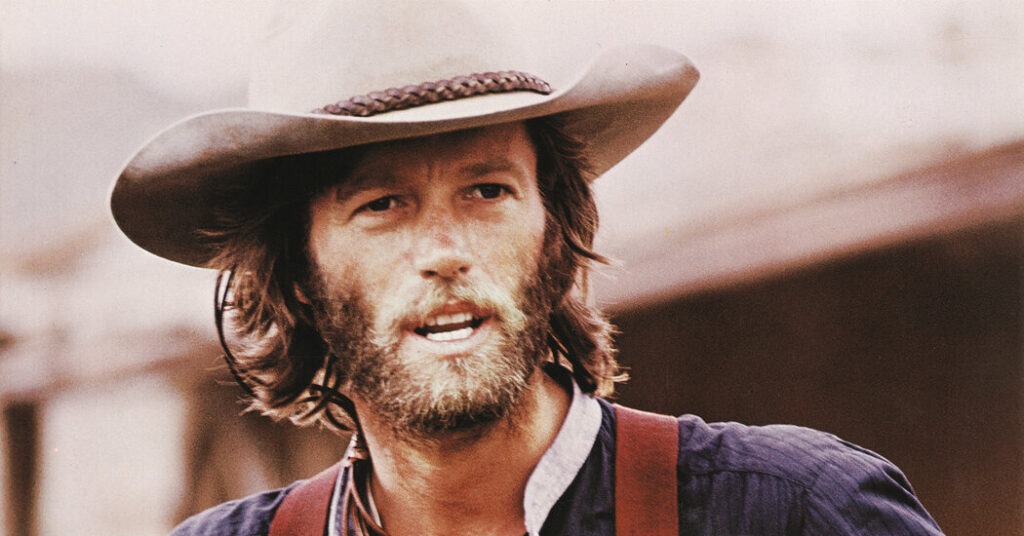
The experimentation of international directors, combined with the freedom allowed by the new ratings system and the cynicism engendered by the war in Vietnam, led to a period of transgressive and often disturbing westerns. The unforgivingly brutal violence of “Ulzana’s Raid,” the sexual surrealism of “The Beguiled,” the bold lyricism of “The Hired Hand” — all called into question not only the tropes of the western, but of American exceptionalism itself. And many took pains to redress the issues of representation that dog the genre to this day, though the series also highlights several exceptions to the rule, including the sympathetic portrayals of Native Americans in Douglas Sirk’s “Taza, Son of Cochise,” Mexican “insurrectos” (and a rare gunslinging woman) in Budd Boetticher’s “Wings of the Hawk” and the Indigenous farmer at the center of Edgar G. Ulmer’s “The Naked Dawn.”
Westerns are produced infrequently in contemporary Hollywood, and the most recent film in the “Universal Westerns” series is Fred Schepisi’s 1982 effort “Barbarosa.” But it concludes on an appropriate note, with the title character’s protégé (Gary Busey) bursting into a celebration of Barbarosa’s death, astride his mentor’s horse and wearing his sombrero, terrifying his enemies anew. And the western similarly refuses to die; it merely shifts with the times, taking on new forms while donning old clothes.
“Universal Westerns” begins June 5 at the Museum of Modern Art. Viewers outside of the tristate area can find “Straight Shooting,” “Hell Bent” and “The Naked Dawn” on Tubi; “High Plains Drifter” on Netflix; and “Barbarosa” on Amazon Prime Video, Tubi and PlutoTV. “The Spoilers,” “Destry Rides Again,” “Winchester ’73,” “Bend of the River,” “The Far Country,” “Two Mules for Sister Sara,” “Ulzana’s Raid,” “The Beguiled” and “Taza, Son of Cochise” are available to rent or buy on major platforms.
The post Why Westerns Still Matter appeared first on New York Times.