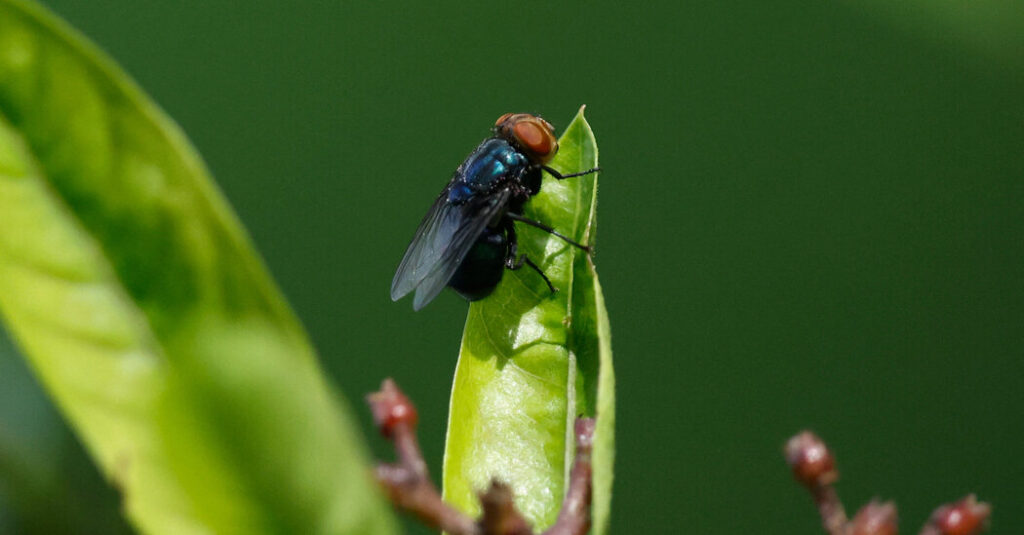
The New World screwworm, a flesh-eating fly that preys on livestock and other animals, has staged an unwelcome return to the United States, 60 years after the parasitic pests were officially eradicated from the country.
The infestation was found in a 3-week-old calf in Texas, federal officials announced on Wednesday night.
An aggressive decades-long eradication campaign had pushed the flies out of North and Central America. But over the last few years, the insects, which remained common in South America, have been moving back north and creeping ever closer to the United States border.
In the past, screwworm has taken a particular toll on cattle, and the pest’s comeback could place new pressures on cattle farmers and send beef prices even higher. “It has the potential to be damaging, very damaging, to our livestock industry,” said Caleb Hubbard, an entomologist at New Mexico State University.
But the pests are not picky about their hosts and can also pose a serious risk to wildlife, pets and, in rare cases, even people.
Federal and state officials are taking steps to contain the infestation in Texas and say that the risk to the American public remains low. “If we all work together and follow animal treatment and the movement restriction guidance, there is no reason to believe that this incursion will result in any sort of establishment of the pest,” Brooke Rollins, the agriculture secretary, said at a news briefing on Thursday.
But experts said that they were braced for the possibility of more cases and that it was too soon to say how serious the problem would become.
“Containment is underway,” said Sonja Swiger, an entomologist at Texas A&M University. “But it is going to take an effort to definitely re-eradicate this fly.”
Here’s what to know:
What is the New World screwworm?
The New World screwworm, or Cochliomyia hominivorax, is a type of blow fly, a group of often metallic insects commonly found hovering around dumpsters and feeding on roadkill.
“Blow flies traditionally are decomposers,” Dr. Hubbard said. “They’re helping break down those animals, or whatever it may be, in the environment, and they really don’t cause any problem.”
The New World screwworm, native to the Americas, is an unfortunate exception, feeding not on dead flesh but living tissue.
“And that’s really where New World screwworm becomes very problematic,” Dr. Hubbard said. (The literal translation of the Latin word “hominivorax,” he noted, is “man eater.”)
Adult females lay their eggs in the open wounds or orifices of warm-blooded animals. The eggs turn into larvae, which then use their sharp mouth parts to bore into, and feed upon, the flesh of their hosts. Infested animals can develop deep, painful, foul-smelling wounds, severe tissue damage and serious, sometimes fatal infections.
The larvae typically spend about a week feeding, before dropping off their hosts and burrowing into the ground. They eventually emerge as adult flies, starting the cycle anew.
What risk does screwworm pose to livestock?
Although screwworm can infest a range of animals, it has a track record of inflicting particular damage on livestock.
“It does seem to really do a very good job at attacking cattle,” perhaps because cattle are so numerous and ubiquitous, Dr. Swiger said of screwworm. “Cattle are, in a sense, easy targets.”
The flies appear to be especially attracted to calves and other newborn animals, often laying eggs in or around the unhealed umbilical cord. (The infested calf in Texas was discovered with larvae “in its umbilical area,” according to the U.S.D.A.)
Although affected livestock can be treated if the infestation is caught early, in practice, that can be difficult to do, Dr. Swiger said. Even tiny wounds can attract the flies, and infestation sites are not always easy to see. Detecting cases early can require frequent, hands-on examinations of each animal.
Untreated, an infestation can kill an animal in about a week, Dr. Hubbard said. And even less serious, nonfatal infestations can cause severe pain, drastic weight loss, scarring and other problems for livestock.
What other species are at risk?
Screwworm poses a significant, and perhaps underappreciated, threat to wildlife, which are not tracked nearly as closely as farmed animals. Screwworm flies briefly returned to the United States in 2016, causing a short, limited outbreak in the Florida Keys, where they killed endangered Key deer.
Pets are also susceptible and numerous cases have already been reported in dogs and cats in Mexico.
Human cases are relatively rare, but possible. Last year, for instance, a screwworm infestation was reported in a Maryland woman who had recently returned from El Salvador. She recovered, though some human cases can be fatal.
How did the United States eradicate screwworm the first time?
Scientists developed an approach known as the sterile insect technique, breeding a large number of screwworm flies and then exposing them to radiation, making the males infertile.
Then, these sterile males were released into the wild, where they began breeding with wild females. Because females breed only once in their lives, those that mated with a sterile male would die without having any offspring, leading to a population decline.
The approach proved remarkably successful. In 1966, the United States was declared free of indigenous screwworms, and over the decades that followed, the sterile insect approach pushed the flies to the Darién Gap, a narrow, hard-to-traverse land bridge that connects Panama and Colombia.
And for a while, the continued release of sterile flies, in combination with the biological barrier of the Darién Gap, prevented the New World screwworm from moving back north.
“We have essentially kept it at bay,” Dr. Hubbard said.
Why is screwworm back and how is it spreading?
It’s not clear. But in 2023, cases surged in Panama and Costa Rica — and then began to spread steadily northward through Mexico.
Why that happened is difficult to say, but there can sometimes be hiccups with the sterile insect approach — if not enough insects are released, if the mass-produced sterile populations diverge too far from wild populations, or if the production process makes the sterile males less fit than wild males.
Whether any of those explanations apply remains unknown, Dr. Hubbard said. “We don’t really have definitive evidence.”
Once the fly population began surging, the insects probably did not simply wing their way to the United States, experts said. Instead, they most likely hitched rides on infested livestock.
“These flies typically move great distances because humans move animals,” Ms. Rollins said at the briefing.
How are U.S. officials responding?
Officials had already taken a variety of measures to prepare for the return of the screwworm. As the pests moved through Mexico, for instance, the Southern border closed to live cattle imports. And earlier this year, in Texas, construction began on a new sterile fly production facility, although it is not expected to be operational until next year.
Federal and state officials are now taking more targeted action in the area around the infested calf, including restrictions on animal movement, stepped-up surveillance and the release of more sterile flies.
From January to June 2025, more than 2,100 employees left the Agriculture Department’s Animal and Plant Health Inspection Service, which detects outbreaks, according to a watchdog report.
In congressional testimony on Thursday, Ms. Rollins said staffing reductions did not affect the agency’s “ability to react and to research,” but she did not specify whether any scientists or inspectors working on screwworm response had left the agency.
Linda Qiu contributed reporting.
Emily Anthes is a science reporter, writing primarily about animal health and science. She also covered the coronavirus pandemic.
The post This Flesh-Eating Fly is Making an Unwanted Comeback appeared first on New York Times.