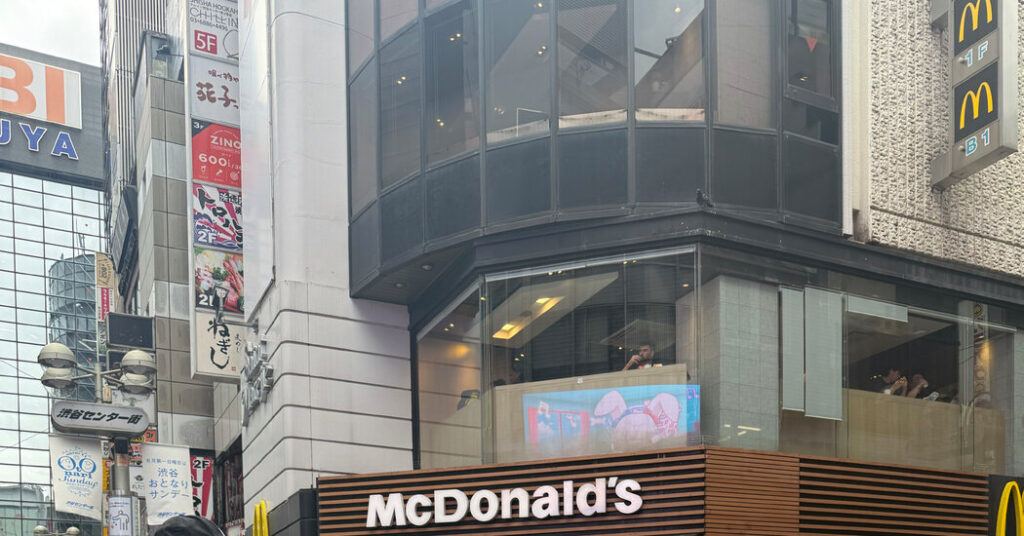
It was a cloudy afternoon in Shibuya, one of Tokyo’s busiest areas, and a team of city officials was on high alert. They scanned the crowds, looking to catch anyone littering and to deliver on-the-spot fines — part of a new campaign to encourage better behavior among visitors.
When an unassuming tourist discarded a small piece of paper on the ground, the officials pounced. Holding a binder of notices and a payment terminal, they fined him 2,000 yen, or about $12.50. As his friends laughed, the tourist shook his head and pulled out his wallet. The entire encounter lasted about three minutes.
In Shibuya, one of Tokyo’s 23 wards, dropping trash now comes with a price tag. As of June 1, litter bugs face immediate fines under a new ordinance. The rules are meant to help combat a surge in littering, officials say, as Japan has welcomed a record number of tourists over the past few years.
Operating under the slogan, “If you throw trash, you lose cash,” up to 60 patrollers, including more than a dozen multilingual officers, split into teams to monitor the area every day. Fines can be paid via cash, credit card, transit cards or various QR code and mobile payment apps.
Yasutaka Ogata, 47, an official who was part of the patrolling team, said that to ensure interactions went as smoothly as possible, he focused on speed and avoiding conflict.
“When you stop someone, you are interrupting their good mood, taking their time and taking their money,” he said. “Because of that, finding the right balance can be difficult when it comes to gaining their understanding.”
The new rules are a central part of Shibuya’s effort to clean up the city by sending a message that it is tough on littering.
Japan has long had a dearth of public trash cans, largely because of fears that they could be used in terrorist attacks, and also because of concerns about maintenance costs.
Under the new rules, the government hopes to increase the number of bins — requiring some businesses and vending machine operators to provide trash cans, with noncompliance carrying a ¥50,000, or roughly $313, fine.
Shibuya officials also plan to install more public trash cans, starting in the area around the ward’s main train station.
Shibuya is one of Japan’s best-known entertainment and shopping hubs, and, according to a survey conducted by the Tokyo Metropolitan Government, it is the top destination for foreign visitors in Tokyo. The area has also been a cultural hub for Japanese youth for around five decades.
Japan saw a record-breaking 42.6 million international visitors in 2025, roughly double the number a decade ago. While tourism has risen to become one of Japan’s economic pillars, the country is grappling with the challenges of overtourism, and some local governments are putting in place rules to deal with the influx of visitors.
In Fujiyoshida, a town in the foothills of Mount Fuji, a cherry blossom festival was recently canceled to protect the local community from overwhelming crowds. In Kyoto’s historic Gion District, several private roads have been barred to tourists following complaints of visitors crowding and photographing traditional geisha.
Back in Tokyo, on the streets of Shibuya, patrol teams caught 10 people littering on the first day of the new ordinance, 15 on the second day and nine on the third, according to city officials.
Hironori Nakao, a Shibuya official who is helping lead the crackdown on litter, said he hoped the new rules would drive a shift in behavior among visitors.
“Shibuya is a city with a constant influx of new people, so no matter how much we publicize the rules, it is incredibly difficult to reach everyone,” Mr. Nakao said.
“In a place like Singapore,” he added, “travelers already know beforehand that they will be fined for littering or spitting, so they simply don’t do it. That is the level of awareness we want to achieve here.”
Amid the buzzing crowds at the famous Shibuya Scramble Crossing, Ivo Xavier Marques da Rocha, an IT engineer from Portugal, stood holding a large shopping bag alongside a friend. The pair were on a two-week trip to Japan, their first visit to the country, drawn by cultural staples like Pokémon and Nintendo.
Mr. da Rocha, 28, said he had been unaware of Shibuya’s new littering fine until he arrived and noticed the warning signs plastered across the pavement.
While he finds Japan “amazingly clean” overall, Mr. da Rocha said, he views the penalty as a positive step.
“If they catch you littering, maybe ¥2,000 isn’t that much money,” he said. “But at least it acts as a deterrent.”
Kiuko Notoya is a Tokyo-based reporter and researcher for The Times, covering news and features from Japan.
The post On Patrol With Tokyo’s New Litter Police appeared first on New York Times.