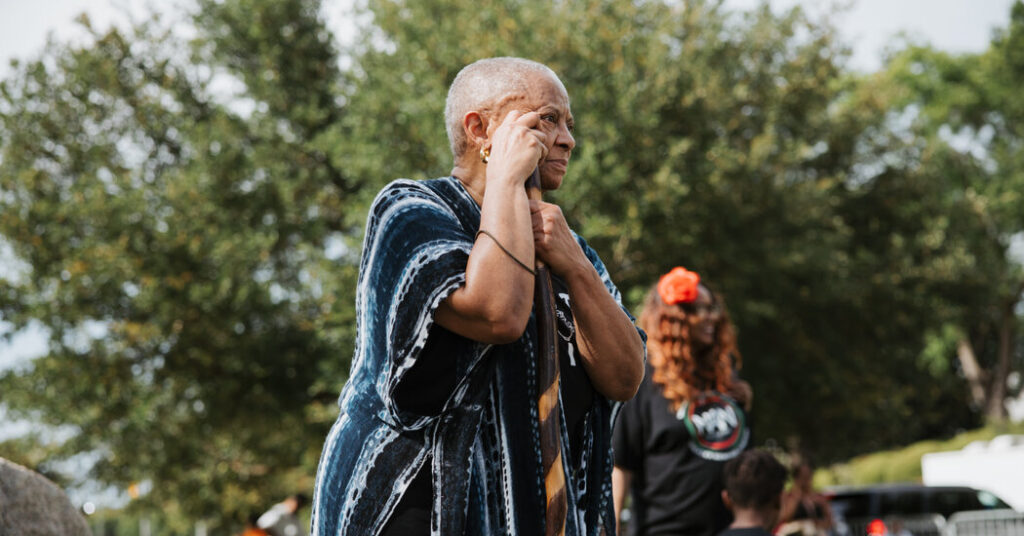
Outside the blindingly white antebellum columns of the Alabama State Capitol on a recent Saturday, Martese Chism stood in the Southern heat with thousands of others, rallying for voting rights. It was a show of defiance amid a sweeping attack on Black political power.
To get there, Ms. Chism, 65, left Mississippi before dawn, drove to Memphis and rode a bus five hours to Montgomery with her 8-year-old great-nephew Carson in tow. They made the trip to honor Ms. Chism’s great-grandmother Birdia Keglar, a civil rights activist killed while fighting for the same rights in Mississippi 60 years ago.
Millions of Americans like Ms. Chism live in states where Republicans are drawing maps that dilute the power of Black voters, and those who share their interests. Just on Tuesday, the Supreme Court allowed Alabama to eliminate one of only two Black-majority districts. By the fall elections, and almost certainly by the next presidential election, new maps will be in place.
The Supreme Court decision in April severely weakened the Voting Rights Act by allowing political parties to gerrymander voting districts for partisan advantage, no matter the effect on Black voters. The effort to destroy Black political power in the South is among the greatest betrayals of Black Americans, and those who have voted alongside them, by the federal government in living memory. It will have far-reaching consequences for all Americans, and for our democracy. Despite this, the work of mobilizing a response is largely falling to Black people.
In Montgomery, many of these Americans had come from across the South to gather in what was the first capitol of the Confederacy and register their outrage.
Elderly Black people protested in soaring temperatures. Some told me they had marched many times before, over decades. Parents carried small children who had overheated and fallen asleep, fanning them as their brown limbs dangled from their arms. White Americans showed up, too, joining the largely Black rally with signs that said, “No Jim Crow Maps.”
Black Americans have carried extraordinary burdens in the United States, not only to exercise their own rights, but also to make the country a democracy. The Voting Rights Act, passed in 1965 and strengthened in the decades that followed, had protected them from racial gerrymandering that divided them across multiple districts in order to blunt the impact of their votes. This was just one of a multitude of tactics Southern officials used to limit Black suffrage and stifle competition during Jim Crow.
In more recent years, an increasingly ideological Supreme Court began issuing rulings weakening the Voting Rights Act. On April 29, the court’s 6-to-3 conservative majority eviscerated much of what was left of the law, effectively saying the legislation that Americans marched, bled and died for decades ago was no longer necessary. Congressional maps that diminish the Black vote are now acceptable, according to the court, so long as state lawmakers say they are drawing them based on partisan advantage and not on race.
The suggestion that partisan gerrymandering has nothing to do with race is fantastical. It ignores the defining role of race and racism in shaping partisan affiliation in the United States. For instance, the embrace of the civil rights movement by the national Democratic Party is, according to many historians, the main reason so many white Southerners became Republicans in the second part of the 20th century, a phenomenon known as realignment.
Since the court’s April ruling, largely white Republican-led legislatures across the South have moved to dismantle Black political power at stunning speed, breaking apart voting blocs at the urging of a failing president desperate to keep control of Congress in this fall’s midterm elections. The redrawing of these maps is almost certain to sharply reduce the number of Black Americans serving in the U.S. House and could critically diminish the ability of Black voters and millions of other Americans to elect candidates of their choice. At the same time, they will become less able to hold the elected officials who come to represent them accountable. Redistricting has already happened in Tennessee, Louisiana and Alabama. Lawmakers plan to redistrict in Georgia and Mississippi for future elections.
The clearest assessment of this arrangement came from Ms. Chism. “Yes, I can vote, but I have no power,” she told me. She then recalled the U.S. Constitution, which for 80 years when determining congressional seats counted enslaved Black Americans as three-fifths of a person. “They’re using our body, our vote, as part of the census, like they did during slavery. They count us, but we don’t have no voice. We back to that.”
All Americans, everywhere, have a deep stake in what happens to voters in the South. The harm of severely limiting the power of Black voters across the region will not be limited to Black Americans and marginalized people.
The South will be more likely to send members of Congress to Washington who have directly benefited from the erosion of the Voting Rights Act. These lawmakers can be expected to be less responsive to Black constituents and other Democrats in their own districts, but also the interests of voters across the country who hold similar political preferences.
The political careers of these candidates will most likely depend on extreme gerrymanders that limit competition from Black voters and other Democrats, even when those Americans make up large portions of the region’s population. The new map enacted in Louisiana, for example, gives Republicans a solid advantage in five of the six congressional districts, even though Black people make up one-third of the entire state population. And though Black voters are the heart of the Democratic coalition in the South, that coalition includes Latino, Asian, Native and white Americans as well. Polling can be sparse on the subject, but it’s worth noting that Pew found in the 2010s that about one-third of white Southern voters identified as Democrats.
Democrats, facing long odds in the South, will be motivated to engage in aggressive gerrymanders in the states they control, as seen last year in California after Texas acquiesced to a demand by President Trump. This will place even more voters into congressional districts where they are less likely to have a shot at fair representation. Extreme gerrymandering is bad for democracy, making it harder for parties to recruit qualified candidates, gain the support of voters and mount the competition necessary for a healthy democracy.
“You have to view this in historical context,” Eric Holder, who under President Barack Obama was the nation’s first Black attorney general, told me. “If you go from Reconstruction to 2026, the federal government’s support of the voting rights of people of color generally, and African Americans specifically, has ebbed and flowed. What we’re seeing now is consistent with the worst of what the federal government has done along that arc.”
Mr. Holder described the actions of the Supreme Court and the Trump administration as a “betrayal.”
Among the most striking examples of the campaign underway has been unfolding in Memphis, one of the largest majority-Black cities in the country. Court rulings around the Voting Rights Act have for decades acknowledged the need to draw congressional districts that were “compact” and include Americans “of similar interest.” Under the new map, thousands of Memphis voters now sit in the redrawn Ninth District, which stretches over 200 miles through rural Tennessee almost to Nashville. Republicans split the city’s voters into three congressional districts — each with a solid Republican advantage — to bury Memphis’s Democratic votes. Republicans in some Southern states are also planning redistricting that will determine control of state legislatures.
At Mount Vernon Baptist Church in Memphis one evening recently, a crowd of mostly older Black voters gathered with their elected officials, all Democrats, to learn about the redistricting that had taken place the previous week. The sanctuary filled with people and the temperature rose. One woman pulled out a giant fan with a portrait of Dr. Martin Luther King Jr. and used it to create a gentle breeze. When the legislators dimmed the lights and projected an image of the new congressional map onto the wall, loud gasps filled the air.
“I hear you,” Representative Jesse Chism told them. Then Mr. Chism (a cousin of Martese Chism) turned to an old axiom from the Black church derived from Genesis. “What the Devil mean for bad…,” he began. Instead of finishing the verse — “God turns for good” — he paused. The crowd broke out into knowing laughter and applause, transforming the energy in the room.
In a powerful display of grit and tenacity, State Representative Justin Pearson, a Black progressive from Memphis, is continuing his bid for the gerrymandered Ninth District congressional seat anyway.
I met him one morning at the Cossitt Library in downtown Memphis, where the novelist Richard Wright had found his way around a rule barring Black people from taking out books by borrowing a white man’s library card. Inside a reading room, the soft-spoken 31-year-old with an Afro whose oration and quiet confidence tends to captivate voters, greeted me with a hoarse and exhausted voice. “My grandparents all grew up during segregation,” he said. “We do not quit because it is hard. We do not yield because of white supremacy. I grew up in a Black prophetic tradition of faith that began before I was born.”
Mr. Pearson said he believed he could build a coalition across race, geography and class and would campaign not only in Memphis but also in every one of the 14 other counties, mostly rural, that now make up the district. “This race is a race for Black folks and for the South, to show our stake in this democracy,” he said.
To build this kind of coalition and win under the new maps, Mr. Pearson and other Democrats in the South will need to increase turnout as well as persuade thousands of new voters to take to the polls. They will also have to do the work of changing people’s minds and persuading at least some Republicans to vote for them instead.
The new congressional maps are very likely to make it significantly harder for generational talents like Mr. Pearson to get to Congress. He has also faced headwinds from curious places inside his own party. Before the Memphis seat was redrawn, Representative Hakeem Jeffries, the Democratic minority leader in the House from Brooklyn, had endorsed Mr. Pearson’s 77-year-old primary opponent, Steve Cohen, the incumbent. Mr. Cohen, who is white, has held the seat for decades. The week after the redistricting, he announced his retirement. Watching Mr. Pearson draw crowds throughout the South, it is easy to see why Republicans in Tennessee and the Democratic establishment alike might want him out of the way.
To understand what’s at stake, consider the impact of veteran Black members of the House elected since the civil rights movement. For decades, members like Bennie Thompson, James Clyburn, John Lewis and Barbara Jordan championed not only issues like Black employment, but policies like Medicaid expansion, funding for poverty programs and public schools, and the Affordable Care Act that have helped Americans across the country. Black Americans elected to state legislatures and local offices throughout the South since the adoption of the Voting Rights Act have often played a similar role.
Then there is the power of the Black electorate. Across the South, Black voters introduce critical competition into a region largely dominated by the Republican Party. They also remain the heart of what has been a growing coalition for the Democratic Party in states like Georgia, Virginia and North Carolina.
It’s not only the speed of the redistricting campaigns underway in the South that is notable, but the spirit and character animating them.
Republicans in Tennessee were in such a hurry to, as one put it, “send an entire Republican delegation from Tennessee” that a state Democrat questioned how they could have known the partisan score of the new districts they were creating. The Democrat said Republicans had used census data to draw the maps, which does not include party affiliation.
Gov. Jeff Landry of Louisiana suspended an election already underway so the Republican-led Legislature could scrap one of the state’s two majority-Black and Democratic districts, tossing the votes of more than 40,000 Americans who had already cast ballots. I met one of those voters in Memphis, outside the National Civil Rights Museum at the former Lorraine Motel, where Dr. King was assassinated in 1968. “I have to vote a second time,” Rosalyn Baty, 67, a Black woman visiting from Louisiana, told me.
Mississippi’s governor, Tate Reeves plans to wipe his state’s only majority-Black and Democratic House district, now represented by Mr. Thompson, off the map. “Congressman Bennie G. Thompson’s reign of terror on MS-2 is over. It is not a matter of ‘IF…’ Just a matter of ‘WHEN!’” Mr. Reeves wrote on Facebook. Mr. Thompson led the Jan. 6 committee hearings in the House and organized voter registration drives during the civil rights movement as a member of the Student Nonviolent Coordinating Committee.
Georgia Republicans are expected to redraw their maps for the 2028 cycle. In Montgomery, Ala., Republicans continued their vote to approve redistricting legislation even after tornado sirens began to sound, warning of an arriving storm.
Footage from inside capitol buildings across the South shows that Americans of all backgrounds are showing up in protest, a significant point of hope. There have been pockets of opposition from Republicans, too; in South Carolina, a group of state senators blocked an effort to turn the state into a 7-0 map.
But videos have also captured the animus and glee with which largely white Republican caucuses throughout the South have carried out Mr. Trump’s request for widespread gerrymandering. William Arnold, the director of justice and re-entry programs at the advocacy group Memphis for All, said the experience of watching the Republicans vote on the maps in Nashville left him shaken. “They were laughing. Laughing and smiling,” he said. He described it as “one of the most jarring experiences of my life.”
Many Americans outside the South tend to see the region as exceptional. But its politics have long been shaped by national politics, from the decision to abandon Reconstruction, to the infamous 1896 Supreme Court case Plessy v. Ferguson upholding Jim Crow, to the Voting Rights Act and its enforcement by the Department of Justice. The recent decision by the Supreme Court, Louisiana v. Callais, weakening the Voting Rights Act, continues that tradition.
The attack on democracy and Black political power in the South was made possible by justices in Washington, a president from Queens and a Democratic Party that has so far failed to stop them. “This is a national movement of national antidemocracy activists who happen to be acting at the sub-national level,” said Robert Mickey, a political science professor at the University of Michigan who has written extensively about U.S. political development. “It’s easiest to do this in the South.” Mr. Mickey said the political system is placing an undue burden on individual citizens. “We’re outsourcing the response to undemocratic laws back to the people who are harmed by them,” he said.
The Democrats were largely unprepared and ill equipped to respond. Democrats have trifectas (control of all three branches of state government) in 16 states; Republicans have trifectas in 23. Of the Democratic-led states, only a handful offer significant opportunities for the party. California voters approved a ballot initiative last year allowing Democrats to redraw maps, an effort that could add up to five Democratic seats this year. Efforts by Democrats in other states have so far yielded little. Virginia’s Supreme Court tossed a ballot initiative approved by voters that could have added four House seats for Democrats.
Wes Moore, Maryland’s Democratic governor, has pushed hard to move forward with a redistricting plan but has so far been stymied by the State Senate president, Bill Ferguson, also a Democrat. Mr. Ferguson is now signaling he may be open to the plan. Democrats in New York are working on a plan that could add several Democratic seats, but, for process reasons, not until 2028.
Many of the same people who are mobilizing across the South right now are also in mourning. The oldest Black Americans, who grew up during Jim Crow, are now watching key gains of the civil rights movement being dismantled. Generations of Black Americans are coming to terms with the exhaustion, rage and grief from knowing that they and their children will most likely continue to face exceptional headwinds in the United States, a country their ancestors helped build.
At the voting rights rally in Montgomery, U-Conjay Nelson, a 31-year-old Navy veteran from Tuscaloosa, Ala., held a sign that read, “By any means necessary, so don’t let the necessary occur.” I noticed that she seemed to be staring off into the cloudless Alabama sky. Temperatures had risen to nearly 90 degrees, and her three young children rested on the ground beside her. The youngest, a 3-year-old boy, wore Spider-Man Crocs and was sitting on a curb, staying as still as possible to try to keep cool. I asked Ms. Nelson whether she was OK. “People thank you for your service all the time, and you come home to this,” she answered. “It makes you wonder: What did we serve for?”
Martese Chism was just 4 years old in 1966 when her great-grandmother Birdia Keglar — who had housed Student Nonviolent Coordinating Committee activists and faced threats — traveled to Jackson, Miss., and never made it home. Local authorities at the time said that she and a fellow activist, Adlena Hamlett, were killed in an accidental head-on collision, a story the family never accepted. Ambushing cars on the roadway was a known tactic of the Ku Klux Klan.
Ms. Keglar began organizing in earnest in 1955, incensed that she and other Black residents were barred from the all-white jury that had failed to convict the white men who lynched 14-year-old Emmett Till. The day she died in 1966, she had gone to Jackson to attend a civil rights meeting.
The Federal Bureau of Investigation reopened the case of her death in the 2000s, part of a review of possible hate crimes that took place before 1970. By that time, 40 years after the deaths, investigators said they had “insufficient evidence” to indicate a hate crime had taken place. The car the women were driving in, which belonged to Ms. Keglar, was never returned, according to the family. Vernon Dahmer, a prominent Black civil rights leader in Mississippi, was assassinated just one day earlier by the Ku Klux Klan. The Voting Rights Act had been signed into law months before.
These are the Americans who made the freedoms that we have enjoyed possible. In their stories are indispensable lessons about how to keep the country moving forward.
In a moment when many things are calling for our attention, it is tempting to look away. But there are tectonic, generational shifts in power unfolding before our eyes that demand action. This is about the disenfranchisement of millions of Americans to achieve the permanent dominance of a single political party. This is about the rolling back of the clock to a time that many Americans living today do not recognize, and others fear because they do.
The Times is committed to publishing a diversity of letters to the editor. We’d like to hear what you think about this or any of our articles. Here are some tips. And here’s our email: [email protected].
Follow the New York Times Opinion section on Facebook, Instagram, TikTok, Bluesky, WhatsApp and Threads.
The post A Shocking Betrayal of Black Americans appeared first on New York Times.