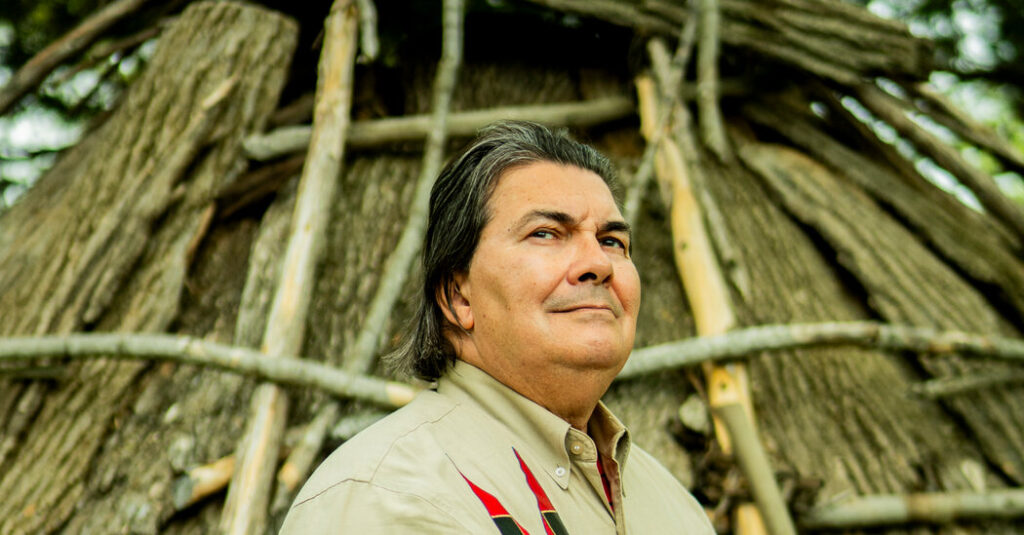
On the bank of the Delaware River in Pennsylvania, Jeremy Johnson fell to his knees. It had been a long trip from Bartlesville, Okla., the windswept pocket of prairie where he was born and where he is an educator with the Delaware Tribe of Indians.
In some ways it was a journey several centuries long.
He plunged his hands into the river and let the waters run between his fingers. Above him were tulip trees, valued by his ancestors for the dugout canoes they made from the trunks. His ancestors could trace their history back 18,000 years, when this land — which flows through modern-day New York, New Jersey, Pennsylvania and Delaware — was called Lenapehoking, “the people’s land.” It was home to the Lenape, now known as the Delaware, before forced removals, federal decrees and broken treaties landed them in Oklahoma.
“I was the first person in my family probably in 250 years to ever touch that water,” Mr. Johnson said, recalling that trip five years ago. He sat in a nondescript conference center at the tribe’s Bartlesville headquarters, while a powwow fund-raiser carried on in a rec room next door. Tribal iconography was inked up and down his arms. He began to quietly weep, knotting his fingers together — one tattooed with the leaf of the tulip tree.
It was only there, on the bank of the Delaware, he said, that he realized that as central as the tree is in the culture of the tribe, he had never actually seen one in his entire life. Tulip trees, like the Lenape, are not native to Bartlesville.
“It’s not so much painful,” Mr. Johnson said finally. “It’s actually kind of a joy.”
But after more than four centuries spent in flight, the descendants of the original Lenape have begun dreaming of a more permanent connection to Lenapehoking.
“It’s not just a story, it’s not just an elder telling us, ‘That is where we used to be,’” said Brad KillsCrow, chief of the Bartlesville tribe, who for the last five years has been leading pilgrimages from Oklahoma to the homelands. “I want all of my community to feel that.”
Home Away From Homelands
The exodus from Lenapehoking began in 1626 with a myth: the supposed sale of Manhattan to the Dutch for a handful of beads and 60 guilders. But this was only one of a string of broken accords that forced the tribe to uproot every generation.
The Lenape were one of the first nations to sign a treaty with the newly formed United States of America, just two years after the Declaration of Independence, according to Christopher Lindsay Turner, curator and cultural research specialist at the National Museum of the American Indian. It was also the first treaty the United States would violate, he said.
Ceaselessly uprooted by federal fiat, violence and westward expansion, they landed in so-called Indian Territory, now Oklahoma, about 150 years ago and reside there today. The Lenape were crammed alongside about 40 other federally recognized tribes.
“Oklahoma was basically a pile of betrayed nations,” Mr. Turner said. “And the Lenape were at the bottom of that pile.”
Most of Oklahoma’s Delaware live in the northeastern part of the state, on a 90-acre parcel of what was once solely Cherokee land. In addition to the Delaware Tribe of Indians, there are a few other federally recognized Delaware communities in the United States — the Delaware Nation is in the southwest of Oklahoma, in Anadarko; the Stockbridge Munsee Community is in Wisconsin. There are a few groups of Lenape descendants in Ontario, which are recognized by Canada. And then there are scattered communities that also claim tribal heritage — a tremendous point of contention among the tribes with federal recognition.
The largest community of Lenape descendants is around Bartlesville, named for Jacob H. Bartles, who ran a cowboy hotel and in 1868 married Nannie Journeycake, the daughter of a Lenape chief whose dowry included the land that would become the city.
Situated in the tallgrass prairie along the Caney River at the northernmost reach of the state, Bartlesville is home to just under 40,000 people, about 5,000 of whom are members of the Delaware Tribe of Indians. In Oklahoma, about 12 percent of white residents live in poverty; for Native Americans it is nearly 20 percent. In contrast to the neighboring Cherokee Nation, which runs 10 casinos statewide and contributes $3.1 billion to the Oklahoma economy, the Delaware Tribe of Indians has fewer economic outlets.
One of them is Teton Trade Cloth, a native-style textile company on Bartlesville’s main drag. The company faltered in about 2022 amid controversy over cultural appropriation, allowing the Delaware to purchase it in distress. About 20 miles north of the city, on a rolling prairie filled with heifers just over the state line in Kansas, sits a luxury ranch house that the tribe rents out as a retreat.
Bartlesville is home to the tribal government, food pantry and child education center, and where on a recent afternoon a group of elders were throwing a stomp dance for this year’s teenage “Powwow Princess,” who would serve as an ambassador for at tribe at native ceremonies and events. For Leslie Jerden, the chief executive of Teton Trade Cloth, Lenapehoking sounds wonderful, but Bartlesville is where they now belong. “I’ve never touched the water, I’ve never climbed the mountains,” she said. “Yes, we were displaced, but Oklahoma has been home.”
A Return to Lenapehoking
But for Curtis Zunigha, an outspoken former chief of the Delaware, the homelands exert a near-mythical force.
When he was chief, his main focus was on restoring federal recognition, which was revoked twice, and last restored in 2009, but these days he spends his time looking back east. Four years ago he moved for a time back to Lenapehoking — to Kingston, N.Y., an artsy town up the Hudson River from Manhattan. Nearly 20 years ago, he helped found the Lenape Center, a New York City-based nonprofit that promotes the tribe’s culture, and he was back to cultivate a Lenape seed garden. In Kingston, amid the rows of blue corn his ancestors would have planted, Mr. Zunigha said, he was able to reckon with his own his past.
His father and grandfather had grown up out West at the notorious Indian boarding schools sponsored by the U.S. government as part of a late-19th-century initiative to stamp out Native American culture. The brutality, he said, was brought home to his family — he recalled being punished by his father, who used the same words he had been told at school: “You are nothing.” It is a legacy that he vowed would end with him. In Kingston, he said, he was able acknowledge that trauma for the first time.
“I’m there in that valley, all those years later, putting the same seed in the ground, digging my fingers into the earth,” he said. “The same earth that my ancestors lived on. The same earth that their bones are buried way below.”
Complicating their desire for a foothold back east is the fact that the homelands are already home to groups like the Ramapough Lenape and the Nanticoke Lenni-Lenape nations, in New Jersey, as well as the Lenape in northern Delaware, each of which claims tribal ancestry. But these tribes have only state recognition, a far less exacting process than obtaining federal recognition.
Nonetheless, the Delaware Tribe of Indians have embarked on a more permanent return: Since 2022 the tribe has fully embarked on an initiative to track down the remains of thousands of Lenape Indians still held in university and museum collections and bury them in Lenapehoking earth.
So far they have reburied an estimated three-hundred-plus ancestors, and tens of thousands of funerary objects, said Martina Thomas, the Bartlesville tribe’s historic preservation officer, the remains pulled from the collections of universities like Seton Hall and Rutgers, both in New Jersey. The burial sites are on donated land in Pennsylvania, Ms. Thomas said, but the exact location is a tribal secret, because they are routinely pillaged by amateur archaeologists looking for arrowheads and wampum.
But already the tribe is running out of gravesites, with untold numbers of ancestors waiting to be buried. “That is where my anger comes in,” Ms. Thomas said. “We have a large quantity of ancestors that are still on the shelves. Where are we going to put them?”
But burying them out West, far from the original homelands, the tribe agrees, is out of the question. Lenapehoking is home.
Returning Home
And so the pilgrimages continue. On a bright April morning, Mr. Zunigha stood over a mound of earth in Inwood Hill Park in Upper Manhattan, dusting the soil with a fistful of ceremonial tobacco leaves.
He had flown from Bartlesville to teach New York City Department of Parks and Recreation rangers how to plant crops like the purple kingsessing beans that the Lenape would have sowed. He was leading them in a ritual to bless the future harvest.
One ranger, Mara Pendergrass, led a group weeding an overgrown patch beside a replica wigwam, who then piled the fresh earth into mounds at Mr. Zunigha’s instruction. He showed them how to press Nanticoke squash seeds and Sehsapskink blue corn kernels into the dirt at the proper intervals, so they could teach children at an event at the Inwood Hill Nature Center next month how to sow them in a circle as Native Americans would have, so that the plants prop up and fertilize one another.
As Mr. Zunigha completed the tobacco ceremony, Ms. Pendergrass spoke up. “How does someone who is part of the conquering people,” she said, her voice catching, “teach about the conquered?”
“Together,” Mr. Zunigha responded after a time. “I am the grandchild that my ancestors were praying for, hoping that we would survive,” he added. “And we have.”
Sarah Maslin Nir is a Times reporter covering anything and everything New York … and sometimes beyond.
The post Driven From Lenapehoking, They Hope to Return to New York appeared first on New York Times.