Few if any congressional districts in the United States possess the wealth and cultural cachet of New York’s 12th District, which encompasses much of the core of Manhattan. Bursting with landmarks like the Empire State Building and Central Park, the solidly Democratic seat is a choice perch from which to build a national profile and gain influence.
The seat is currently held by Representative Jerrold Nadler, the former House Judiciary Committee chairman who helped lead President Trump’s impeachments. Mr. Nadler announced last year that he would not seek re-election after more than three decades in Congress.
Vying to replace him is a crowded field of Democratic candidates who will face off on Primary Day, June 23. Four of them — Alex Bores, an East Side state assemblyman; Micah Lasher, a West Side state assemblyman; Jack Schlossberg, the grandson of John F. Kennedy; and George T. Conway III, the ex-husband of Mr. Trump’s former campaign manager — have led the limited public polling that has been conducted.
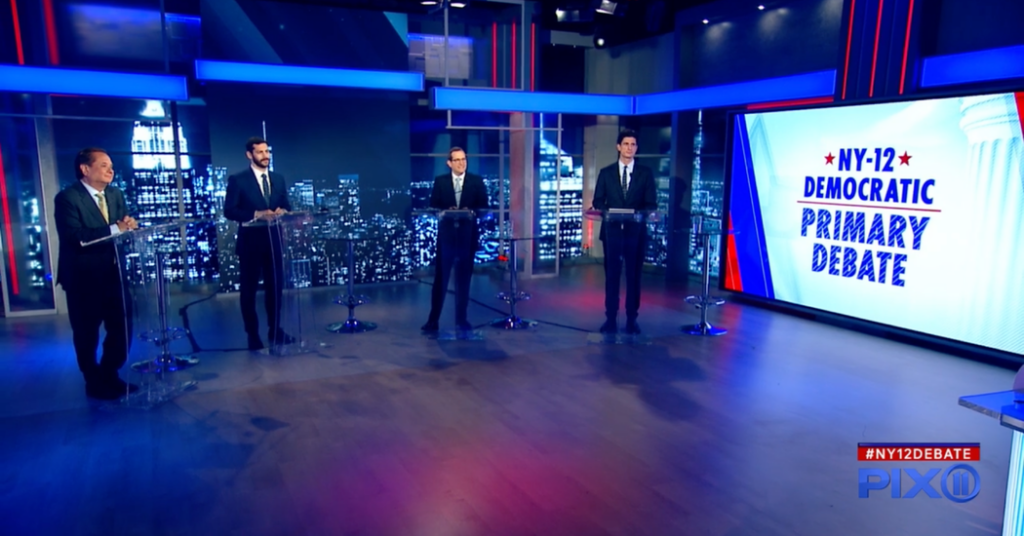
The candidates have tussled in forums and on social media, but on Thursday night they took part in the first televised debate of the race. Here’s an overview.
An early clash over A.I. policy
Mr. Bores made a name for himself in Albany sponsoring legislation that would establish new rules governing the safe development of the most advanced artificial intelligence models.
The bill prompted a flood of spending against him from well-funded super PACs, which were seeded with money from executives at companies like Open A.I who also supported Mr. Trump.
Responding to the first question of the night, Mr. Lasher was quick to point out that other groups, funded by employees, investors and backers of Open A.I.’s largest competitor, Anthropic, were supporting Mr. Bores. He noted how Chris Larsen, a billionaire crypto investor, spent $3.5 million to boost his campaign.
Mr. Bores has been a proponent of cryptocurrencies, answering a questionnaire from one industry group by saying that if elected, he would “make sure that poorly constructed regulation does not hinder crypto innovation or blockchain adoption.”
“Alex only wants to tell you half the story about one A.I. company that’s spending millions to defeat him, and that’s bad, but he’s not telling the whole story,” Mr. Lasher said.
Mr. Bores said in response that he had been a supporter of aggressive crypto regulation in the State Legislature. He also argued that the spending against him reflected how scared the technology industry was by the prospect of his election, while sidestepping questions about the money being spent in his favor.
“With friends like these, who needs Republicans?” Mr. Bores said. “The Trump disinformation is coming from within the party.”
Trumping the others on Trump
The 12th District is solidly Democratic, and went for former Vice President Kamala Harris during the last presidential race by about 64 percentage points. So it’s no surprise that the candidates all sought to hype their anti-Trump bona fides on the debate stage.
They all spoke with horror about the president’s immigration policies and called for ICE to be abolished. Several noted that they had recently visited Delaney Hall, the immigrant detention center in Newark where law enforcement has been clashing with protesters. Mr. Bores pointed to the donors funding the super PACs attacking him and noted that many of them support Mr. Trump.
But it was Mr. Conway, who rose to fame as an anti-Trump Republican who frequently criticized the president on cable news, who invoked Mr. Trump the most. He circled back to Mr. Trump in response to nearly every question, asserting that nothing of policy significance could be discussed until steps were taken to impeach the president.
“None of the proposals that you have heard here in the last couple of minutes will be going anywhere while Donald Trump is president,” Mr. Conway said at one point. (All the candidates agreed that Mr. Trump should be impeached.)
A wave of Bores bashing
Mr. Bores was a little-known member of the State Assembly when the race began. But on Thursday night, he was the main recipient of on-stage attacks, reflecting how his star has risen in the race.
Both Mr. Schlossberg and Mr. Lasher repeatedly reminded viewers about the outside money flowing in to support Mr. Bores, which has resulted in the district’s voters being inundated with mailers and text messages about his campaign.
They similarly attacked his prior employment at Palantir, a technology company that has aided ICE in its efforts to deport undocumented immigrants, and questioned his assertion that he chose to leave the company in 2019 in protest of that work.
Mr. Bores has insisted that his discomfort with the company’s collaboration with the Trump administration is what prompted him to quit.
“My record on leaving Palantir is absolutely clear. I’m happy to release anything,” Mr. Bores said Thursday. “This is a shameful lie that they are repeating.”
At another point in the debate, Mr. Bores seemed to acknowledge that his rivals were uniquely focused on him.
“They’re so feisty today,” he said.
Different Shades of Blue
For the all the punchiness in the debate, the candidates found many areas of agreement.
Though they differed on whether the United States should sell weapons to Israel, they were all unwilling to describe Israel’s actions in Gaza as a genocide.
They all said that taxes on people making more than $1 million should go up. They all said members of Congress should be barred from trading individual stocks. They even all said that the Ed Koch Bridge should be renamed over the former mayor’s handling of the AIDS crisis.
The overlap reflected how little daylight there is between the candidates on most issues, and suggested that all of them would likely vote similarly if elected to Congress.
Benjamin Oreskes is a reporter covering New York State politics and government for The Times.
The post House Candidates Spar Over A.I. and Trump in Contentious N.Y.C. Debate appeared first on New York Times.