This week in Newly Reviewed, Will Heinrich files a dispatch from Los Angeles covering Charles Ray’s strangely lifelike sculptures, James Harrison’s flowers and a group show! (Exclamation point will make sense).
Charles Ray
Through June 6. Jeffrey Deitch, 925 North Orange Drive, Los Angeles; 323-925-3000, deitch.com.
Through June 13. Matthew Marks, 1062 North Orange Grove, Los Angeles; 323-654-1830, matthewmarks.com.
Charles Ray’s 1993 aluminum “Firetruck” is hard to place. Its material and relative lack of detail make it look like a toy, but at more than 40 feet long, it’s pretty much the size of a real truck. This ambiguity, which is funny in an understated way that also reads as magical, extends to more philosophical categories, too: Is a truck like this really a thing, or would it be more useful to regard it as an idea?
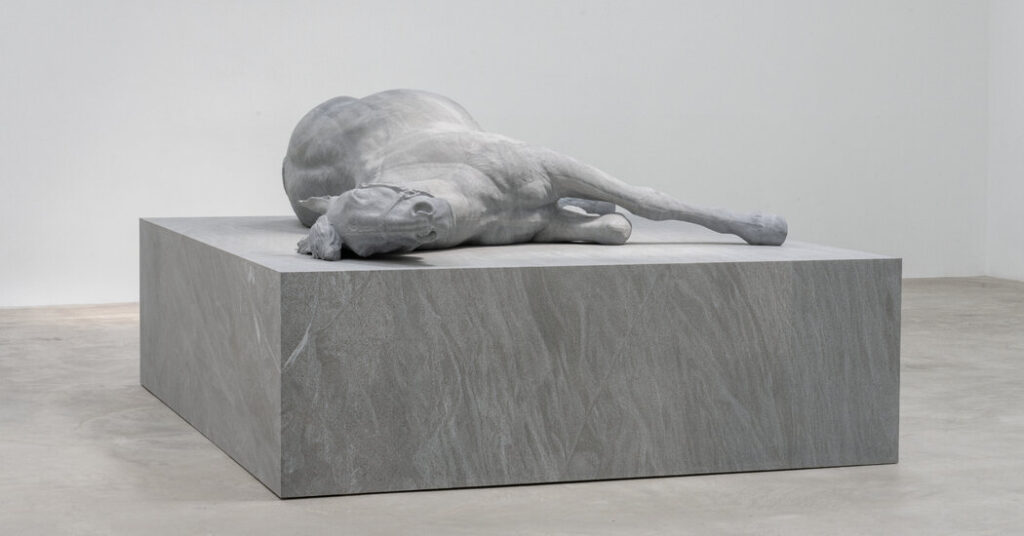
It’s helpful to keep these ambiguities in mind as you proceed from Jeffrey Deitch Gallery, where “Firetruck” is on display with two other older works, to Matthew Marks, which is showing several new pieces by Ray, most notably “Fallen Horse.” Carved from a single granite boulder, with machine help, it depicts a mare lying on a broad pedestal, her powerful neck stretched out almost self-consciously.
The surface of the stone looks as rough as fresh clay or concrete, and its color varies from light gray to dark gray according to the bit that cut it. One straight border between light and dark runs right across the horse’s neck, a permanent shadow between body and mind.
The result is a sculpture that seems at once unfinished and strangely lifelike. The roughness and color changes evoke the uneven nap of an animal’s coat; the play of shadow, if you stand in the right place, lights up the inanimate eye. All this, in turn, raises weightier questions than those of the fire truck: What does it mean to make something, or to have an idea? What exactly is a boundary? What exactly do we mean by being alive?
James Harrison
Through June 13. Overduin & Co., 6693 Sunset Boulevard, Los Angeles. 323-464-3600, overduinandco.com.
James Harrison, a British-born, Los Angeles-based painter, starts by drawing flowers, usually from life but sometimes from a printed textile. Then he copies the drawing onto a canvas, continues it to the edges and paints it in. It’s a simple enough procedure, but with it he arrives at something genuinely arresting.
In “Pansies,” a five-foot-tall canvas is filled with thousands of tiny, irregular blobs of color. The drawing is light but precise, and once you get close enough, you can even pick out details of floral anatomy.
But the painting is vigorous and gestural, and Harrison applies to the blossoms and to the spaces between them the same fanciful range of saturated hues, in this case an almost tropical variety of yellows, oranges, lavenders, eggplants and teals. The effect is overwhelming, like a grand orchestral chord in which every instrument is distinct but the whole is too much to take in.
“Ace of Cups” has a looser feel; with more space between flowers, it’s easier to distinguish the yellow geranium blossoms and their green and orange leaves from what is nominally the background, a Chinese-lantern red.
Here, too, you can fix on details, but it still feels strangely difficult to come to grips with the whole. The painting’s overall structure feels like abstraction, but its building blocks are figurative. The textile reference is evident — but so is the painterly attention to the surface. It’s flat, but not completely flat; expansive, but controlled; pretty, but manifestly serious. After a while, I started thinking of “negative theology,” the proposition that the only way to describe something that surpasses ordinary categories is to list the things it isn’t.
10 Years LA!
Through Aug. 8. Sprüth Magers, 5900 Wilshire Boulevard and 6145 Wilshire Boulevard, Los Angeles. 323-634-0600; spruethmagers.com.
The typical gallery anniversary show feels something like a high school reunion. Despite their shared circumstances and good will, the pieces on display rarely have much to say to one another. “10 Years LA!,” celebrating a decade of West Coast operations for the gallery founded in Cologne, Germany, by Monika Sprüth and Philomene Magers in 1983, is different.
It includes work by more than 60 artists from a range of generations, origins and approaches — Bridget Riley and Kara Walker, Gilbert & George and Joseph Kosuth, the German photographers Bernd & Hilla Becher and the echt Californian John Baldessari.
The gallery’s 10,000-square-foot building, which sits across Wilshire Boulevard from the newly renovated Los Angeles County Museum of Art, is full of art, and so is the dining room of a disused Sizzler a few steps down Wilshire, where the gallery has covered the windows and installed a video program.
What makes this profusion thrilling instead of dutiful is the shared commitment the artists all have not to a particular style or subject matter, but to an intellectual approach to art making. Combining politics, philosophy and aesthetics in equal measure, they do their best to be conscious of what they’re doing and to awaken their viewers, too, whether it’s with a provocation, a joke, an incisive observation or an optically demanding painting. The neatest example may be Richard Artschwager’s 2008 sculpture “Exclamation Point (Chartreuse),” a kind of plush three-dimensional punctuation mark that floats above the floor. It’s silly, cynical, exuberant and memorable — and, most of all, absolutely vibrating with self-awareness.
See the May gallery shows here.
The post Art Gallery Shows to See in June appeared first on New York Times.