Democrats in New York took a major step in clearing a pathway to redraw congressional maps ahead of the 2028 elections, a significant victory in the swiftly escalating next phase of their party’s state-by-state redistricting battle with Republicans to draw increasingly partisan district lines.
State lawmakers voted late on Wednesday to allow for middecade redistricting instead of once every 10 years, linked to the U.S. census. The bill also removes restrictions on districts drawn to benefit incumbents or one political party over the other.
These proposals, which passed without the support of any Republicans in Albany, must be signed off by the Legislature again next year and then approved by voters in a referendum in November 2027. Under that timeline, the Democrat-led Legislature could oversee new district lines before the 2028 election, potentially putting as many as four Republican-held seats in play.
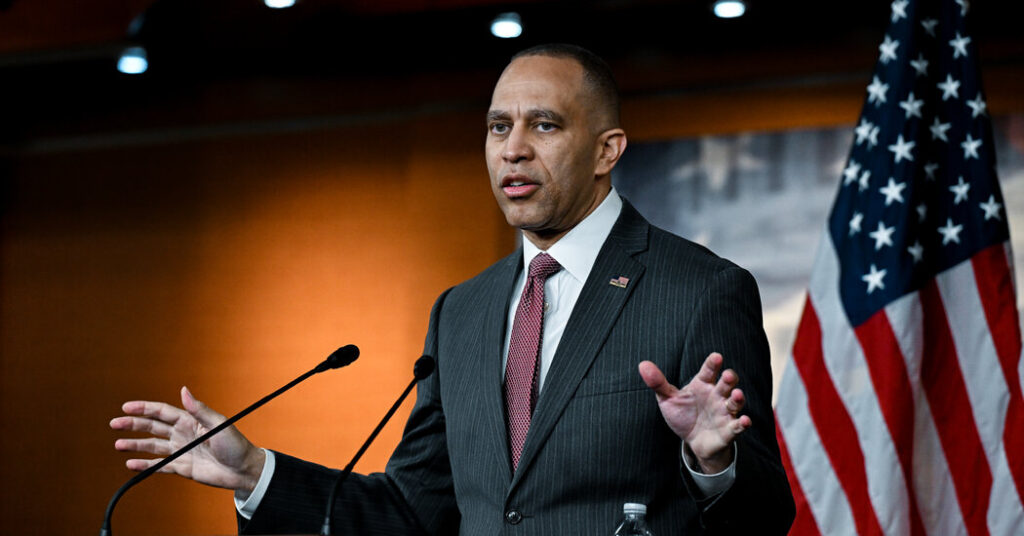
“As long as Republicans are going to continue to try to aggressively gerrymander in states in the South and beyond, we need to be in a position to respond next year, and we will,” Representative Hakeem Jeffries, the House minority leader, said in an interview.
“There will come a point where we need one national standard to prevent things like aggressive, partisan gerrymandering,” Mr. Jeffries added later. “But until that day arrives, blue states like New York have to respond decisively.”
What started with Republicans in Texas last year has spread across the nation, with elected officials from both parties looking for any advantage — however small — to increase their chances of winning a governing majority in the House of Representatives.
Perhaps no state is more critical to the Democrats’ plan for maximalist, aggressive redistricting in 2028 than New York. Democrats are eager to pull back to even, or possibly ahead, in the national redistricting wars next cycle after being dealt significant setbacks this year.
But New York Democrats have had a tortured recent history with drawing maps, with some of their efforts overturned in court. Scarred by these fights in recent years, Mr. Jeffries, the minority leader of New York, and Representative Joseph D. Morelle of New York have been working closely with Senator Michael Gianaris, the deputy majority leader in the State Senate, and other state Democrats to enact these changes.
In doing so, Mr. Jeffries and Mr. Morelle are seeking to revisit and revise some of their own history: They were both in the State Assembly and supported many of the reforms in 2012 that they are now undoing. Republicans controlled the State Senate majority at the time, and they reached a deal with the state’s Democratic governor, Andrew M. Cuomo, to form an Independent Redistricting Commission.
The commission comprised 10 appointees split evenly between both parties, with the stated goal of preventing partisan gerrymandering.
On Wednesday, Democrats moved to scrap many of those reforms, while making it easier for the State Legislature to redraw the lines if the state’s Independent Redistricting Commission cannot agree on a map.
“The fear was that if you set up a political commission that is split evenly between the parties, it is designed to fail, and that’s precisely what happened,” Mr. Gianaris said.
“What you’re seeing now is the states that are willing to abuse the process lean heavily Republican,” he added. “California got to redo their maps, but there’s not been much else counteracting what Texas, Florida and others are doing. We are a very big state that has the opportunity to be responsive to what’s going on around the country.”
Among Democrat-led states, New York’s potential gains could only be matched by a possible redistricting redo in Virginia and a push for three new Democratic-leaning districts in Colorado. Other states on the Democratic battle plan for new maps in 2028, like New Jersey, Oregon, Washington, Illinois and Maryland, are likely to only add a single new Democratic-leaning district in each state.
But Republicans are also likely to further expand their redistricting efforts next year. Georgia is set to take up 2028 redistricting this month, and Republican leaders in South Carolina and Mississippi have indicated that they plan to redraw their maps for the next cycle. Other states that have already redrawn, such as Texas and Louisiana, could further split up their maps, and some Republican states that once refused, like Indiana and Kansas, could try again next cycle.
All told, given the political turmoil, the looming 2028 election and the legal guardrails on redistricting all but gone, the redistricting wars are likely to intensify across the country. Still, Republicans questioned the motives of the ruling Democrats.
“We’ve heard a lot about how we’re not playing games alone, and that there are things happening in other parts of the country. Last time I checked, we’re sitting in the New York State Capitol and we’re talking about the New York State Constitution,” said Senator Jack Martins, a Republican from Long Island, who noted how Democrats like Mr. Gianaris had supported various anti-gerrymandering and independent redistricting efforts in the past.
“I fail to see how these changes are going to actually inure to the benefit of the residents and the voters of New York State,” Mr. Martins added.
One of the challenges for Democrats, should they get the go-ahead to redraw congressional maps, is to maximize partisan gain while not blowing up Black and minority communities core to the Democratic base.
For example, predominantly Black districts in Brooklyn will most likely need to be divided to tilt the district held by Representative Nicole Malliotakis, the lone Republican in the city’s House delegation. Similar divisions would be likely to break apart minority communities in Queens to potentially flip red-hued Long Island districts.
Mr. Jeffries deflected a question about how New York Democrats might protect minority voters while still drawing the most aggressive map possible.
“We can do both,” he said, but declined to offer any details, only allowing that Democrats will meet “as a delegation” to discuss possibilities before any maps are drawn.
“We can respect the value of giving traditionally underrepresented communities the ability to elect the candidate of their choice, while at the same period of time creating competitive races so that we can respond to the unprecedented gerrymandering scheme that Donald Trump has launched,” Mr. Jeffries said.
Benjamin Oreskes is a reporter covering New York State politics and government for The Times.
The post N.Y. Democrats Move to Allow More Frequent Redistricting appeared first on New York Times.