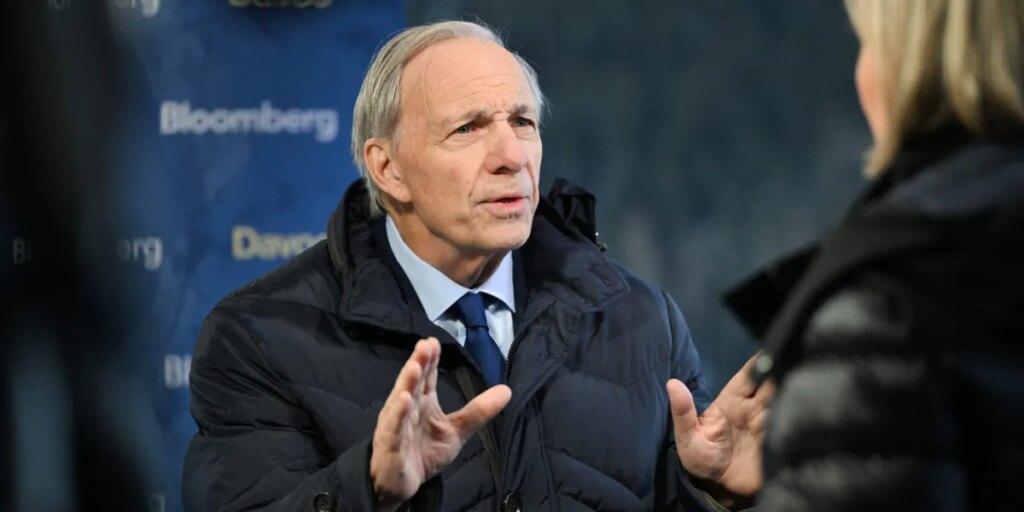
Billionaire investor Ray Dalio delivered a stark dual warning Wednesday, telling Bloomberg Television U.S. equity markets were nearing bubble territory last seen before two of history’s worst financial crashes—even as a separate debt-driven crisis has already crossed a threshold from which there is no escaping.
“We are right now rising close to—not at—the same level in 2000 and the same level in 1929,” Dalio said, citing his proprietary bubble indicators that measure sentiment, concentration, and valuation. He was conjuring up two of the most famous bubble-popping moments in the last century: the onset of the Great Depression and the dot-com crash.
He was careful to note that a bubble forming and a bubble bursting are two distinct events, and the “pricking” comes when investors must convert wealth into cash to cover debts or tax obligations.
“You cannot spend wealth,” he said, stating an obvious, yet under-appreciated, dynamic. “You have to sell wealth to get money, because you can only spend money.”
On the debt side, Dalio was less equivocal. With the federal government spending roughly $7 trillion annually against $5 trillion in revenue, he said the dynamic has already become self-reinforcing and irreversible in the near term.
“We’re past the point of no return,” he said in direct response to that question, comparing the buildup of debt service payments to “plaque in the circulatory system, squeezing out the flow of blood.”
Warning signs already visible
Dalio said the bond market is already flashing the early signals of a debt crisis: long-term rates rising relative to short-term rates, a weakening dollar, and capital rotating into gold and alternative assets. That rise in long rates, he argued, feeds directly into equity pressure—compressing the return premium that stocks have historically commanded over bonds.
The result, he said, is a stagflationary environment that puts the Federal Reserve in an almost impossible position. New Fed Chair Kevin Warsh, who has publicly pledged his independence from the White House, will likely face a severe test from the bond market, Dalio suggested.
“One man’s debts are another man’s assets,” he said. “If there’s not a high enough real return, those bonds are not appreciated.”
Dalio drew a direct parallel to the 1930s, describing what economists call “financial repression”—where central banks suppress yields through asset purchases, potentially accompanied by foreign exchange controls and higher inflation.
“I think it’s exactly headed to that kind of thing,” he said, though he stopped short of predicting outright capital controls. “I’m not saying we’re going that far.”
Dalio’s conclusions closely echoed those of Pulitzer Prize-winning historian Liaquat Ahamed, who recently told Fortune we see this happening all around us today. He pointed to a real-world preview of what a U.S. version could look like: the U.K.’s Liz Truss moment, when bond markets revolted within days of an unsustainable fiscal announcement and the Prime Minister had a historically short tenure.
AI is both a miracle and a bubble
The Bridgewater Associates founder acknowledged the genuine transformative power of AI while warning the investment frenzy surrounding it is following a historically familiar and dangerous script.
“All great technology changes produce bubbles,” he said, explaining competitive pressure forces companies to massively overspend with no clear endpoint—and investors conflate the promise of the technology with the value of the stocks. “Buying the stocks is betting on the technologies, which is a different thing—because the stocks can be expensive.”
Ahamed’s new book found similarities in the financial crisis of 1873 in his new book, when railroad mania—the AI of its era—produced the same dynamic: transformative technology, massive capital misallocation, and a financial system that couldn’t withstand the eventual reckoning.
AI’s wealth-creation dynamic also amplifies a broader inequality problem, Dalio warned. A small sliver of the population will benefit enormously, while most won’t. Asked whether political cooperation could address that gap, he was blunt: “I’m not optimistic on us working together to solve some of these issues.”
The geopolitical wildcard
Dalio, who said he recently spent a month in Asia, including 10 days in China, added a geopolitical dimension he believes markets are underpricing. Asian leaders he spoke with have concluded the U.S. can no longer credibly project military force across multiple theaters simultaneously. The geopolitical alarm is one Dalio has been sounding with increasing urgency. Speaking to Fortune at Davos in January, he said the global rules-based order was already “gone”—a declaration that set the tone for what has become a running theme in his 2026 public appearances.
“It’s clear that the United States cannot fight a war,” he told Bloomberg, citing public unwillingness to absorb casualties and economic costs. “That process of containment [of China]—that’s over pretty much.”
He flagged Taiwan as the most acute flashpoint, noting China could trigger a global market crash simply by signaling a chip blockade: “It’s entirely within the power of the Chinese government to basically say, let’s put a blockade and have a week of no chips coming out,” he said. “All the AI stocks, everything would crash.”
Dalio’s warnings align almost eerily with those of Ahamed, who said “the situation today is frightening”—and the scenario that keeps him up at night is a geopolitical adversary, specifically China, choosing to weaponize its U.S. debt holdings at a moment of maximum fiscal vulnerability.
In February, Dalio predicted the world was “on the brink” of a capital war—where money itself becomes a geopolitical weapon, and central banks and sovereign wealth funds begin treating asset allocation as an act of statecraft.
Dalio identified the window between the 2026 midterm elections and the 2028 presidential election as a period of particular vulnerability, when debt pressures and intensifying political conflict over taxes and spending will converge.
For this story, Fortune journalists used generative AI as a research tool. An editor verified the accuracy of the information before publishing.
The post Ray Dalio warns the stock market is approaching 1929 and 2000 bubble levels—but another crisis is ‘past the point of no return’ appeared first on Fortune.