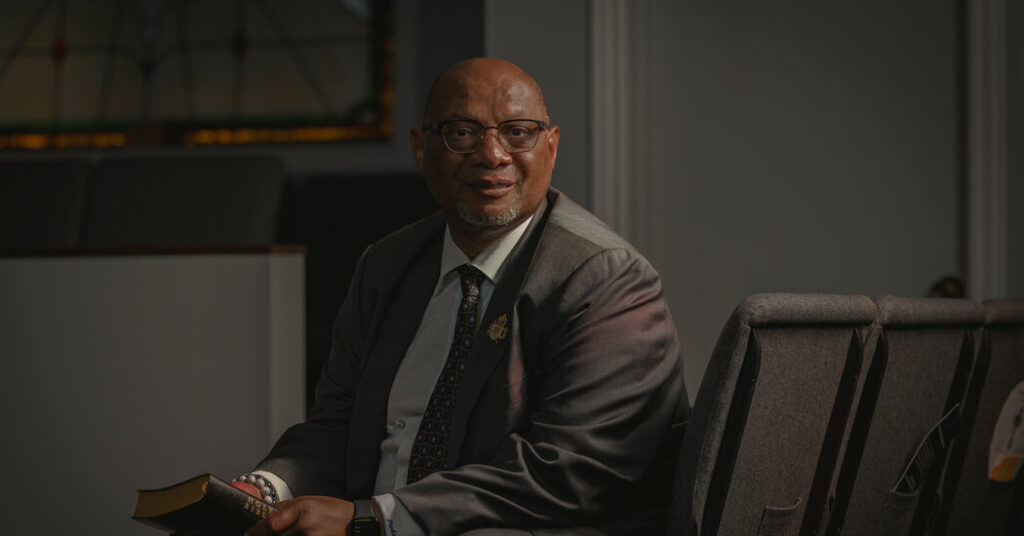
Reginald T. Jackson, a bishop in the African Methodist Episcopal Church, one of the country’s largest majority-Black denominations, and a leading figure at the intersection of religion and Black electoral politics for more than 30 years, died on Tuesday in Washington. He was 71.
His death was announced by Saint Matthew A.M.E. Church in Orange, N.J., which he led as pastor for 31 years before being elected a bishop in 2012. His daughter, Regina V. Jackson, said the death, in a hospital, was from cardiac arrest.
Bishop Jackson was part of a long tradition among Black religious leaders in which they’ve wielded influence by urging congregants to use their voices at the ballot box. “No vote, no clout,” he liked to say.
He emerged as a power player in New Jersey politics not long after arriving at St. Matthew in 1981. As the executive director of the Black Ministers Council of New Jersey, a coalition of several hundred ministers, he was able to rally other faith leaders behind or against mayors, senators and governors. It was said that his endorsement could easily sway the votes of 400,000 churchgoers across the state.
“You could not do things in politics without coming and engaging with him,” Senator Cory Booker, Democrat of New Jersey, told The New York Times in 2024. “It would be a malpractice in New Jersey to be politically active without seeking his counsel and his wisdom, and understanding that he was a force in his own right.”
As a bishop, he brought that skill to the A.M.E. Church’s Sixth District, which includes Georgia; there, he oversaw more than 500 congregations from 2016 to 2024. Through get-out-the-vote campaigns, he helped draw hundreds of thousands of voters to the polls in support of Joseph R. Biden Jr. for president in 2020. Mr. Biden narrowly defeated Donald J. Trump in Georgia to capture its 16 electoral votes on his way to the White House.
Bishop Jackson played a similarly pivotal role in getting out the vote for Jon Ossoff and Raphael Warnock, both Democrats, in their Senate races in 2020. In a special election that year, Mr. Warnock, a Baptist minister, was the first Black Democrat elected to the Senate from the South. He won re-election to a full term in 2022.
Bishop Jackson tended to back Democrats, but he insisted that he was not beholden to their party. On multiple occasions in the 1990s, he supported Republicans, including Gov. Christine Todd Whitman of New Jersey in her successful re-election campaign in 1997.
He used his church’s political power to achieve significant civil rights improvements, particularly on criminal justice issues like racial profiling. After two white New Jersey state troopers admitted to pulling over a van in 1998 because it was driven by a Black man — and then firing 11 shots into the vehicle, wounding three occupants — Bishop Jackson led a public outcry against the New Jersey State Police.
Despite death threats, he pressed on until the agency was placed under federal oversight, which lasted a decade. The state also settled a lawsuit brought by the three men for nearly $13 million.
“It just erupted once we started finding out all the cover-up,” Bishop Jackson told New Jersey Monthly in 2001.
After the Republican-led Georgia State Assembly tried in 2021 to rewrite the state’s election law to, among other things, restrict voting on Sundays — a time when many church attendees go to the polls — he organized a boycott against Georgia-based companies like Coca-Cola, Delta Air Lines and Home Depot to pressure them into opposing the change.
The restrictions on Sunday voting were removed, but the law passed with several other elements that Bishop Jackson and his allies opposed, like voter-identification requirements.
That experience left Bishop Jackson skeptical about whether Democrats were ready to fight Republicans on civil rights issues. The party, he told The Times, was “on the right side of an issue, but they are not as committed to the fight as Republicans of the far right are.”
Reginald Thomas Jackson, the third of four sons, was born on April 26, 1954, in Dover, Del. His father, Charles, was a driver for Delaware State College (now University), a historically Black school in Dover. His mother, Lillian (Bowers) Jackson, worked in food services at Wesley College, which is now part of Delaware State University.
Reginald found his calling early, giving sermons as a youth at his church in Dover. Still a teenager, he also became involved in politics, working on Mr. Biden’s first campaign for the Senate from Delaware in 1972. He graduated in 1976 with a degree in history and political science from Delaware State and received a masters in divinity in 1979 from Turner Seminary at the Interdenominational Theological Center in Atlanta.
That same year, he was assigned to St. John A.M.E. Church in Jersey City, which he led for three years until moving to St. Matthew.
His first assignment after being elected bishop, from 2012 to 2016, was in Africa, to oversee a district that includes Malawi, Zimbabwe, Tanzania and Uganda.
In 2024, after serving two terms in Atlanta, Bishop Jackson was assigned to the A.M.E. church’s Second District, which encompasses Maryland, Virginia, western North Carolina and the District of Columbia.
His first marriage, to Carol Balentine, ended in divorce. In 2004, he married Christy Davis, who had run Jon S. Corzine’s successful Democratic campaign for U.S. senator from New Jersey in 2000. She later worked with Bishop Jackson as a district administrator for the A.M.E. church. She died in 2024.
Along with his daughter, from his first marriage, he is survived by a son from his second marriage, Seth; and his brothers, Charles, Everett and Melvin.
When The Times asked him in 1996 why getting out votes was so important, Bishop Jackson recounted running for student council president at his high school. Of the school’s 2,000 students, 400 were Black, and he was the only Black candidate. He lost by eight votes.
He later learned that 20 Black students had not voted. If they had, he reasoned, he might have won.
“I still get livid when I think of that,” he said.
Clay Risen is a Times reporter on the Obituaries desk.
The post Reginald T. Jackson, A.M.E. Bishop With Political Power, Dies at 71 appeared first on New York Times.