An explosive drone snaked between the hills of southern Lebanon before striking an Israeli armored personnel carrier. Two days later, another slammed into a tank. Three days after that, a third pounded into a missile-defense system.
Each day, multiple drones attack Israeli forces, the Israeli military has said, and with lethal effect. In the past week alone, they have killed three soldiers.
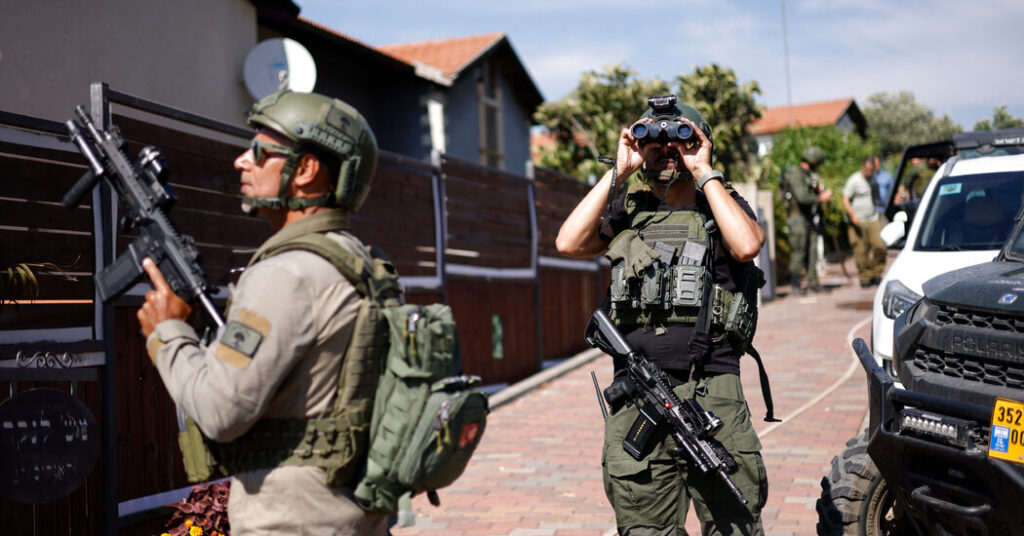
The relentless drone attacks by Hezbollah, the Iran-backed Lebanese militant group, have exposed cracks in Israel’s defenses, shocking its public and forcing a rushed search for solutions by its military and political leaderships.
They have sown fear among Israeli ground troops in Lebanon and challenged Israel’s longstanding air superiority in Lebanese skies. The drones have also revealed a shortcoming in Israel’s strategy to seize territory in southern Lebanon, build a buffer zone and displace Hezbollah militants beyond the range of antitank missiles that have plagued tens of thousands of civilians living in northern Israel.
The drone onslaught, however, was no surprise: As early as 2024, military officers warned that Hezbollah would likely start using drones that are controlled through thin fiber-optic cables to evade electronic jamming, according to three Israeli officials who insisted on anonymity because they were not authorized to speak with the media. Fiber-optic drones have also become commonplace on the battlefield in Ukraine.
Despite the warnings, the military’s top brass appeared to do little to prepare for the threat, the officials said. When Israeli soldiers started facing daily drone attacks in April, the military still had not adopted simple countermeasures that are routine in Ukraine, like suspending protective nets over stationary soldiers and equipment.
“Two years ago, we discussed how Hezbollah would deploy these drones,” said Guy Hazut, a reserve brigadier general who led an effort in the Israeli military to learn lessons between 2024 and 2025. “But the security establishment needs a slap in the face to wake up.”
Though it largely held its fire over the past year despite repeated Israeli strikes, Hezbollah, set back by a 2024 war, has re-emerged as a fighting force. After the U.S.-Israeli war on Iran began in late February, the militant group started firing rockets and drones at Israel.
The Israeli military advanced deeper into Lebanon in a bid to stop Hezbollah’s attacks. It has taken over dozens of villages in southern Lebanon and carried out widespread demolitions.
The Israeli military has said its attacks target Hezbollah, but Israel Katz, Israel’s defense minister, said the approach in southern Lebanon was meant to emulate tactics used by the military in Gaza, where entire neighborhoods were reduced to rubble.
Over 3,400 people have been killed in Lebanon, according to the health ministry, which does not distinguish between combatants and civilians, and the government says more than 1 million have been displaced.
And yet, Hezbollah has managed to strike the military with its drone attacks on Israeli territory, which have killed at least ten soldiers and one civilian since April.
In a statement, the Israeli military said that it takes the drone threat “very seriously” and that it was trying to find solutions to what it described as “a complex technological and operational challenge.”
Hezbollah has boasted about inflicting pain on Israel’s technologically advanced military with the low-cost drones.
“This challenge has started to shake the occupation army,” Hassan Hejazi, the Arab affairs editor for al-Manar, a TV channel owned by Hezbollah, said in an interview in May with al-Manar.
In a statement, a Hezbollah spokesman said that the drones have weakened the spirit of Israeli soldiers. And in May alone, Hezbollah published more than 30 videos of drones attacking Israeli military personnel and equipment. The videos, featuring dramatic music for maximum propaganda effect, appear to show stealthy drones zeroing in on Israeli soldiers.
In one video, recorded on May 9, a drone approaches a military post in Shlomi, a town in northern Israel, and a soldier runs as fast as he can toward a fortified room. The drone crashes just as he reaches the entrance to the room. The video cuts off the moment the drone crashes, leaving it unclear whether the soldier was harmed.
In response to mounting public criticism, Prime Minister Benjamin Netanyahu said he had ordered the establishment of a special team of experts to address the drone threat.
“I told them something that surprised them a bit: You have an unlimited budget,” he said at a meeting with government ministers in mid-May. “However much it costs, it costs.”
In the past, Hezbollah used radio signals to control attack drones, which the military could disable through electronic jamming.
Now, the group mounts drones with explosives and spools of fiber-optic cable that unwind as they fly toward their targets, with an operator at the other end. Because these drones do not rely on radio signals, the main defense against them is to shoot them down or sever the cables.
Soldiers on the ground have little time to try to shoot down the drones before they explode.
The drone war came to the Israel-Hezbollah front after being pioneered and highly developed in combat between Ukraine and Russia. While drones used in that conflict can fly as far as about 50 miles, three Israeli officials said Hezbollah’s fiber-optic drones so far had a range of only 12 miles.
In January of last year, Ukrainian military officers visited Israel to explain how their military confronted the threat from Russian drones, according to two Ukrainian officials, who spoke on the condition of anonymity to discuss internal deliberations.
In recent weeks, Israeli officials asked Ukraine to send another delegation, but the Ukrainian government conditioned a second visit on Israel increasing support for Ukraine’s air defenses, according to the Ukrainian officials. The Israeli defense ministry declined to comment.
Experts are now warning that the next big challenge for Israel is a tool that Ukraine is using to bring the fight to Russia and could be adopted by Hezbollah. Ukrainians have been incorporating SIM cards, like those in cellular phones, in drones for their offensive attacks on Russian territory.
Analysts say that by using the mobile network, Ukraine was able to attack Russia from hundreds of miles away, and in some cases, Russia had to shut down cellular networks across entire regions to counter them.
“We can’t wait to find a solution to this threat,” said Mr. Hazut, who recently published a book about how the military has neglected its ground forces. “We must act now.”
Former Israeli security officials said the threat from Hezbollah’s drones was overlooked as attention was directed at more pressing concerns, like Iran’s ballistic missile program.
“Israel had to prepare for many other challenges,” said Brig. Gen. Shachar Shochat, a former commander of the Israeli military’s air and missile defense forces.
“At the end of the day, these drones can kill and cause damage, but they’re a tactical threat, not a strategic one. They won’t defeat us, but they can harm our morale.”
Euan Ward and Hwaida Saad contributed reporting to this article.
Adam Rasgon is a reporter for The Times in Jerusalem, covering Israeli and Palestinian affairs.
The post Hezbollah’s Fiber-Optic Drones Expose Cracks in Israeli Defenses appeared first on New York Times.