TAMPA — Carole Hopson’s alarm went off at 5 a.m.
She rose from her airport hotel bed, showered and made some coffee in the room. Then it was time to go over her flight plan. There would be some turbulence on the 9 a.m. short haul to Newark — nothing severe, but she’d have to tell the flight crew to stay seated a little longer after takeoff and before landing.
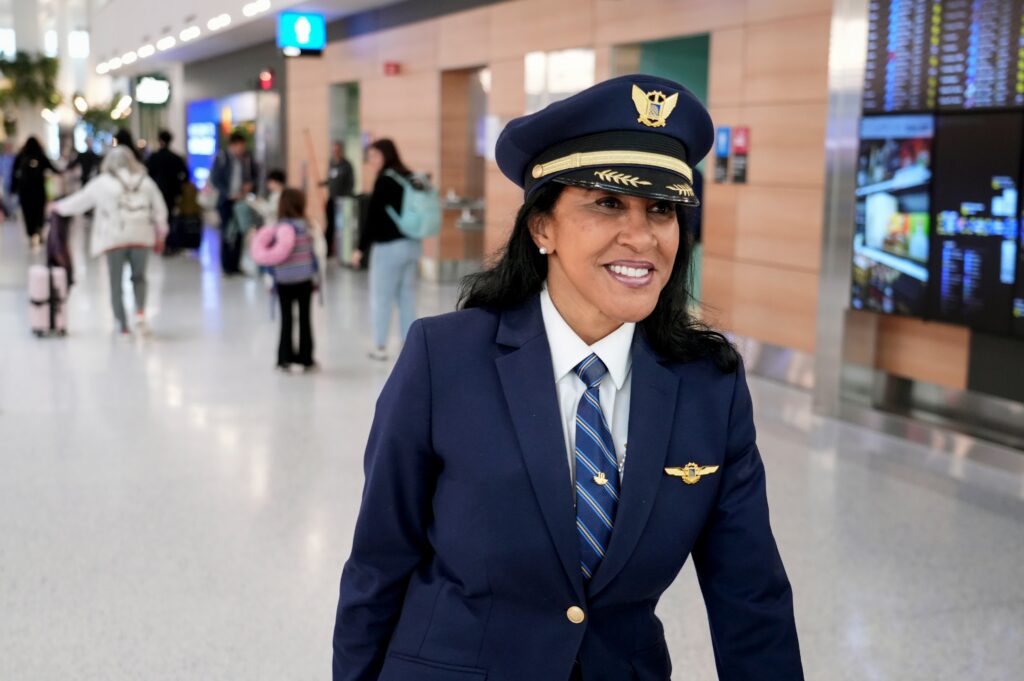
Hopson put on her uniform: a crisp white dress shirt and navy Brooks Brothers suit made custom for United Airlines. The wrists were stitched with four gold stripes that identified her as captain. The golden braid embroidered on the brim of her pilot’s cap denotes the same.
She grabbed her luggage and went downstairs to catch a ride to Tampa International. It was time to go home.
Today was the last leg of a three-day pairing, pilotspeak for trip schedules, and the final act of a “1-2-1”: one flight one day, two the next, and one more on the third.
“It’s busy,” said Hopson, 62. “Stamina is important.”
This stretch last month began on a Thursday with a 6:30 a.m. “transcon” (transcontinental) from her New Jersey base to San Diego. She had time to walk to the beach and have dinner at an Italian restaurant during her 20 hours in California before heading back in the other direction. On Friday, there was a 6:15 a.m. to Houston, then a 12:50 p.m. to Tampa.
“The middle day is long, but it’s a good long,” she said.
Hopson talked about her schedule with an enthusiasm most people reserve for Christmas morning. Even under unforgiving airport lighting, she seemed to be beaming. Maybe it was the gallon of water she drinks each day or the Aquaphor moisturizer she applies to her skin.
Or maybe it was just the glow of a person who loves their job. “All of it,” she said.
Hopson came to the profession later in life than most of her peers. She was 50 when she was hired at a regional carrier, 54 when she moved up to United proper and 58 when she became captain. And in three years, she’ll age out of the job she’d wanted all her life.
‘There was an envelope with my name on it’
In 1993, 29-year-old Carole Cary was catching a subway in New York City when she spotted someone she recognized from college. It was Michael Hopson, the brother of a classmate at the University of Virginia, and the man who would eventually become her husband. On their first date at the Comic Strip on Second Avenue, they caught up about their lives since graduation.
She told him that after earning her degree in Spanish language and literature, she’d moved to Brooklyn to become a journalist and found a job as a crime reporter at the Bergen Record in New Jersey. She filed “plenty of stories about bad people doing bad things,” she said, but covering a particularly brutal murder case made her question if the profession was right for her. The newspaper sent her to get a master’s at Columbia; she tried new beats. But her heart wasn’t in it anymore, so she pivoted — first to the National Football League, where she helped players find new careers after sports, then to Foot Locker, where she became the vice president and director of training and development.
Michael asked what she wanted to do next. Hopson was embarrassed to share.
“It was the first time I had ever let it leave my lips,” she said. “I said, ‘I want to fly.’”
According to the Federal Aviation Administration’s Civil Airmen Statistics, women make up roughly 5.7 percent of pilots who hold Airline Transport Pilot (ATP) certificates, the highest level of pilot certification. The FAA does not disclose ethnicity statistics, but 2025 data from the Bureau of Labor Statistics shows 91.7 percent of people employed as aircraft pilots and flight engineers in the U.S. identified as white, 1.6 percent as Black, 3.8 as Asian and 6.9 Hispanic or Latino.
In the 1990s, the field was even less diverse.
“I just thought it was beyond imagination,” Hopson said. “I’d never seen a pilot who looked like me.”
On their second date, Michael invited Hopson to his Upper East Side apartment for dinner. He cooked trout amandine, and when it was time to clean up, Hopson lifted her plate and discovered a surprise.
“There was an envelope with my name on it and 10 gift certificates to go fly,” she said.
Hopson was stunned. Not only had Michael waited the entire meal to reveal the gift, he’d taken her dream seriously and figured out how to get her started.
There are several ways to become a commercial pilot.
Members of the military can transition their careers through intensive flight training programs. Civilians have different tracks that, according to the Air Line Pilots Association, usually take several years to complete, between logging the necessary flight hours and undergoing the education component “whether that’s through a college or university, local airport with a flight school, or a dedicated training center focused on pilot careers,” an ALPA spokesperson said in an email.
The process can cost upward of $100,000, and first-year commercial pilots can expect to earn roughly $85,000 to $95,000 per year.
When Hopson was growing up in the suburbs of Philadelphia, the process felt unattainable.
She’d heard about the military approach, but knew that her eyesight wouldn’t meet the uncorrected 20/20 requirement of the time (the rule has since changed). No one in her family was in aviation to tell her about the other paths. Her father was a science teacher, and her mother was a hairdresser until the couple divorced and she went back to school to teach special education.
Michael’s gift certificate for a “discovery flight” showed her a new way into the field.
At her first lesson, Hopson took to aviation immediately. She said it was like trying on a shoe that fit.
“I felt a level of ‘I found what I’m supposed to do,’” Hopson said.
Over the next six years, she and Michael got married, moved into a rent-stabilized apartment in New Jersey and saved as much as they could. By 2000, Hopson could finally afford the leap to leave her full-time job. She started flight school and looked to networks like Women in Aviation International and the Organization of Black Aerospace Professionals for guidance on next steps.
In less than a year, Hopson went from novice to certified flight instructor, taking customers on introductory lessons that followed the Hudson River down to Manhattan and around the Statue of Liberty.
On the night of Sept. 10, 2001, Hopson got a call that her students needed to cancel their upcoming 7:30 a.m. appointment. After the Sept. 11 terror attacks, everything hit pause.
Back to school
The way Hopson tells it, she blinked and 14 years of her life had gone by. She was 50 years old, focused on parenting her two sons and working as a part-time flight instructor. It was a job that allowed her to keep her pilot dreams alive and still be first in the pickup line at elementary school.
But if she wanted to reach her goal, she told her husband, it was now or never. FAA regulations forbid major carriers from employing pilots after the age of 65, and she still had to fly for a regional airline before she could graduate to the big leagues.
Her sights were trained on United: She had mentors who worked for the airline, and it was based in Newark, close to her home in Montclair, N.J., so she wouldn’t have to commute or uproot her family.
But first, the regional. Commercial pilots must get certified to fly specific aircraft. For ExpressJet, she had to complete a “type rating” course for the Embraer ERJ 145. The training included intensive ground-school and skill tests, covering everything from standard operating procedures to the nuts and bolts of the planes’ innards.
“It is the equivalency of college coursework, but it’s completed in two months’ time,” Hopson said.
She’d be away from her family at a training center in Houston, “but we had our weekends off,” she said. “I could run home and see my kids, make dinner for the week and go back to class.”
Hopson was the oldest person in her class of about 18, one of two Black students and the only woman.
She passed her training and was hired by ExpressJet, popcorning around the Northeast and into Canada — to Buffalo, Baltimore, Toronto, often in the same day. The schedule was grueling.
“Every trip was four days,” Hopson said. “We would sometimes have six legs a day.”
With the mandatory pilot retirement age looming, Hopson wanted to get to a major carrier quickly. Instead of following ExpressJet’s gradual pipeline to the mainline, she applied for an interview with United “off the street.” She met with a panel made up of human resources employees and captains who tested her decision-making skills with hypothetical aviation scenarios, like strong winds and mechanical failures.
Three years after starting her commercial career, Hopson got a call. “There were about 17 people on the phone to welcome me to United,” she said.
It was off to the airline’s Denver training center to master a new plane: the Boeing 737.
‘You’ll have to learn a lot about weather’
Back in Tampa at Gate A9, Hopson boarded her morning’s assigned plane with a roller bag and a tote heavy with gifts. There were Toblerone candy bars for the flight crew and a few copies of her book, “A Pair of Wings‚” a novel based on the life of Bessie Coleman, the earliest known Black person to earn an international pilot’s license.
She took a seat in the cockpit with her co-pilot, Jalen Scott, a 25-year-old who lives in Tampa, and pulled out an tablet with an app that showed her weather updates along their flight path.
To fly any kind of plane, “you’ll have to learn a lot about weather,” she said.
But to fly a 737, you’ll also have to learn about Mach numbers, high-altitude aerodynamics and everything about the plane’s systems — “hydraulics, brakes, engine, electrical,” Hopson said.
The control panel of the cockpit alone is dizzying. Every inch has buttons, levers, screens, dials, lights and knobs.
“There may come a day when the public agrees to having automation fly, but it’s not here,” Hopson said.
The flight from Tampa landed on time in overcast New Jersey. Most passengers had passed the journey on their smartphones. Hopson and Scott had spent the two hours 50 minutes maneuvering around spring storms to keep the ride as smooth as possible.
As the plane emptied, Hopson stood in the doorway of the cockpit thanking travelers on their way out.
“I believe, in our industry, we need to be more visible because the passengers trust us,” she said.
She also sees it as a recruiting opportunity.
“Young women don’t often think about this as a career,” she said. “I get stopped all the time and people say, ‘Wow, how did you do that? Is that an opportunity for me?’”
Often the attention is positive, but it can also be negative. “I don’t allow it to bother me,” Hopson said about racial and gender discrimination. “I’d be bothered every day.”
Instead, Hopson continues to be a particularly feminine role model in a predominately male industry. She accessorizes her uniform with jewelry, including a pearl necklace that doubles as a lanyard for her crew badge. Her long nails were painted a bright robin’s-egg blue. She’ll tell you that her proudest role is as a mother, and that being a pilot is actually more conducive with motherhood than others assume.
“I think that this is the surprise: As you’re at an airline, and you get more and more senior, you have more control over your schedule,” she said. “There’s a lot of flexibility in this job. [Women] just don’t even see the opportunity. What we see is the obstacle.”
In 2021, Hopson founded the the Jet Black Foundation, a nonprofit dedicated to sending 100 Black women to flight school by 2035. She hopes the initiative will serve two purposes: to diversify the industry and address the pilot shortage.
“Every single major airline loses one to two pilots [to retirement] every day. … That’s 1,000 to 2,000 people every year. And the pipeline is where?” Hopson said. “That’s where I say we look for a talent pool that’s never been tapped.”
On her way through the terminal toward the exit, Hopson stopped to say hello to a handful of pilots she’s come to know over the years — all men.
The post She’d never met a pilot who looked like her. At 50, she became one anyway. appeared first on Washington Post.