CHECKMATE: Genius, Lies, Ambition, and the Biggest Scandal in Chess, by Ben Mezrich
Ben Mezrich is always on the lookout for the next big film adaptation. He makes this explicit in his latest book, “Checkmate.”
In a chapter near the end (in which he oddly refers to himself in the third person), he writes, “His dream had never been to win a National Book Award or a Pulitzer — it was to see his paperbacks in the front rack of an airport newsstand, each glistening copy sporting that eye-catching sticker: NOW A MAJOR MOTION PICTURE.”
By this measure, Mezrich has been remarkably successful. Three of his earlier books, “Bringing Down the House,” “The Accidental Billionaires” and “The Antisocial Network,” have been turned into movies: “21,” “The Social Network” and “Dumb Money,” respectively.
This may help to explain why “Checkmate” reads more like a screenplay than a work of nonfiction — though it is a true story.
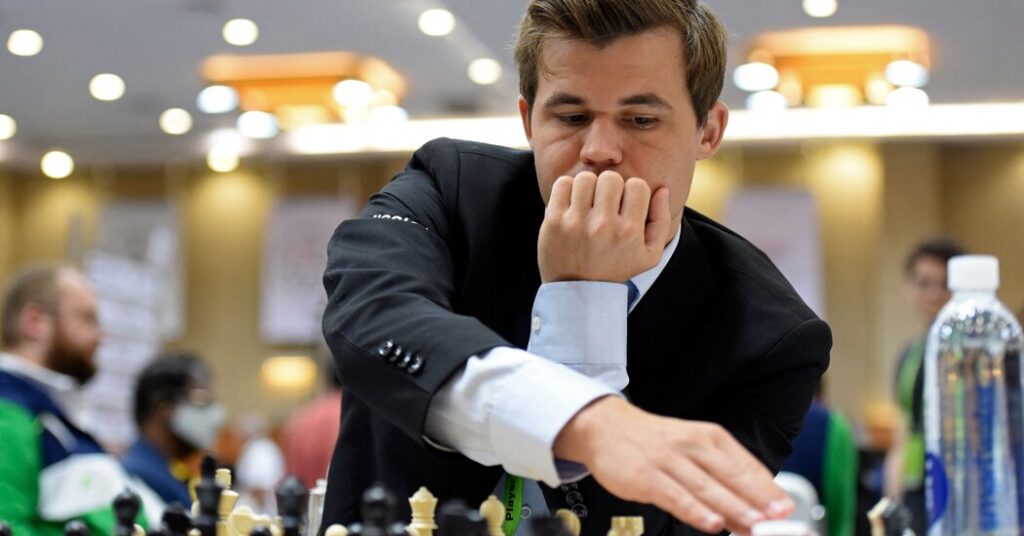
Mezrich traces the personal histories and circumstances leading up to a chess game played in September 2022 in St. Louis as part of the Sinquefield Cup, a major American tournament. It pitted Magnus Carlsen, a Norwegian grandmaster and the world’s top player for some 15 years, against Hans Niemann, a brash 19-year-old American grandmaster.
In a significant upset, Niemann won. But afterward, Carlsen insinuated that Niemann had cheated — and the top brass of Chess.com, one of the game’s most popular hubs, issued a report in which the editors stated that, in their opinion, Niemann had cheated more than 100 times while playing on the site.
The story roiled the insular world of chess, but might have ended there. Instead, a rumor circulated on social media that Niemann might have cheated by getting signals from an accomplice through a device that was vibrating in his anus — specifically, anal beads. It was irresistible comedy gold.
Niemann, incensed by what he saw as a conspiracy to trash his reputation and ruin his career, filed a $100 million lawsuit alleging libel and conspiracy against Carlsen, Chess.com, Danny Rensch (the chief chess officer of the company) and Hikaru Nakamura, one of the world’s top streamers. (The case was ultimately settled, and Carlsen issued a statement declaring that there was “no determinative evidence that Niemann cheated” in the Sinquefield Cup.)
The scandal had all the ingredients Mezrich looked for: “brilliant, quirky, sometimes shady characters; a billion-dollar, bootstrapped company; accusations of cheating, lying, betrayal; and maybe even a hint of a crime at its center.”
He dived in and did what he does best — sought out the principals in the contretemps and let them tell their side of the story.
Though Mezrich does not consider himself a journalist, he has done some excellent reporting. This is a particularly noteworthy accomplishment when it comes to Niemann, who is clearly a difficult and irascible subject. Mezrich teases out little-known facts — that Niemann’s mother was undergoing chemotherapy during the worst of the media storm; that he was banned from playing in St. Louis after trashing a hotel room — often channeling the young grandmaster’s voice with expletives.
Perhaps most impressive of all is a chapter devoted to tracking down the basis of the anal-bead rumor. Mezrich often speculates when conjuring scenes, based on what the players in the drama told him, and these re-creations are often deft and insightful.
Unfortunately, the subject at the heart of the story — chess — is not one that the author knows well, and in those sections of the book where he tries to explain the events of individual games, he can go wildly astray. The most egregious example is a match between Niemann and Samuel Sevian, another American, played during the U.S. Chess Championship a month after the Sinquefield. Mezrich incorrectly identifies how Niemann performed before the game, mistakes the name of the opening and references moves that were never made. (One detail that is true to life is the moment when, in the middle of the game, Sevian picked up Niemann’s king and snapped off its head.)
There are also errors in the book that have nothing to do with understanding chess, a carelessness that is hard to understand. Magnus Carlsen qualified for the world championship by winning a tournament in London, not New York; he never had a 53-match winning streak — certainly not one that ended with his loss to Niemann.
“Checkmate” is also rife with hyperbole. Carlsen, in Mezrich’s florid telling, has the capacity to calculate “to the end of the game, and often through the next game and the next game after that.” He also sprinkles words like “staggering” and “unprecedented” throughout the narrative, possibly to justify telling the story — or perhaps to ensure the sale of a screenplay.
Mezrich says that his hero is Hemingway, and, at times, this is all too obvious. In one scene set in a hotel, Erik Allebest, Chess.com’s chief executive (sporting a physique “too stereotypically masculine”), is lying on a bed adorned with pillows “embroidered and tasseled and frilled, like the upholstery version of some overly tattooed circus freak”; his colleague Danny Rensch talks loudly, because “it just felt good to talk in a way that made people listen.”
Mezrich is good at telling a story and in “Checkmate” he has a good one. The characters are compelling, the events dramatic and occasionally absurd. But in trying to achieve his goal of seeing it on a big screen, he has hustled it into print too quickly. In his acknowledgments, the author thanks “the brilliant folks in Hollywood who are working to turn this into what I believe will be an incredible film.”
CHECKMATE: Genius, Lies, Ambition, and the Biggest Scandal in Chess | By Ben Mezrich | Grand Central | 289 pp. | $30
The post A Chess Scandal Makes for Good Viewing but Mediocre Reading appeared first on New York Times.