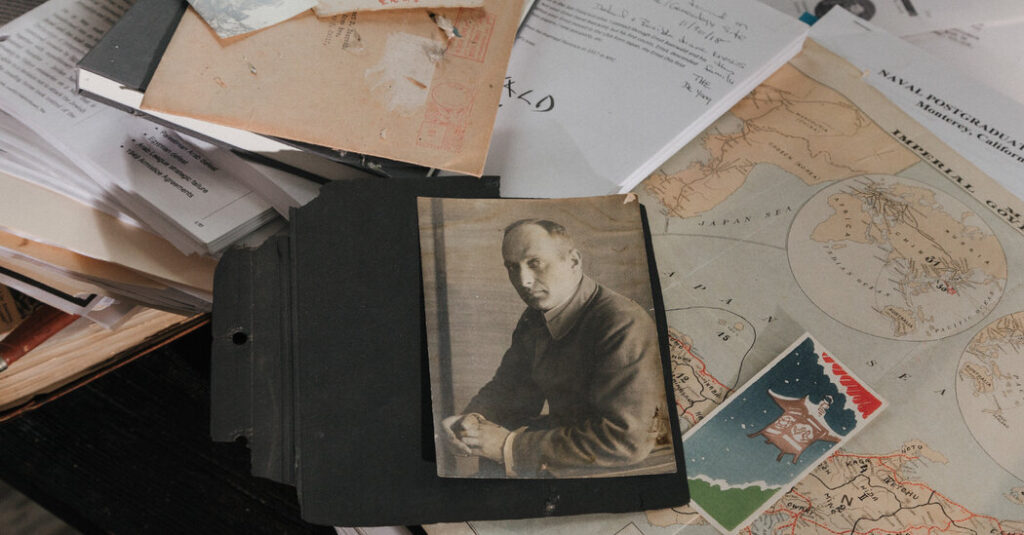
History caught up with David Baerwald one afternoon in 2017 in Los Angeles, as he was readying his childhood home for sale. That day Baerwald, the gravelly voiced musician who first hit it big with his platinum-selling album “Boomtown” when he was half of the 1980s duo David & David, made a startling discovery that would help him begin to piece together the truth about his shadowy grandfather, Ernst Baerwald. Buried in a carport storage unit, he found, was a trove of documents, among them letters and diaries, business and intelligence records, as well as photo albums. There was also a miniature Minox camera and a samurai sword. Together, they composed a portrait of a complicated man: a cultured German-Jewish aristocrat who had worked as an executive in a chemical company that became indispensable to the Third Reich, a soldier, a Buddhist and a European expat living among the highest levels of Japanese society. And a spy.
Over the next eight years, as Baerwald, 65, researched his grandfather’s story, he came to understand why his childhood had been shrouded “in an aura of shame and secrecy.” The result is his debut novel, “The Fire Agent,” published this week by Spiegel & Grau. Baerwald, who now lives in Kingston, N.Y., said writing a nearly 600-page novel was like “writing a song a day” — as he has co-written songs like “Leaving Las Vegas” and “All I Wanna Do” with Sheryl Crow and “Come What May” for Ewan McGregor and Nicole Kidman in “Moulin Rouge.”
“What I do as a singer-songwriter is find tells,” said Baerwald, comparing the process to writing fiction, “indications of a person’s character that tell what they couldn’t say.”
The soul-mining the novel demanded from Baerwald became a reckoning with his family, which as long as he could remember was in denial about the past. “Whenever Ernst’s name came up, my father would change the subject,” he said. Hans Baerwald wanted nothing to do with Ernst and his long association with I.G. Farben, the German chemical conglomerate that became a cornerstone of the Third Reich and the mass exterminations of the Nazi death camps.
Baerwald pulled out a photo his grandfather had taken in 1933 of Adolf Hitler moving through Berlin in an open car, when Ernst was on an official visit with Prince Fumimaro Konoe of Japan. As Ernst rose through the ranks at I.G. Farben — a company that once made him proud for its innovative initiatives in reversing a worldwide famine — he was also operating as a German spy. But the same year he took the photo, as fascism spread across Europe and the Far East, he switched allegiances — and his espionage skills — to the United States.
Until he resigned from I.G. Farben in 1938, Ernst’s position as head of its Asia division provided him with an ironclad cover. But it was also the perceived black mark on his résumé that, as far as Hans was concerned, made Ernst, who died in 1952, a taboo subject in the family, his belongings boxed up and hidden away. As Baerwald’s novel took shape, he came to recognize that his grandfather’s life, and his father’s, relegated devastating experiences to a willful forgetting, and created a legacy of inherited trauma.
“Sometimes,” he said, “it’s hard to tell what’s a new wound and what’s a scar.”
A Silken Tightrope
At 18, Ernst, a bright young man who sometimes ran with a rough crowd, was encouraged in the direction of espionage by his father. He spent the next nine years in Milan with a chemical firm that was eventually absorbed by I.G. Farben, while mastering Japanese, karate, the strict codes of honor of samurai swordsmanship and the double life of a spy. He took those skills with him when Farben posted him to Tokyo in 1910.
By the mid-1930s, Ernst’s faith in Farben eroded as he watched its alliance with the Nazis lead to the development of chemical agents for use in the gas chambers. He also obtained footage of Japan’s Unit 731, which was conducting lethal experiments on human subjects in occupied Manchuria. “It’s one of the places where the symbiotic relationship between big business and criminal war activities originated,” Baerwald said.
Ernst walked a silken tightrope operating undercover in the upper echelons of Japanese and expatriate European society. A consummate gentleman, together with his wife, Ottilie, he famously hosted salons with leading performers of the day and visitors like Albert Einstein, “a distant cousin,” Baerwald said, their names recorded in guest books that Ernst would take with him when he left Japan. In the novel, Baerwald added a second love interest, a beautiful Japanese fashion designer and spy entangled with both Ernst and his wife.
As the clouds of war gathered, Ernst sent his wife and son, Hans — called “Kurt” in the novel — to Switzerland and embarked on a perilous journey into the far reaches of his soul. Conscious that the U.S. military and the inchoate intelligence arm known as the O.S.S. would require extreme measures to defeat Japan and its far-flung spheres of influence, Ernst recognized that he had the kind of information required. And so he struck a bargain: American citizenship and relocation to the United States for his wife, son and himself in exchange for his intimate knowledge of Japan. It included access to the maps he compiled of the subterranean natural gas system that, under targeted bombardments, could erupt in firestorms that mimicked the 1923 Kanto earthquake on a far greater scale. Ernst signed on to destroy what he loved.
Initiated in 1944, the fire bombing of 67 Japanese cities resulted in more casualties than the atomic bombs dropped on Hiroshima and Nagasaki. Hans Baerwald, by then a young officer in the U.S. Army, was deployed to Tokyo in the horrific aftermath, an experience David Baerwald re-creates in the opening pages of “The Fire Agent.”
Eventful and panoramic in scope, the novel locates its mix of historical figures and imagined characters in a world hellbent on betraying the promise of 20th-century progress and humanistic values with unprecedented greed, violence and calculating descents into two world wars.
Above all, “The Fire Agent” is never untethered from Baerwald’s deepest concerns. “He uses a lot of the material to get at significant moral quandaries,” said the author Joseph Kanon, whose espionage novels share many elements with “The Fire Agent,” “and he uses historical fiction to figure out how we got to where we are now.”
The post A Songwriter’s Unspeakable Family Secret appeared first on New York Times.