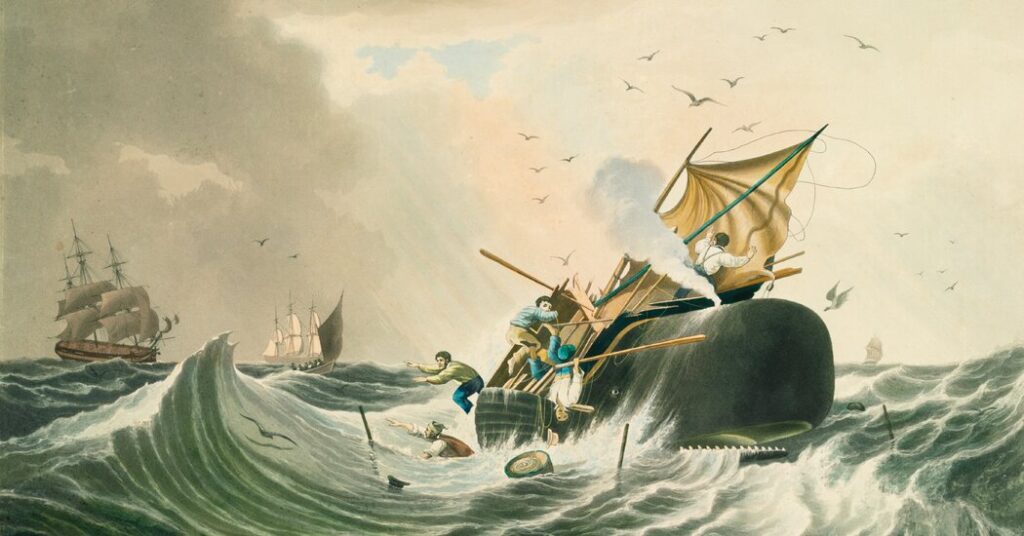
THE WRECK OF THE MENTOR: A True Story of Death, Despair, and Deliverance in the Age of Sail, by Eric Jay Dolin
It’s said that all stories fall into two categories: Someone goes on a journey, or a stranger comes to town. In his introduction to “The Wreck of the Mentor,” the true tale of an American whaling crew’s marooning on Palau in 1832, Eric Jay Dolin describes his book as an attempt at the second — a rare effort to view Western seafaring through the eyes of the people upon whose territory the ships encroached.
That the story of the Mentor’s wreck was not unique in its time does nothing to make the events less remarkable for the modern reader. The whaling ship crashed under thick clouds on the reef of the Pacific archipelago, which was inhabited by warring tribes. Survivors made their way to a tiny cay, where they were approached the next morning by a fleet of war canoes. Trouble ensued. Eventually the remaining sailors were enslaved by one of the warring tribes, and two years later — tattooed, emaciated and so weak that they could only crawl — they were rescued by a British merchant ship.
En route to this denouement, the book detours through the stories of two other shipwrecks of the era. In one case, the Europeans allied with the Palauans, exchanging guns for assistance in building a new ship and bringing home as an honored guest the chief’s son Lee Boo, who was reportedly delighted by all he encountered in London. In the case of the other ship, wrecked near the Mentor, all survivors were systematically killed.
Though most records of the Mentor’s journey were kept by Americans, Dolin tried, he writes, to balance those accounts with as much Palauan oral history as possible, a challenging task given that the Palauan population dropped precipitously after these events. Despite his efforts, Indigenous perspectives rarely come through in the text, which reads as if it could have been based entirely off Western accounts — rendering the introduction, which I excitedly read as a promise, into more of a disclaimer.
It is often striking, in reading the Western accounts, to see how eager Europeans were to use Palauan culture to prop up the then-popular idea of the noble savage — the idea that without the vices of civilization, Indigenous people were morally pure and lived in idyllic, uncomplicated ways. That they were simple, innocent, almost childlike. This, in the face of stark evidence of their innate complexity.
The book is at its strongest when Dolin turns an anthropologist’s eye not only on the Palauans, but also on the desperate sailors and the whaling societies whence they came. I wish he’d gone even further, resisting the temptation to treat Western culture as the default. True, most readers won’t be Palauan, but then, they won’t be 19th-century whalers, either.
At one point, Dolin describes a Palauan priestess as having 2-to-3-inch fingernails and wearing a braided skirt that falls like a horse’s mane. Her fellows are so interested in the whalers’ clothes that the latter, when fleeing an attack by canoe, throw their garments into the sea at intervals in the hopes that their attackers will stop to retrieve them.
We’ve seen the priestess’s cool skirt, but what are the sailors wearing (or, rather, removing) that’s so special? Are they in uniform? Sweaters? Shorts? An explicit parallel, even a brief one, would shed light on both groups’ experience of these encounters, and help in curbing the Eurocentrism that the author is attempting to resist.
“The Wreck of the Mentor” can, at times, feel more like a catalog than a story, presenting as it does — for pages at a stretch — sequential timelines of events. Who went where in what year? Who saw a whale when? Who gave whom oranges and a wife? People and places blur; more vivid characterizations would have brought them back into relief. Who were these individuals? What were their fears, quirks, dreams? We hardly know.
Take Captain Barnard, under whose command the Mentor wrecked ashore. Before this unfortunate excursion, we learn, he had captained several sailors who, given the opportunity, chose to sail with him again — indicating that he “was a decent master.” I clung to that rare characterization for the next 220 pages like a drowning man to a plank.
Still, “The Wreck of the Mentor” is a work of serious research and clean prose, and contains plenty of interesting illustrations that keep the pages turning fast. In presenting a detailed and respectful account of the encounters between Western sailors and the Indigenous residents of Palau, it excels — but doesn’t transcend. Landlubbers may find it too inside whaling; fans of maritime history will enjoy the ride.
THE WRECK OF THE MENTOR: A True Story of Death, Despair, and Deliverance in the Age of Sail | By Eric Jay Dolin | Liveright | 281 pp. | $27.99
The post A Tale of Shipwreck and Adventure on the High Seas appeared first on New York Times.