In July 1981, Cheryl Huston looked out the back window of her parents’ grocery store in Skidmore, Mo., and watched as a man was killed, shot multiple times as he sat behind the wheel in his pickup truck outside a local bar.
And then, she said, she went to make sure he was dead.
“There was a crowd of people there, and I was looking at him, and I said, ‘Oh, my God, if he’s not dead, they’re going to have to shoot him again,’” Huston said. “Or he’ll kill every one of those men.”
The dead man in the truck was Kenneth Rex McElroy, 47, known as a brutal local bully accused of everything from sexual assault to hog rustling. His slaying at the hands of an unknown assailant — or assailants — has echoed through this small town, and various threads of popular culture, for 45 years.
The reason for the lasting fascination is simple: The shooting occurred in midmorning sun, on Skidmore’s main drag, with all manner of witnesses near McElroy’s truck, including Huston, whose father had been shot in the neck by McElroy a year before.
And no one, it seems, saw who did it.
“They were looking under every stone, trying to dig something out,” said Huston, now 68. “And guess what? They didn’t find anything.”
In a nation with a seemingly unslakable thirst for true crime, the killing in Skidmore has spawned documentaries and dramatizations, including a 1991 TV movie starring Brian Dennehy, based on Harry MacLean’s best-selling 1988 nonfiction account, “In Broad Daylight.”
Podcasts like “Criminal” and others have dived in, and in 2019, the Sundance Channel aired a six-part series that essentially posited that a curse of violence had fallen on Skidmore after the town decided to go quiet about who shot McElroy.
Unable to find anyone willing to testify as to who pulled the trigger or triggers, the authorities repeatedly failed to secure an indictment, in McElroy’s slaying. And as the years have passed, the story of Skidmore — a farm town tucked into the rolling hills of northwest Missouri — has seemingly continued to resonate because of the twisty questions it raises: Was this a pure case of vigilantism — or justifiable homicide? Was justice denied — or delivered?
“The basic foundation of a civilized society is that the primary job of the government is to provide safety for the inhabitants,” MacLean said. “Once the government fails in its obligation, aren’t the citizens released from theirs?”
The most recent take on Skidmore comes from “Kenrex,” a “true crime thriller” imported from London and currently playing Off Broadway (through June 27), at the Lucille Lortel Theater in the West Village in Manhattan. It stars Jack Holden, who recently won an Olivier Award for best actor, England’s equivalent of the Tony, for portraying not only McElroy, but also dozens of other characters, most of whom are based on real people from the case.
Holden, who also co-wrote the play with Ed Stambollouian, said they were drawn to the crime, because “the ingredients were so strong: the characters, the location, the name of the town, the baddie.” He added: “And we liked that it was unsolved.”
In addition to podcasts and newspaper accounts, the team also leaned on an early 1980s segment about the crime on “60 Minutes,” in which a group of townspeople quietly admit that they would not tell the authorities who had killed McElroy, while seemingly acknowledging that most people knew who did it.
And as the “Kenrex” writers researched, they became increasingly intrigued that the various versions of the story contain differing details, including about McElroy himself.
“We were like, ‘OK, so this has sort of become mythic now,’” Holden said, of those discrepancies. “And therefore we felt slightly more permitted to approach it.”
Indeed, both men readily admit that parts of the play are pure fiction. And the real life prosecutor in the case, David Baird, who recently read the show’s script, concluded the same.
“I think they got three things right,” said Baird, 73, who is now retired and sat for an interview in his home in Liberty, Mo., about 100 miles southeast of Skidmore. “The crime happened in Nodaway County. Ken Rex McElroy ends up dead. And it happened in Skidmore, Missouri.”
“Beyond that,” he said, “none of it is factually correct.”
So Many Unknowns
Artistic license in service of a good murder story is nothing new, of course, a tradition that includes classics like “In Cold Blood,” set in another dusty rural Midwestern town.
What most interpretations of this case capture, however, is the pure level of fear seemingly inspired by McElroy, a burly, intimidating figure with a boogeyman-like reputation of killing people’s pets, burning their homes, and placing rattlesnakes in their mailboxes if they crossed him. He was known to sit outside the homes of his perceived enemies, or slowly drive past, revving the engine of his favorite truck, a tan-and-brown Silverado, or blasting out street lights.
“He would stop and just idle,” said Kim Swyers, 69, who was married to the town’s mayor at the time of the killing. “And then you would hear a gunshot.”
Local law enforcement had investigated McElroy for years for various crimes, including rape, livestock theft and child molestation. But according to “In Broad Daylight,” most cases faded “because the primary witness declined to prosecute, changed his or her story, or became unavailable for one reason or another.”
In 1976, for example, McElroy had been charged with shooting a man, Romaine Henry, in the abdomen, an attack that Henry described to “60 Minutes.”
“He more or less laid the barrel of that shotgun right against my stomach and pulled the trigger,” Henry says in the segment. “And when he did, why of course, it laid my flesh all open.”
But two alibi witnesses emerged at trial to say McElroy was with them at the time of the Henry shooting, and he was acquitted.
All of which, MacLean said in an interview, led to a feeling of helplessness in Skidmore, where modest houses with small lawns are dwarfed by surrounding corn and soybean fields.
“They had 20 years of proof that the law wasn’t going to protect them,” said MacLean, who spent six years researching and writing his book. “I hate to be that kind of dramatic, but it was that dramatic.”
At the time of his killing, McElroy, whose family farmed, had just been convicted of second-degree assault for shooting Huston’s father, Bo Bowenkamp, with a shotgun, at the Bowenkamps’ grocery store in 1980. (Bowenkamp remarkably survived, outliving McElroy by a decade.) That crime was apparently sparked by a minor grievance: an accusation, levied at one of McElroy’s children, over a piece of stolen candy.
Because of a quirk in Missouri law, McElroy was freed on bond even after he was found guilty, pending a possible appeal. (In the play, McElroy has not been convicted when he was killed, but rather is free while awaiting trial.)
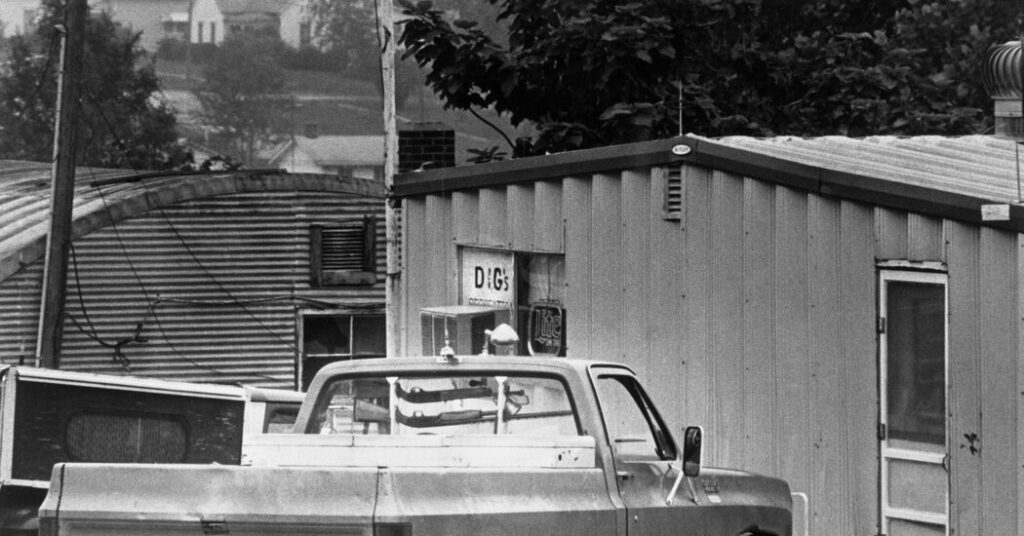
But on the morning of the murder — July 10, 1981 — McElroy faced the possibility of returning to county jail for violating his bond: He had brought a rifle, with a fixed bayonet, into the D & G Tavern just days after his conviction.
And townspeople — their exact numbers unknown — had gathered at an American Legion hall to discuss how to deal with McElroy, still on the streets, including possibly forming a community watch.
A hearing on possibly revoking McElroy’s bond had been scheduled for that morning, and several residents were ready to testify to help put McElroy back in jail. But a scheduling conflict had caused a court delay. And then came word that McElroy was at the tavern, along with his young wife, Trena, whom he had begun having sex with and impregnated when she was still underage.
A crowd of men filled the bar, as others stayed outside. McElroy emerged on the street, carrying a six-pack and displaying his usual bravado. He and Trena got into the Silverado, as some of the men followed him out. He opened a pack of cigarettes, and went to light one.
Then, shots.
Its unclear exactly how many bullets hit McElroy. At the time, Baird, the original prosecutor, said two to four, with a fatal wound to the top of McElroy’s skull. Similarly, it is unclear how many guns were used: Three different bullet types were recovered, according to ballistics tests.
What is certain is that nobody came forward to confess. In an interview last month, Baird said while a few witnesses initially told the authorities that they saw the shooter, they soon decided that they were mistaken, and started to equivocate:
“‘Ah, no, you misunderstood what I said,’” he recalled.
Baird convened a so-called coroner’s jury, similar to a grand jury, whereby the state presents its case, with no defense. At that hearing, Trena told six jurors who she thought shot Ken.
But the jury apparently didn’t believe her, Baird said, instead deciding that it was a “death by criminal means, person or persons unknown.” Subsequent attempts to bring an indictment, including by a county grand jury and after a federal investigation, also failed.
In his book, MacLean asserted that a local — Del Clement, a scion of a ranching family and a co-owner of the D & G Tavern — was believed to be one of the shooters, something that Trena believed, too, eventually filing a $5 million federal civil rights lawsuit against him, and others. It was eventually settled for $17,500.
Clement died in 2009. And shortly thereafter, Baird said he received a small plain envelope, with no return address.
“And inside was a folded up piece of paper that said, ‘Dear Mr. Baird, you can stop looking for the killer of Ken Rex McElroy,’” the prosecutor recalled. “‘We buried him last week.’”
A Source of Fame, or Infamy?
In the years since, Skidmore has witnessed a long, slow decline in its public life. The D & G Tavern is long gone, as is the American Legion hall. From its main intersection, much of what you see is crumbling buildings, including the one that once held the Bowenkamp grocery, replaced by a bar called Good Time Charlie’s. But it’s gone, too.
Many key players in the McElroy murder — now characters in “Kenrex” — have also died: Trena in 2012, her life with Ken unmentioned in her obituary. Romaine Henry, the man McElroy shot in the abdomen, died that same year. So did Richard McFadin, a Kansas City trial lawyer who represented McElroy, portrayed as a clever, conniving character in “Kenrex,” a literal song-and-dance man whom Holden seems to revel in playing.
While New York critics have been less impressed with “Kenrex” than their British counterparts, Holden won the Drama Desk Award in New York for outstanding solo performance last month. John Patrick Elliott, who performs his original country and rock score, also won for outstanding music in a play.
As is the way with every interpretation, the play has prompted discussion among the residents of Nodaway County, and the tiny towns therein, as to whether the McElroy murder is a source of fame, or infamy.
One former Skidmore resident, now 80, who was in the bar when the shooting started and asked to remain anonymous because he still lives in the community, says he worries about its reputation.
“That story is like Jesse James, it’s never going to die,” the man said.
Toney McElroy, 53, a former Marine and great-nephew of Kenneth Rex who lives across the state line in southern Iowa, said that family members had initially feared for their safety after the shooting, carrying pistols. But that had faded, though some in the area would still stop by to chat, in friendly terms, about his great-uncle, talking about his love of hunting and coonhounds.
“A lot of what his deal was was he just didn’t deal with disrespect,” he said, adding: “And if you picked on his family, you knew what the consequences were. And they were swift.”
He said he knew, too, that his great-uncle had done some bad things, but wondered if his killing wasn’t haunting Skidmore, saying “that bad energy just kind of follows along with you.”
“Reap what you sowed, you know what I mean?” he said. “You’re going have to deal with it for the rest of your lives until you somehow cleanse yourself of it, I guess.”
Even now, the case is technically still open, according to Tina Deiter, the current prosecuting attorney in Nodaway County. The case itself could move forward if anyone spoke up.
“It would be the same with any cold case, right?” she said. “If you get a clue, then the investigation restarts and here we go.”
In the meantime, however, the legend of that July morning continues to simmer in Skidmore. On a recent sunny afternoon, Huston sat outside the long-shuttered D & G Tavern, in almost the exact spot where McElroy died.
Would there ever be a break in the case, I asked her?
No, she said, with a faint smile.
“Most of the people that were here that day are gone,” she said. “But even the ones that are still alive, like me, aren’t going to say a word.”
Kirsten Noyes contributed research.
Jesse McKinley is a Times reporter covering politics, pop culture, lifestyle and the confluence of all three.
The post A Bully’s Murder, Still Unsolved, Is Revisited Onstage appeared first on New York Times.