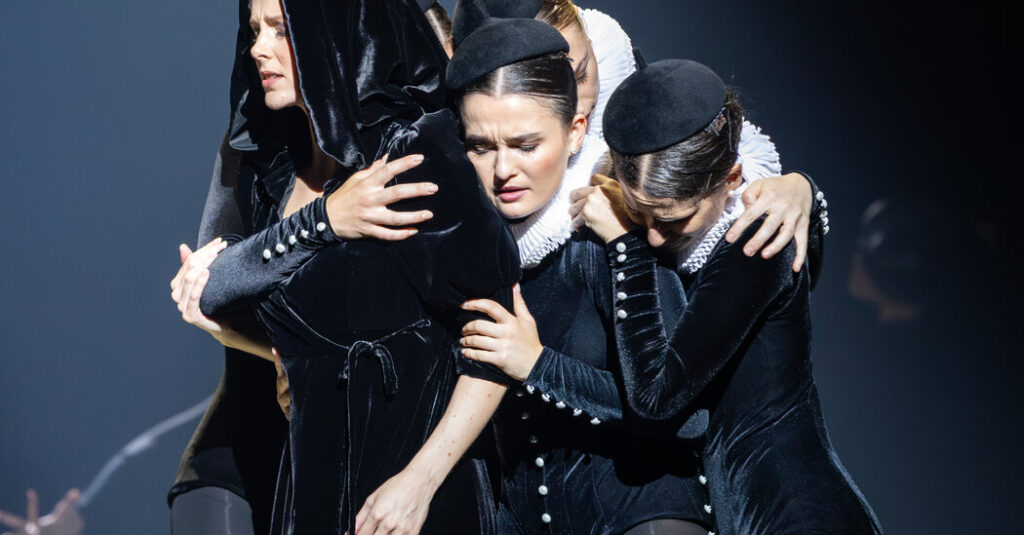
When Mena Mark Hanna went to Edinburgh in 2025 for the world premiere of Scottish Ballet’s “Mary, Queen of Scots,” he already knew that it would travel the next year to Spoleto Festival USA, for which he serves as general director. And so when he talked to the creative team, he had his home base of Charleston, S.C., in mind.
“I said to them, ‘One thing that American audiences are going to struggle with is that this is not a story they know,’” Hanna said.
Story ballets have become an artistically and financially fruitful export for Scottish Ballet, which over the last decade has toured full-length productions of works like “The Crucible,” “A Streetcar Named Desire” and a gender-fluid “Cinderella.”
But while the story of Mary Stuart is integral to Scottish history, it doesn’t have the same resonance for American audiences as “Crucible” or “Streetcar.” New York audiences can weigh in when “Mary, Queen of Scots” arrives on Thursday for a five-performance run at the David H. Koch Theater at Lincoln Center, after a stop in Charleston.
“That’s the puzzle,” said Christopher Hampson, Scottish Ballet’s artistic director.
Sophie Laplane, the ballet’s choreographer, said she grappled from the beginning with how deeply to delve into the life of Mary Stuart, who inherited the throne of Scotland when she was only 6 days old, was beheaded at 44 and packed several lifetimes’ worth of intrigue in between.
“We ended up with too much material,” she said. “The trick is to keep what is truly necessary for the story to be told.”
During almost two years of development, she and the work’s director, James Bonas, made some decisions: They would depict only two of Mary’s three husbands, and they came up with the idea of a Jester character who could break the fourth wall and connect directly with audiences. Since then, they have tweaked the work further with an eye toward the advice that Hanna gave in Edinburgh.
“These help a lot with clarity,” Laplane said of the changes. “More than just, ‘Now who are they?,’ they are also about their character and personality.” And so the Jester heralds the birth of Mary’s son, the future King James I of Bible revision fame, by writing “JAMES” on a balloon with a felt-tip marker. Mary’s second husband, Lord Darnley, gets an even bigger signifier in the form of a large foam DARNLEY hand pointing him out.
“I think the characters are really well introduced, one by one,” Hampson said. “And I feel like the audience is trying to make sense of it at the same time that Elizabeth does.”
“Elizabeth” is, of course, Queen Elizabeth I, Mary’s cousin and eventual executioner. This “Mary, Queen of Scots” is a fevered memory ballet told from Elizabeth’s guilt-ridden perspective, making her what Hampson described as the work’s “incredibly unreliable narrator.”
This structure also helps the creators skirt a problem that has plagued pretty much every fictional retelling of the two queens’ story, whether in theater (Schiller’s “Mary Stuart”) or opera (Donizetti’s “Maria Stuarda”) or film (“Mary Queen of Scots,” 2018): Despite 19 tumultuous years of correspondence and imprisonment, the two women never met.
“We studied the history but also the many ways that other artists have chosen to shape this narrative,” Bonas said. “It was instructive how everyone from Schiller on tried to make them meet somehow, which we were quite keen on not doing.”
Laplane described this perennial dramatic problem as an opportunity: “For us, it was great,” she said. “It really allowed us to imagine Mary so many different ways because it all comes through Elizabeth’s imagination.”
The company’s secret weapon on this front is the guest artist Charlotta Ofverholm, 60, who opens the ballet with a propulsive four-minute solo as the older iteration of Elizabeth and dives into the action throughout. (Harvey Littlefield plays the younger Elizabeth, one of several gender-swapped roles in the piece.) The assignment dovetails with Age on Stage, an advocacy project that Ofverholm established in Sweden to create visibility and opportunities for older dancers.
“Basically, my organization is myself,” Ofverholm said. In 2015, she celebrated her dance company’s 20th anniversary by inviting a group of dancers aged 50 and older — including Desmond Richardson, the former American Ballet Theater principal — to appear with her onstage. “When I planned the event, I realized this is a very good way to apply for money,” she said. With the help of European Union funding, she began developing workshops and performances for older dancers.
State-funded European ballet companies often mandate retirement at 42 (frequently with full pensions), but Ofverholm believes dancers have more to offer at that point. “I was amazing when I was 42 — I was at the peak of my career,” she said. “Why should I stop then? And I was even better at 50.”
Laplane and Bonas met with Ofverholm before “Mary, Queen of Scots” rehearsals to get a sense of how best to deploy her. “At first we didn’t know how much she would be involved in terms of movement, to be honest,” Laplane said. “But when we met her, it was very clear very fast that she would be physically involved.”
She added: “For our younger dancers to see someone of her age give 160 percent every single time is so inspiring.”
“We were really keen to work with someone who has had that level of experience,” said Bonas, who also has extensive experience as a stage director. “In the theater, we are more accustomed to seeing older performers on the stage.”
This cross-pollination is set to continue: Ofverholm, who describes herself and her fellow older dancers with the Swedish word “eldsjal” — roughly “fire souls” — said her next project would involve merging members of her company with some of the Scottish Ballet dancers.
Before that, though, Ofverholm’s efforts are devoted to helping Scotland’s national ballet company breathe life into a particularly meaningful chapter of its own history. “Scottish Ballet doing ‘Mary, Queen of Scots’ has its own sellability,” Hampson said. “It goes a long way toward telling audiences what sort of evening they might be getting.”
And not just audiences. Laplane described taking a taxi ride around Glasgow after the “Mary, Queen of Scots” posters had gone up. Even the driver wanted to know how they would stage Mary’s messy beheading.
“We didn’t know yet,” she said, “so we told him he would have come to see it.”
The post Her Cousin Had Her Beheaded. Will U.S. Ballet Audiences Get Why? appeared first on New York Times.