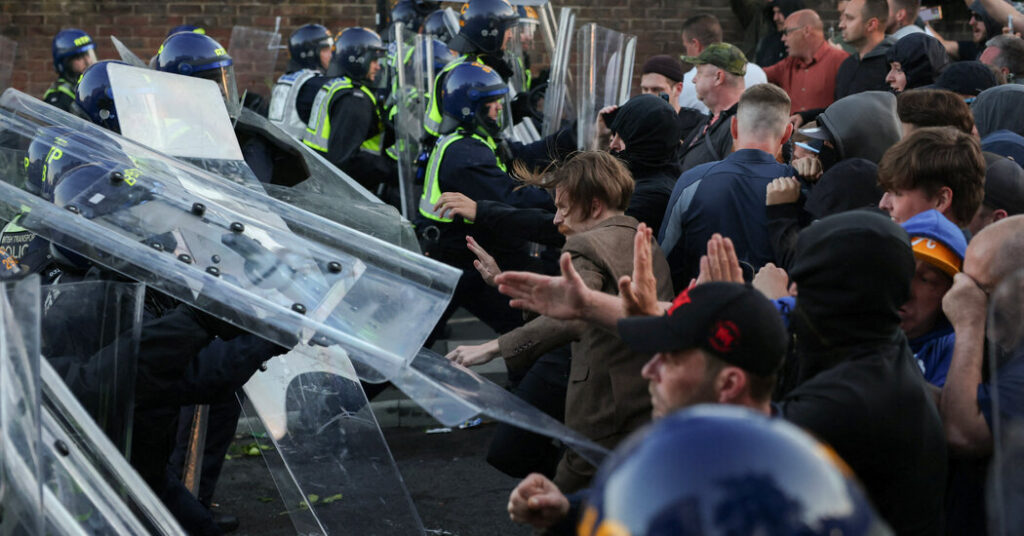
The police and lawmakers in Britain were urging calm on Wednesday morning after a night of protest that devolved into violence in the city of Southampton, in southern England, on the heels of a highly emotive murder case.
After footage was released on Monday evening of officers handcuffing a murder victim, Henry Nowak, while his attacker looked on last December, right-wing commentators and politicians made claims that the British police were biased against white people.
Hundreds of protesters gathered outside the main police station in Southampton on Tuesday evening. They then tried to enter the street where the killer’s family live and attacked officers who had blocked the road. Officers were also attacked elsewhere in the city. Footage shows protesters throwing rocks, flares and garbage cans at the police, and punching and kicking officers’ riot shields. Some of the demonstrators were draped in the British flag.
Shabana Mahmood, the British home secretary, who oversees policing, called the scenes “completely unacceptable.”
“There can be no justification for hijacking this tragedy to stir up violence and disorder,” Ms. Mahmood said in a statement. “Those responsible can expect to face the full force of the law.”
She also thanked the police “who have tonight shown great bravery and calm in the face of disgraceful violence directed at them.”
Eleven police officers were wounded in the violence, according to the Hampshire and Isle of Wight Constabulary, which oversees policing in Southampton.
Mr. Nowak, 18, was stabbed by his attacker, Vickrum Digwa, 23, in December 2025 after the two men had met in a chance encounter on the street in Southampton. Mr. Nowak had been returning to his college housing after a night out.
Mr. Digwa, who is Sikh, stabbed Mr. Nowak and then lied to the police, saying that he had been the victim of a racist attack. Mr. Digwa was sentenced to life in prison on Monday. After his sentencing, police body-camera footage was released, showing officers handcuffing Mr. Nowak as he lay dying.
Police officers arrested and handcuffed Mr. Nowak for about a minute before they realized that he was severely wounded and began administering first aid, the judge said in court at Mr. Digwa’s sentencing.
The case has been seized upon by far-right activists online and by Nigel Farage, leader of the right-wing populist Reform U.K. party.
In a video posted on Reform’s social media sites on Tuesday, Mr. Farage claimed that the British police had “anti-white prejudice” and encouraged his followers to “respond with pure cold rage.” His statements were condemned as divisive by lawmakers from across the political establishment.
Prime Minister Keir Starmer, speaking in a televised interview from Downing Street on Tuesday evening, said that Mr. Farage was “completely wrong to use this to try and create division.”
“He would be wrong in any circumstances, but when Henry’s family are saying, ‘Please don’t do that, it’s our son’, then really, as politicians, as human beings, we should start where they start.”
Tommy Robinson, a far-right agitator with multiple criminal convictions, posted calls online for people to gather in Southampton on Tuesday night and spoke at the gathering outside the police station. Mr. Robinson, whose real name is Stephen Yaxley-Lennon, asserted that a “whole race” had been “betrayed” by policing in Britain.
The case has put a spotlight on Britain’s police. Some members of the opposition Conservatives, including Chris Philp, who speaks for the party on law and order issues, have criticized a 2022 Police Race Action plan that included language on tackling racial inequalities in police responses. The document is not a formal policy or training paper for officers.
The National Police Chiefs’ Council, the body that coordinates police forces nationally, said on Tuesday that it would review its antiracism guidance to ensure clarity.
Chief Constable Gavin Stephens, chair of the council, said in a statement on Tuesday that it was essential “that we police without fear or favor in keeping the peace and enforcing the law. We must do so to earn the confidence of all communities.”
He noted that police forces nationally had been urged to renew efforts to address racism and discrimination.
“We are listening to legitimate concerns about how some of these commitments are worded or phrased, and, where needed, we can and will make changes, but this should not detract from the intent, which is to improve the quality of policing,” he said.
Megan Specia reports on Britain, Ireland and the Ukraine war for The Times. She is based in London.
The post U.K. Protests Over Murder Case Turn Violent, as Leaders Urge Calm appeared first on New York Times.