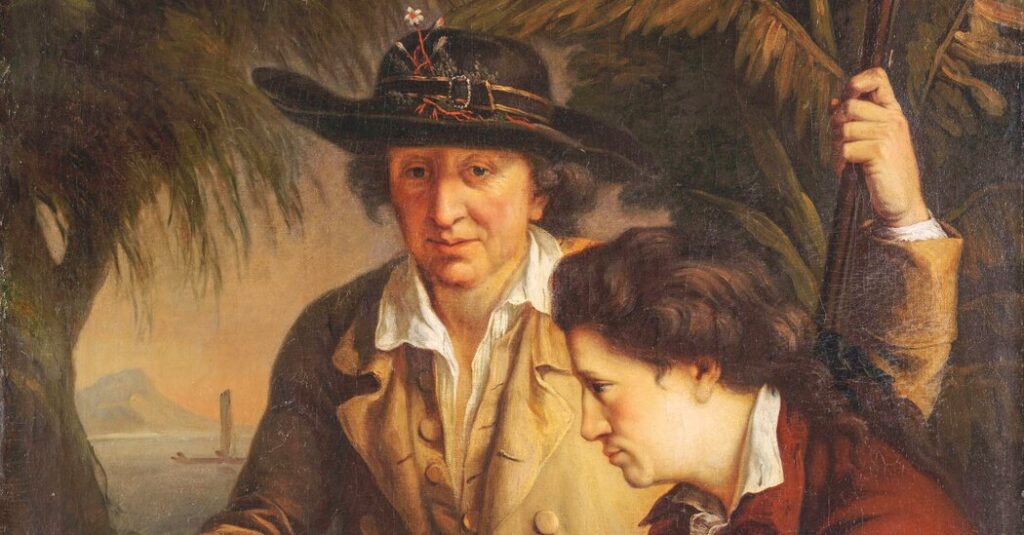
THE TRAVELER: One Man’s Quest for Humanity From the South Seas to Revolutionary Paris, by Andrea Wulf
George Forster is one of the most fascinating figures you have probably never heard of. He was a naturalist, a humanist, an explorer and a revolutionary. His intellectual and emotional journey began in 1772, when he was still a teenager. For three years and 18 days, he sailed on Capt. James Cook’s second voyage to the South Seas, a young man both enthralled and horrified by what he saw.
The 17-year-old Forster had been recruited to the trip by his father, Reinhold, a Lutheran pastor with a bad temper and scientific ambitions. Reinhold and George collected shells, dried plants and animals preserved in alcohol. George made pencil sketches and watercolors. The journey was treacherous, but he delighted in the lush landscapes and the many islanders they encountered. What appalled him was the behavior of his fellow Europeans.
“They have expressed a horrid eagerness to fire upon the natives on the slightest pretenses,” he wrote in 1773. The following year, when one of Cook’s marines murdered a man in Vanuatu, George had seen enough to identify a dreadful pattern: “Instead of making amends at this place for the many rash acts which we had perpetrated at almost every island in our course, we had wantonly made it the scene of the greatest cruelty.”
Forster is the vibrant subject of Andrea Wulf’s “The Traveler,” a lively new book that hums with her characteristic verve. Wulf first encountered Forster’s name while researching previous books on the naturalist Alexander von Humboldt and the early German Romantics. She was intrigued. Who was this 18th-century man who criticized an “unfair difference between the sexes” and promoted an early concept of human rights? A gifted linguist, Forster also noticed connections between the languages of the South Pacific, developing a theory of Polynesian migration that would be proved some 200 years later. He became enamored with the French Revolution and tried to bring it to Germany. “The Traveler” thrillingly revives the forgotten life of this “liberal thinker far ahead of his time.”
Born in 1754 in a Prussian backwater, Forster was a sickly child who would get little by way of formal schooling. His restless father, dreaming of money and adventure, applied to be a surveyor of German settlements in Russia and took little George on his first expedition when he was 10.
Reinhold was a constant and infuriating presence in George’s life, showing him the world while also forcing him to help provide for the entire family — sometimes all by himself, since the volatile Reinhold often had a hard time holding down a job. By the time George was 12, he was living with his father in London, translating texts as Reinhold’s “keen-eyed assistant.” The two briefly separated after Reinhold accepted a teaching job in the north of England (from which he would be fired less than two years later), placing George in an apprenticeship with a London merchant. But when George’s mother and six younger siblings arrived in London from Prussia three months later, the ever-capable George met them and ferried them north to reunite the family: a “12-year-old boy,” Wulf notes, “in charge of seven other people.”
Cook’s voyage was inevitably transformative. Forster started out with the basic suite of colonial prejudices, complaining about “ignorance and barbarism.” Soon, though, he began writing attentively about the islanders he met, noting their generosity and intelligence. This isn’t to say that he was naïvely sentimental; he objected to Rousseau’s idealized notion of the “noble savage,” which he deemed a figment of the philosopher’s lofty imagination. Violence and conflict weren’t exclusive to “civilization.” He observed that everyone, whether islander or European, was beautifully, frustratingly human.
When Cook’s men encountered resistance, they would speak of intransigent natives. Forster, however, not infrequently empathized with islanders who tried to defend themselves. Imagine that a bunch of strangers arrived on one’s shores and started waving guns around while making demands: “Surely from all appearances these people had a right to look at our men as a set of invaders.”
Forster recounted all of this and more in his “A Voyage Round the World,” which Reinhold pressured him to write after they returned to London and before Cook published his own account. The experience of writing the book was miserable for George; his health had already been worn down by the dangerous voyage, and he was resentful that the authoritarian Reinhold was, yet again, burdening him with so much responsibility.
But Forster wrote with such energy and immediacy that the result is anything but dour and dutiful. He marveled at the world, with its “cackling” petrels and woods “enlivened” by flowers. Even the turbulent sea left him awe-struck rather than fearful. “The sea appeared luminous,” he wrote, “particularly the tops of the waves and part of the ship’s wake, which were illuminated by a mass of pure light.” He didn’t see the point in being a “mere compiler” of data; he wrote exuberantly and poetically — all the better to capture his experience of the world as an exhilarating, resonant whole.
It shouldn’t be surprising that a man who was so receptive to new ideas and new adventures would lead an interesting life, to say the least. Wulf writes movingly about Forster’s unconventional marriage and his unconventional politics. He was helplessly in love with his wife, Therese, while also demonstrating an unusual forbearance when it came to her serious relationships with other men. When Forster’s revolutionary activities made him persona non grata in counterrevolutionary Germany, he ended up stranded in Paris during the Reign of Terror. Wulf recounts these events so nimbly that it would be rude to ruin the suspense with a spoiler.
Forster is such a memorable character that his posthumous obscurity is at least as great a mystery as his open-mindedness. Wulf points out that he ended up politically homeless, with few who were eager to promote his legacy — a German in France, increasingly disgusted by the Terror, and a traitor in Germany, shunned by a number of his contemporaries. In England, he was also out of step with the dominant culture of the time. “A German who had criticized Britain’s imperial ambitions was never going to be popular,” Wulf writes.
Yet it is invigorating, especially now, to read him observing, thinking and enthusing on the page. Forster found solace in the possibilities of human subjectivity, in our potential to see the world from a variety of perspectives — in “reason, feeling and imagination,” he wrote in 1791, “united in the most beautiful dance.”
THE TRAVELER: One Man’s Quest for Humanity From the South Seas to Revolutionary Paris | By Andrea Wulf | Knopf | 484 pp. | $38
Jennifer Szalai is the nonfiction book critic for The Times.
The post Meet the Astounding Teenager Who Sailed the World With Captain Cook appeared first on New York Times.