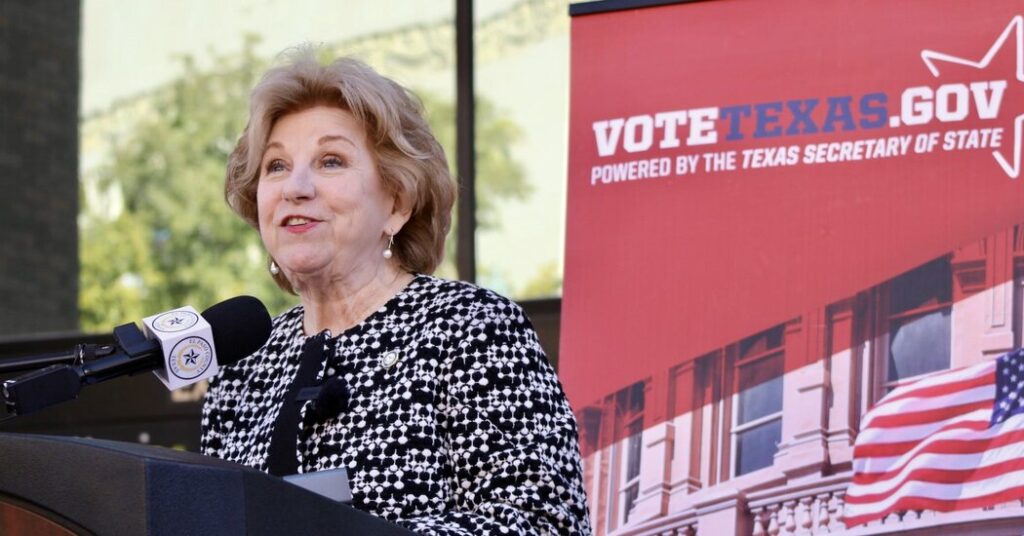
The top election official in Texas, Jane Nelson, is stepping down next month, raising questions about why she is departing and who will administer the state’s most closely watched election in a decade.
Ms. Nelson will serve as Texas secretary of state through July 17, formally resigning less than four months before the general election, her agency announced Tuesday. No further details were provided about why Ms. Nelson was leaving or who would replace her.
Gov. Greg Abbott, who appoints the person in the role, tapped Ms. Nelson for the job in 2023. A spokesman for the governor declined to provide additional information about her departure, saying only that an announcement would “be made at a later date.”
Every statewide elected office is on the ballot this year, and the marquee matchup between Ken Paxton and James Talarico for the U.S. Senate is shaping up to be one of the most expensive and contested races of the year. In that contest, Mr. Talarico, the Democrat, is hoping to end his party’s 30-plus-year losing streak at the top of the ticket.
Ms. Nelson is also departing with a handful of lawsuits pending against her agency relating to voting access. Voting rights groups sued over the state’s use of the Systematic Alien Verification for Entitlements program, or SAVE, a federal database meant to determine citizenship status, saying it could disenfranchise eligible voters by falsely flagging them as noncitizens.
Ms. Nelson also found herself at odds with fellow Republicans over the state’s primary elections system. Last year, the Republican Party of Texas sued Ms. Nelson, arguing that the state should allow political parties to bar voters who are not officially affiliated with their party from voting in their primaries. Mr. Paxton, the Texas attorney general and the state’s Republican nominee for the Senate, sided with the state party soon after.
While Ms. Nelson said she did not oppose the concept, she defended the law in court.
The agency’s announcement noted that Ms. Nelson had overseen seven statewide elections in which 27 million votes were cast. The secretary of state’s office also handles millions of corporate filings and administers millions of dollars in grants.
Kendall Scudder, the chairman of the Texas Democratic Party, applauded Ms. Nelson’s departure, saying her tenure was “marked by controversy and mismanagement.”
Mr. Abbott appointed Ms. Nelson after years of turmoil involving the office’s previous occupants. One former secretary, David Whitley, resigned in 2019 after less than a year in the role, after a review of the state’s voter rolls incorrectly flagged tens of thousands of eligible voters.
Mr. Abbott’s next pick was forced to resign after the Texas State Senate, which must approve his appointees, did not take up her nomination. The governor’s next choice served about a year before Ms. Nelson, a longtime state senator who was the chairwoman of the chamber’s powerful budgetary committee, was chosen.
“Representing Texas on the world stage has been a tremendous honor, and it has been incredibly special to Texas’ continued rise in prominence as the nation’s premiere state for doing business,” Ms. Nelson said in a statement. “Texas is thriving, and the world is taking notice.”
The announcement did not say what Ms. Nelson would do next. An agency spokesperson declined to comment.
Lauren McGaughy is the Texas politics correspondent for The New York Times, writing about the ways that policymakers in the second largest state are changing lives for their citizens and influencing American politics.
The post Top Texas Election Official to Resign, Months Before General Contest appeared first on New York Times.