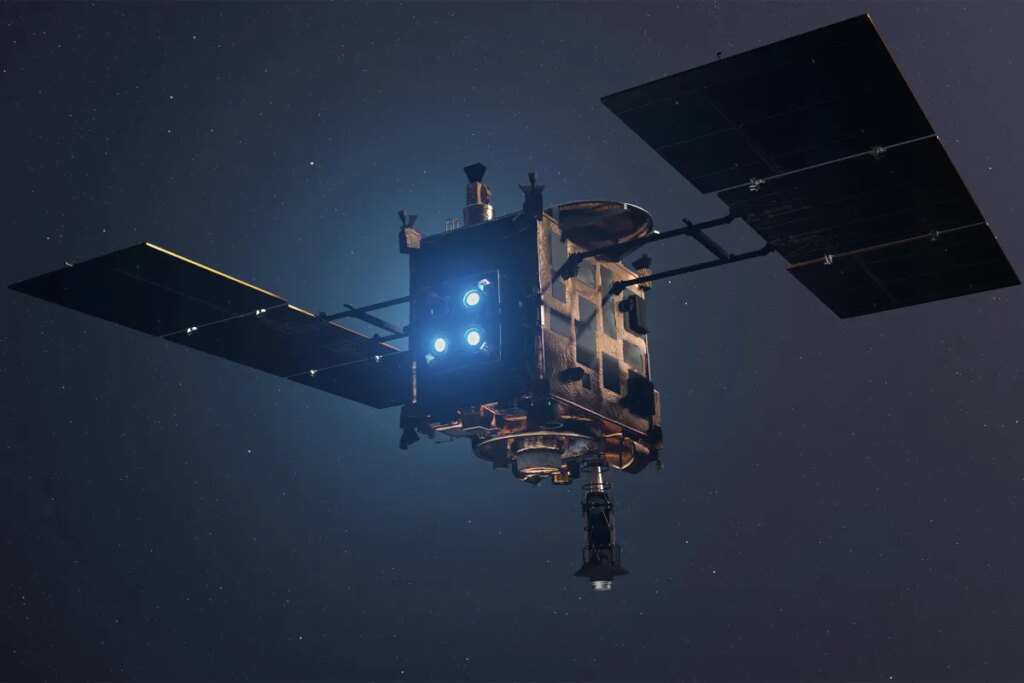
After successfully rendezvousing with near-Earth asteroid Ryugu in June 2018 and sending a sampled cache of rocks back to Earth, Japan’s Hayabusa2 spacecraft is now making its long journey to its next destination, a tiny and rapidly spinning asteroid dubbed 1998 KY26.
The spacecraft is expected to reach the mysterious space rock by July 2031, giving scientists plenty of time to come up with theories as to what it could find once it gets there.
1998 KY26 is an intriguing new candidate for an entirely new class of objects. In 2017, interstellar visitor ‘Oumuamua — the first object from beyond the solar system to have ever been observed — inspired scientists to categorize it as a “dark comet,” a class of asteroids that share some behaviors with comets. (A brief refresher: asteroids are lumps of rock, ice or dust that orbit the Sun but are too small to be classified as planets, while comets are “dirty snowballs” that release gases to form a tail behind them as they pass by the Sun.)
Scientists suggest 1998 KY26 could also be a dark comet, making Hayabusa2’s visit five years from now an intriguing opportunity to get a closer look.
But according to Harvard astronomer Avi Loeb, who has spent years pondering the nature of ‘Oumuamua and its unusual behavior, 1998 KY26 could be something else entirely. As detailed in a yet-to-be-peer-reviewed paper, Loeb and his colleagues suggest the object could instead be a long-lost relic of the Soviet space program.
“In particular, we identify it as potentially a relic of a historical Russian mission to Mars, the Phobos 1 probe, which suffered a failure 2 months after the launch in July 1988, due to upload of a faulty command,” Loeb explained in a blog post this week.
Phobos 1 failed to send back a signal in August 1988 due to what later turned out to be a typo — a missing hyphen — in a command that shut down crucial systems.
In their latest paper, Loeb and his colleagues suggest that the probe’s thruster firings may have put it in a “similar” orbit to 1998 KY26’s, and that the “two orbits converge and are statistically compatible.” The researchers also argue that the defunct spacecraft and dark comet share roughly the same size and a “quite elongated” shape.
Still, the hypothesis is quite a stretch, given the vastness of space. However, in his blog post, Loeb argued that scientists should nonetheless extend their “training data set to include not just rocks and icebergs but also the space objects launched by humans over the past 69 years” just in case.
If 1998 KY26 does turn out to be technological in nature, Loeb argued that the finding could support his controversial theory that ‘Oumuamua may have also been a piece of technology sent to us by an advanced extraterrestrial civilization.
“I wonder whether the mainstream of comet experts will acknowledge that 1I/’Oumuamua may have not been a natural ‘dark comet’ if it becomes clear that their so-called ‘dark comet’ 1998 KY26 is technological in origin, beyond any reasonable doubt,” he pondered.
Nobody knows for sure what Hayabusa2 will find. Besides, thanks to the asteroid’s extremely fast spin, it could prove extremely difficult to land on.
But Loeb and his colleagues argue we should keep an open mind, just in case it turned out to be a long-lost Soviet era spacecraft.
“In anticipation of the Hayabusa2 observations in 2031, which will be decisive in resolving the origin of this object, we encourage further observational, dynamical, and theoretical studies aimed at more tightly constraining the nature and properties of 1998 KY26,” they concluded in their paper.
More on Hayabusa2: Scientist Left “Speechless” After Opening Asteroid Samples
The post Paper Claims the “Asteroid” Japan’s Probe Is Approaching Is Actually a Derelict Spacecraft appeared first on Futurism.