Dropping a tribute to Ridley Scott’s 1979 “Alien” halfway through his franchise-expanding series wasn’t easy. But Noah Hawley just had to do it.
“The show was already a huge lift, and then to sort of make a movie in the middle of it was a challenge for everyone,” says the “Alien: Earth” showrunner, who wrote and directed the episode “In Space, No One …”
“I was trying to do New Alien, and then I thought, I can’t really pass up the opportunity to do my own trapped-on-a-spaceship ‘Alien’ show,” Hawley adds. “If you look at the franchise, you have some of the greatest directors of all time: Ridley, James Cameron, David Fincher. I wanted to throw my hat in the ring and play in the classic waters as well.”
Set two years before the original film, “Alien: Earth” mostly unfolds on our home planet, which has been carved into five giant tech companies’ spheres of influence. Complications commence when a space research vessel smashes into Prodigy Corp.-controlled Bangkok.
The wrecked Maginot is owned by Weyland-Yutani, the same group that operates the tug hauler Nostromo on which “Alien” unfolds. Glimpsed in “Alien: Earth’s” first episode, the Maginot had to be fully fitted out for Episode 5’s flashback to the onboard horror that preceded the crash-landing.
Along with such franchise tropes as face-huggers and rampaging xenomorphs, ship design was the key area where homage overtook the series’ emphasis on new locations, lifeforms and themes.
“I thought it was important that the Maginot and the Nostromo be of the same generation of ships,” says Hawley, who has ample experience referencing a classic film with his “Fargo” series. “That mess hall is as close to an exact copy as we can make it. The bridge is almost exact. The Mother communications room was expanded a bit to put that door in the floor for a gag. Otherwise, the idea is you want to feel like you’re back in that world, authentically.”
It was Andy Nicholson’s job to recapture that ’79 feel in a new way. The Oscar-nominated “Gravity” production designer, who cites “Alien” as the first film that made him cognizant of his future craft, says the research-heavy effort was similar to doing a period piece.
“The first ‘Alien’ was a production-design benchmark in terms of what it did with space interiors, how intricate the sets were, their importance as parts of the show,” the English designer says from the set of a new film project, “Ibelin,” in Norway. “So it was an enormous amount of pressure, and also respect, where I was coming from.”
Nicholson’s team examined a pristine print of the film frame by frame. Though much of the episode was drawn up before access to Disney’s massive “Alien” production archive was facilitated, maddening marathons of detail-checking became common.
“I drove people insane looking at things like how tall Harry Dean Stanton and Yaphet Kotto were,” Nicholson says of the two “Alien” actors. “Harry’s 5’9”, Yaphet’s 6’3” and is always bending over, so from that you can calculate the corridors’ height.”
At an auction, Nicholson found a large, versatile plastic truck pallet that was among many used for the Nostromo’s interior walls. Thousands were precisely reproduced for the cleaner enclosures of the Maginot’s scientific mission.
Arcane semiotics throughout the ship were carefully reproduced. The Mother room, with its 1979 notions of what 22nd century computer technology would look like, was copied down to now-primitive cathode ray screens (sourced from a Chinese manufacturer that still makes them).
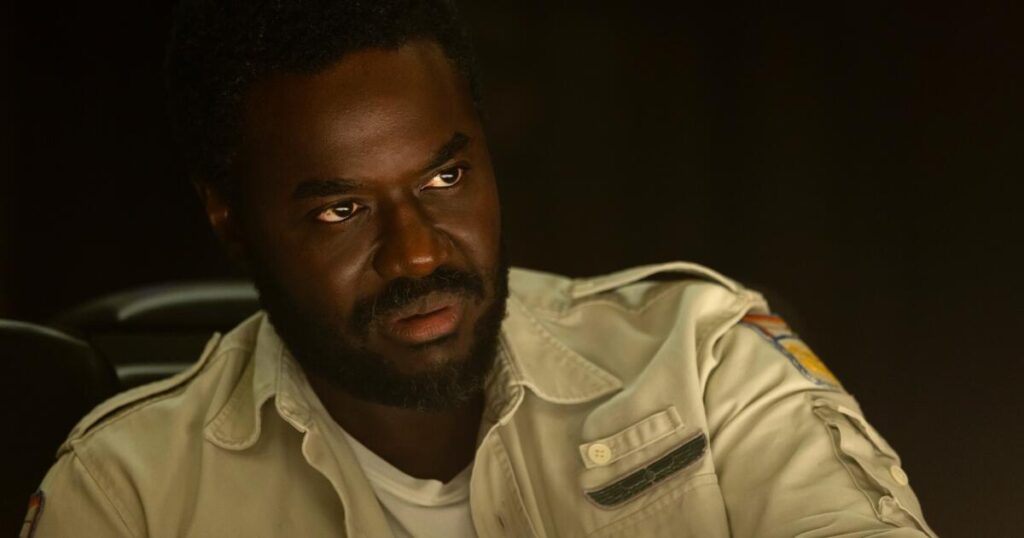
“My first day of filming, I walked into the Mother room and it was like, whoa,” Babou Ceesay, who plays the Maginot’s implacable security officer and only surviving crewmember Morrow, notes from his home in Gambia. “On the bridge, you could click everything on and off. It was like walking onto the 1979 film.”
New wrinkles, such as an extended cryopod chamber for the Maginot’s larger crew, were needed as well.
The “zoo,” in which otherworldly lifeforms such as socket-seeking eye midges and toxic gas ticks are kept, is a smaller version of Prodigy’s containment lab on Earth. Of course, the critters escape and run amok; the show’s faster, sometimes drone-shot xenomorph chases required longer corridors than hide-and-seek-oriented “Alien’s,” some 160-feet-plus.
One of three Bangkok studios the “Alien: Earth” production occupied housed the zoo, mess hall and engineering room sets and their interconnecting corridors on a single stage.
Besides requiring a separate environment from the rest of the series, “In Space” delves into (and picks off) an entirely different cast — all within, remarkably, an hourlong runtime. Ceesay got in some mitigating backstory for his otherwise despicable, cyborg-armed Yutani loyalist.
“Morrow comes back from this 65-year space mission to no family, a daughter he couldn’t have saved,” the actor notes. “He’s sitting on a volcano of emotions that he hasn’t dealt with. He does some pretty horrendous things, but I think people softened up to Morrow because they saw that human side.”
Morrow even spits out a reference to “the f— cat,” “Alien’s” most beloved earthling. Hawley made “In Space” for those who know.
“My hope is that this episode plays as a reward for fans who came to the show maybe thinking that this would be eight hours of classic ‘Alien,’” he says. “We were doing a lot of world-building, there was more thematic and character work — you know, all the stuff that’s critical for a television show.
“The films have a specific rhythm that we weren’t doing. And so my hope was that after four hours, if you get an ‘Alien’ movie you’re gonna feel like this was worth the wait.”
The post In homage to the original, ‘Alien: Earth’ made a 64-minute ‘Alien’ movie. Here’s how appeared first on Los Angeles Times.