Kenya’s high court on Tuesday effectively delayed by three more weeks the Trump administration’s plan to set up a quarantine unit in the country for Americans exposed to Ebola, dealing a new setback to a project that has sparked angry protests among Kenyans.
A judge at the court, the Hon. Lady Justice Patricia Nyaundi, said in a ruling that the next proceedings in the case would not take place until June 23, at which point a date for a full hearing would be set — in effect, delaying any action on the matter until then. The court suspended the plan for the facility last week, after the Katiba Institute, a Kenyan civil society group, filed a petition challenging its constitutionality.
The court also ordered Kenya’s government to provide, within seven days, full details of the terms of the agreement it struck with the United States to set up the facility, including any financial arrangements and measures to protect the Kenyan population.
As part of its response to the Ebola outbreak in the Democratic Republic of Congo, the Trump administration announced last week that it would prevent any American citizens exposed to the virus from returning to the United States for observation and treatment. That decision, a departure from U.S. policy during previous outbreaks of the virus, has shocked many health experts.
U.S. officials also said that a 50-bed quarantine unit would be set up at Laikipia Air Base in central Kenya, for Americans exposed to Ebola during the outbreak.
That proposal has become a political headache for President William Ruto of Kenya, who faces a tough re-election battle next year. His political opponents have accused him of bowing to U.S. pressure and recklessly risking the spread of Ebola in Kenya, which has never registered a case of the virus.
Critics are particularly incensed because U.S. officials said last week that the unit would only treat Americans. The top civil servant in Kenya’s health ministry, Dr. Ouma Oluga, said on Monday that the treatment facility would also be open to Kenyans. U.S. officials did not immediately comment on that statement.
Mr. Ruto has defended his decision to agree to the facility, attempting to set it in the context of decades of U.S. support for Kenya’s health care system, and arguing that Kenya is well prepared should it have to deal with a potential Ebola case.
“I gave the OK because it was an agreement and a partnership with friends who have walked with Kenya for 30 or 40 years,” Mr. Ruto told journalists in the northern town of Wajir on Monday.
“The American government has supported us,” he added. “They have deployed huge resources in Kenya to work with us on H.I.V., AIDS, to work with us on other diseases.”
In practice, health experts say any public health risk from the Ebola unit would likely be negligible, because it would follow stringent international health protocols under which any person suspected of being infected is isolated. And when the United States set up state-of-the-art Ebola treatment centers in Liberia during an epidemic in 2014, they barely treated any patients.
But the speed and the scale of the latest outbreak, and images circulating on social media of people sick with Ebola in other African countries, have raised powerful fears in Kenya. The World Health Organization on Tuesday confirmed 330 cases and 49 deaths from the outbreak, and many more cases are suspected. Almost all of the cases and deaths have been in Congo, with a handful in Uganda.
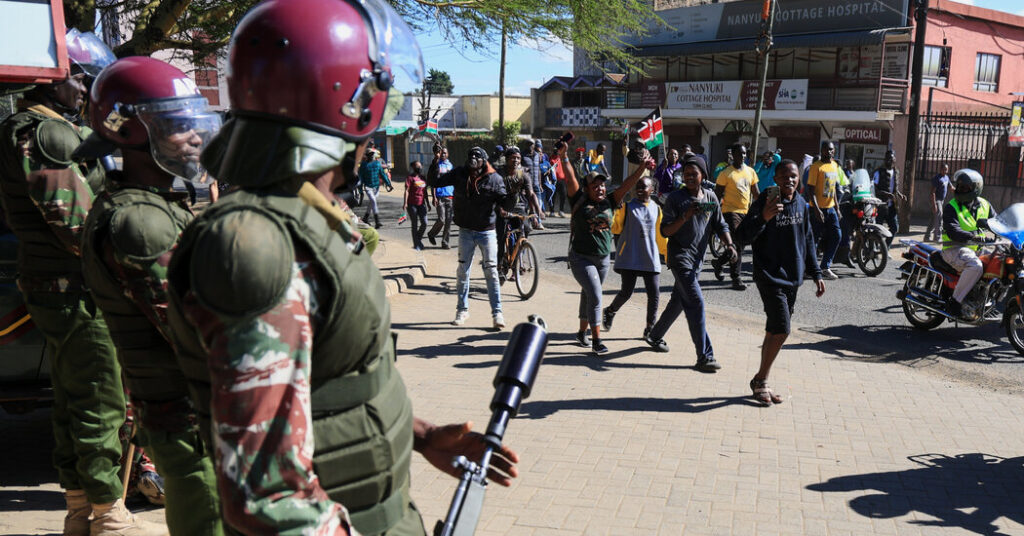
On Monday, hundreds of people marched through the streets of Nanyuki, the town closest to the air base, protesting against the plan to build the quarantine unit. The police fired tear gas, and Kenya’s military deployed an armored personnel carrier to prevent demonstrators from approaching the base.
Mr. Ruto’s decision to permit the unit reflects a strong strategic partnership between Kenya and the United States that has deepened in recent years.
President Joseph R. Biden designated Kenya a major non-NATO ally in 2024, and Mr. Ruto’s government deployed hundreds of police officers to Haiti that same year, in a mission sanctioned by the United Nations and largely financed and organized by the United States. The officers have since returned home.
The Kenyan decision also shows how African leaders have tried to cultivate ties with the Trump administration, even at the risk of domestic political blowback. Several African countries have participated in the administration’s so-called third-country deportation policy, in which countries take in immigrants deported from the United States even though they are not nationals of the receiving country.
Matthew Mpoke Bigg is the East Africa bureau chief for The New York Times, based in Nairobi, Kenya.
The post Kenyan Court Deals New Blow to Plans for U.S. Ebola Unit appeared first on New York Times.