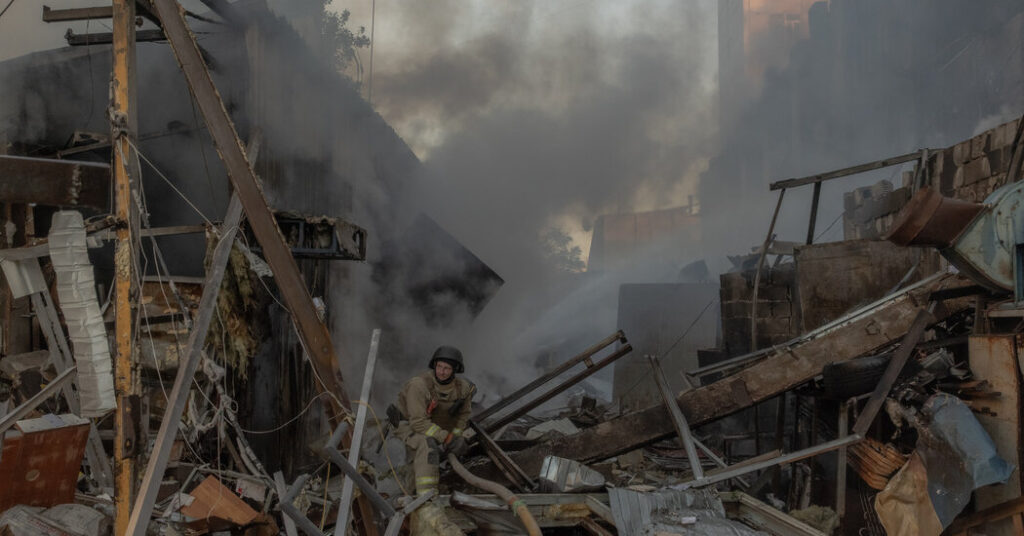
More than a week after Russia warned of an attack on Kyiv that would be so big that diplomats and other foreigners should flee, Moscow finally struck early on Tuesday. Its forces launched hundreds of drones and dozens of missiles at the capital and other cities in Ukraine, killing at least 16 people, the Ukrainian authorities said.
The bombardment of Kyiv was similar in scale to two other deadly attacks last month. Moscow has continued its air campaign against the capital even as the Russian military has suffered its worst period in years on the front line, measured in territory gained.
What appeared to be different with the latest assault on Kyiv was the psychological element. Last month, Russia’s foreign ministry issued dire warnings of retaliation for what Russian officials said was a Ukrainian drone attack that struck a college dormitory in the Russian-controlled Luhansk region of eastern Ukraine, killing 21 students. The toll could not be independently verified.
After Russia threatened another huge strike on Kyiv, including on “decision-making centers,” and told foreigners to evacuate, Western envoys rallied around the Ukrainian government, saying they would stay put and not give in to intimidation tactics.
Still, Moscow’s warnings, and the long amount of time that passed before Russia actually struck, took a toll on residents of Kyiv. For days, Russia launched planes in a manner that imitated a large attack, setting off alarms and wearing people down.
Many families ended up sleeping in Kyiv’s subways and in parking lots for multiple nights. By Tuesday morning, as the first Russian drones crossed the border into Ukraine, shelters were full, a sight less common than it was early in the war, with people having gotten used to the threat of Russian strikes. Those who arrived in the middle of the night, after the first missile warnings, struggled to find a space to lie down.
Subway station floors were covered in tents and yoga mats. Dogs were barking. Children were crying, struggling to fall asleep.
After the alert was lifted, sleepy families walked home as the sun cut through thick clouds of smoke over Kyiv. But shortly after 7 a.m., with some people already on their way to work, Russia hit the city with hypersonic ballistic missiles, Ukrainian officials said, leaving little time for people to seek shelter again.
After the dozens of explosions that shook Kyiv overnight, several sites were still on fire on Tuesday morning. At least five people were killed, and three children were among the 65 injured, said Mayor Vitali Klitschko. A nine-story apartment building in the Podilskyi district, west of the Dnipro River, partly collapsed, he said.
In the city of Dnipro in central Ukraine, 11 people were killed, including two children, and 37 injured as a result of an overnight attack, according to the local authorities.
Overall, Russia launched 656 drones and 73 missiles in the overnight wave of strikes, according to Ukraine’s Air Force, which reported that 33 missiles had hit their targets.
It was perhaps the most advertised attack of the war.
Russia warned on May 25 of its plan to strike “decision-making centers” in Kyiv. On Monday, President Vladimir V. Putin chaired a meeting in the Kremlin about the Ukrainian drone strike on the college dormitory in Luhansk, saying that the attack had added “a new quality to the conflict as a whole.”
Ukraine’s government has described the Russian assertions about the strike as misinformation, but a Ukrainian news outlet identified civilian victims, including students. The Russian Defense Ministry said in a statement on Tuesday that the overnight attacks were a response to what it called “terrorist acts” on targets in Russia.
Russia has been bombarding Kyiv and other cities for years, since long before Ukraine developed the capability to strike back. But in recent months, it has ratcheted up its attacks.
Every major assault on Ukrainian cities seems to achieve a record of one kind or another — the most drones used, the most ballistic missiles fired.
On May 14, Russia launched more than 1,400 drones at Ukrainian cities over 24 hours, the largest drone attack of the war, according to a data set created by The New York Times using numbers drawn from the Ukrainian Air Force. A single ballistic missile fired as part of that bombardment killed 24 people in Kyiv.
On Tuesday, Russia fired a record number of the nuclear-capable hypersonic cruise missiles known as Zirkons. It launched four overnight and the same number later in the morning.
Analysts said the Russian attacks were aimed in part at depleting Ukraine’s limited stocks of Patriot interceptor missiles, its only proven defense against Russian ballistic weapons.
Ukrainian officials have warned in recent weeks that the country is running low on Patriots, even as Russia has fired off more ballistic missiles than ever before. So far this year, Russia has targeted Ukrainian cities with 374 ballistic missiles, more than twice the number that it fired during the same period last year.
Ukraine used Patriots to knock down about one in three of those.
In the days after another major attack on Kyiv, on May 24, President Volodymyr Zelensky of Ukraine sent a letter to President Trump and every member of Congress asking for more of the U.S.-made Patriots. Mr. Zelensky described Russia’s ballistic missiles as Mr. Putin’s “last major advantage on the battlefield.”
Ukraine has seemed to take the upper hand in the war in recent weeks as peace talks have been stalled. Ukrainian forces have increasingly targeted Russian oil facilities and even cities like Moscow with long-range drones. The front line remains largely frozen, as drones make it difficult for either side to move, and Russia’s expected spring offensive has yet to materialize.
As Russia continues to strike Ukrainian cities through the air, Pete Hegseth, the U.S. defense secretary, told reporters on Friday that the United States would “find a way” to help Ukraine defend itself, but he did not offer specifics.
The advanced Patriots are in increasingly short supply worldwide, largely because many have been used in the war launched by the United States and Israel against Iran. But they are also tough to produce. Last year, Lockheed Martin built 620 of them, a record.
Francesca Regalado, Nataliia Novosolova and Ivan Nechepurenko contributed reporting.
Maria Varenikova covers Ukraine and its war with Russia.
The post After an Agonizing Week of Threats, Kyiv Is Finally Bombarded by Russia appeared first on New York Times.