The country went through a lot in the past quarter-century: the 9/11 terrorist attacks, two major wars, the worst recession since the 1930s, the opioid crisis and the transformation of both political parties from the ones that Bill Clinton and George W. Bush led. Yet, in the most recent presidential election, 43 states voted for a presidential candidate from the same party as they did in 2000.
That’s remarkable stability. Only 25 states had voted for the same party in the 1976 and 2000 elections. American politics has hardened into a contest between two fairly solid blocs of states. Presidential elections are increasingly about whether executive actions will impose red-state preferences on blue states or vice versa. The losing states then join forces to challenge the impositions in court.
A growing field of litigation concerns interstate battles over abortion policy. California refuses to extradite a doctor who subverted Louisiana’s law protecting unborn children. Red states have sought to prohibit residents from aiding travel for out-of-state abortions.
Some conflicts among the states are inevitable and perhaps even healthy in our system. But rules must restrain those conflicts so that they do not undermine important national goods such as freedom of commerce among the states. Under the Articles of Confederation in the 1780s, New York launched a trade war against Connecticut and New Jersey. Protecting commerce from what Alexander Hamilton called “the interfering and unneighborly regulations of some States, contrary to the true spirit of the Union,” was one of the objects of the Constitution. James Madison, though less enthusiastic than Hamilton about a strong central government, wrote similarly.
The Constitution therefore includes several restrictions on what states can do to one another and a commerce clause that hands regulatory power to Congress. For almost all of America’s history, the Supreme Court has inferred from that clause that state governments can’t regulate interstate economic activity: a doctrine called the “dormant commerce clause.” Without it, the same transactions might have to comply with the demands of 50 regulators — or more, since subdivisions of states could join in.
But the justices have, unfortunately, grown less and less willing to enforce those limits on the states. They have read the specific rules narrowly and are moving toward a version of the dormant commerce clause that stops only those policies that explicitly target other states’ economies. That leaves plenty of room for state policymakers, and the lawyers advising them, to devise ways to project their power beyond their state borders. The Supreme Court allowed California to require that any pork producers selling in the state follow its pig-protection law. It’s a noble cause, but should one state have the effective power to issue regulations for the entire country?
The justices most committed to originalism — the view that laws should be interpreted as the public understood them at the time they were enacted — have been the most skeptical of restrictions on the states. They object that the dormant commerce clause is not in the text of the Constitution. They also note that to enforce it, judges would have to make tricky distinctions to determine which regulations are legitimate and which amount to extraterritorial aggression — and the Constitution does not tell them how to do that.
Federalism scholar Michael Greve, a law professor at George Mason University, notes that there is something puzzling about this line of argument: The court, and these originalist justices, have enforced other elements of the constitutional structure even though they, too, require going beyond the text. All the conservative justices agreed to strike down federal regulations on carbon emissions because Congress had not provided clear authorization for such far-reaching policies. This rule is known as the “major questions doctrine,” which is not spelled out in the Constitution, either, and it also requires judgment calls.
The decision on emissions inadvertently raised the stakes of the debate over the boundaries of states’ power. The court ruled that Congress hadn’t authorized carbon regulation, and Congress was not about to take such action. So supporters of regulation turned to the states. Some states, mostly blue, have passed laws requiring imported energy — from red states with carbon-intensive energy production — to be “cleaner.”
Blue jurisdictions have also sued energy companies on the theory that their carbon emissions impose costs on them such as an increased need for firefighting. These lawsuits cannot possibly affect climate change unless they alter behavior outside the blue states: They’re an attempt at economic regulation beyond blue borders.
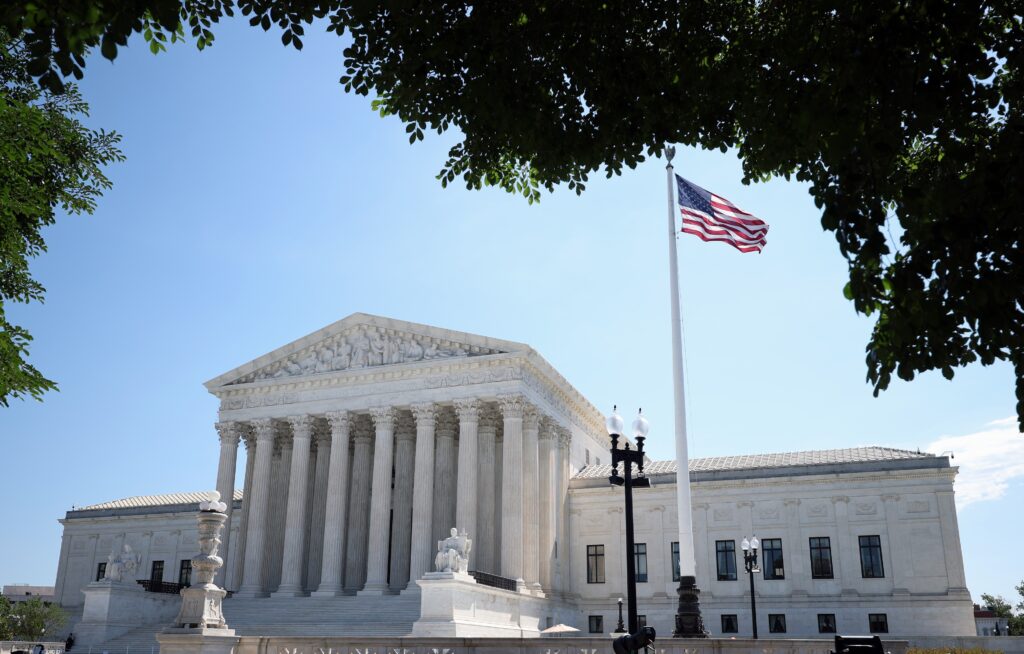
The Supreme Court has taken up one of these lawsuits, brought by the city of Boulder, Colorado. The case is expected to be argued in the fall. Predictably, 26 mostly red states have urged the court to reject Boulder’s claims, saying it would cost them jobs and tax revenue: “The States, upon entering the Union, gave up the right to use their laws to wage this sort of interstate conflict. They gave up the right to impose their policy choices on other States and activities entirely outside the home State’s jurisdiction.”
Those states are right, but they will succeed only if the justices remember that their constitutional duty includes protecting federalism from the states as well as from the federal government. Perhaps Boulder’s attempt to set itself up as a global climate regulator is astonishing enough to remind them.
The post Interstate trade wars are a new front line in red vs. blue appeared first on Washington Post.