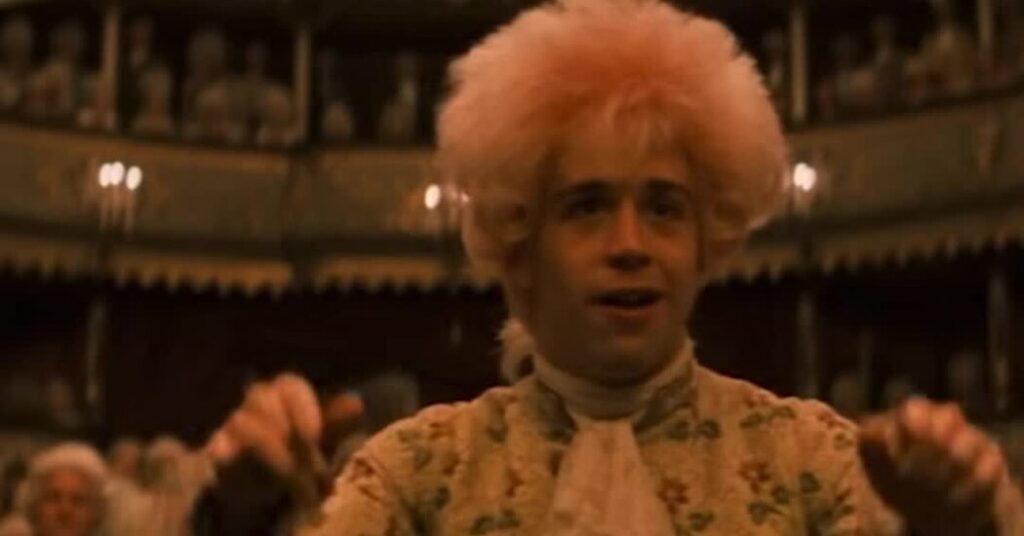
Mozart and Salieri are at it again.
With Starz’s recent release of the mini-series “Amadeus,” Peter Shaffer’s historically dubious, quasi allegorical tale of genius and mediocrity has been seen onstage, in cinemas and, now, on the small screen.
Adapted by Joe Barton and stretched to five episodes, the series stars Will Sharpe as Mozart, the puckish wellspring of astonishingly beautiful music, and Paul Bettany as his foil, Salieri, who was brilliant in his own right, but to whom posterity has been less than kind.
Aside from a few narrative twists, including an ending that puts the story in the hands of Constanze, Mozart’s wife, this “Amadeus” is a version of Shaffer’s play for the “Bridgerton” age: bright colors, liberal anachronisms and little attention to musical detail.
In its departures from the historical record, it’s far from alone. The lives of composers have been recounted onscreen through elaborate fantasies, extravagant pageants and more. Below are five examples.
‘Wagner’ (1983)
Rent or buy it on Amazon Prime Video.
Pick your edit of Tony Palmer’s “Wagner”: It has been released as a lavish film with a running time of nearly eight hours, in a much shorter cut, and, at its longest, as a 10-episode series.
The longer, the better. Like Wagner’s operas, Palmer’s biopic benefits from room to breathe. Starring Richard Burton as Wagner and Vanessa Redgrave as his steely second wife, Cosima, it patiently follows its subject from his rebellious early years in Dresden, Germany, to his death in Venice, filmed largely on location at the royal palaces of Ludwig II and at Wagner’s festival theater in Bayreuth.
At its most operatic, the movie uses Wagner’s music (recorded by the great conductor Georg Solti) as the foundation for poetic montages that treat characters as if they were individual lines of a score that come together in monumental harmony.
‘Mahler’ (1974)
Stream it on the Criterion Channel.
You could dedicate a whole list just to biopics by the provocative and flamboyant British filmmaker Ken Russell. He made deliriously unhistorical biographies and dreamy documentaries about composers; he even published books about their sex lives.
Perhaps his best movie in the genre is “Mahler,” with Robert Powell in the title role. A little bit traditional biography, a little bit sentimental love story, it captures what it must be like to read about Gustav Mahler while microdosing LSD.
His conversion to Catholicism, for example, is flanked by scenes of pure realism yet depicted as a silent film in which he is put through a series of fiery obstacles overseen by a dominatrix Cosima Wagner, whose leather outfit is decorated with studs that form a cross on her chest and a swastika on her rear.
‘Lisztomania’ (1975)
Rent or buy it on most major platforms.
If “Mahler” flirted with fantasy, then Russell’s “Lisztomania” plunged into psychedelic frenzy. A bit of a mess, it depicts Franz Liszt as the first rock star and casts Roger Daltrey of the Who to make the case. (Russell also directed Daltrey onscreen in the Who’s “Tommy.”)
Time and history mean nothing and Freudian imagery means everything in “Lisztomania,” which puts Liszt’s music through a synthesizer prism in the soundtrack by Rick Wakeman of Yes, who makes a cameo. So does Ringo Starr as the pope.
Cosima Wagner, Liszt’s daughter, appears again here, and she receives no more flattering a portrayal than in “Mahler.” She orders around Richard Wagner, who is shown as a Nazi vampire then as a “Frankenstein”-esque monster whom Liszt destroys with a musical flamethrower and laser beams shot out of an angel-winged spaceship from heaven. Seriously.
‘Chevalier’ (2023)
Classical musicians are still catching up to the works of Joseph Bologne, Chevalier de Saint-Georges. The son of a French plantation owner and an enslaved woman in Guadeloupe, he was born in the mid-18th century and rose to fame in France as a champion fencer and virtuoso violinist. But until recently his story was neglected.
His resurgence has included this handsome but somewhat aimless film by Stephen Williams, starring Kelvin Harrison Jr., whose Bologne has the swagger to challenge none other than Mozart to a violin duel. Bologne is a darling of Marie Antoinette, but as he becomes increasingly aware of his Blackness and its limitations, he is thwarted and eventually cast out of Paris’s elite circles.
‘Amadeus’ (1984)
Rent or buy it on most major platforms.
The gold standard for composer biopics may be Milos Forman’s adaptation of “Amadeus,” which gives Shaffer’s play (itself inspired by Pushkin’s “Mozart and Salieri”) a sumptuous treatment on every level: opulent period sets and costumes, operatically grand performances by Tom Hulce as Mozart and F. Murray Abraham as Salieri, gorgeously imagined recreations of stage works by Twyla Tharp.
Like “Wagner,” this film exists at different lengths. The director’s cut runs about 20 minutes longer than the theatrical one, which is the better of the two, at times seeming as carefully edited to fit Mozart’s scores as a music video. It’s a tough act for any similar movie to follow; certainly, the new series on Starz doesn’t replace it.
Joshua Barone is an editor for The Times covering classical music and dance. He also writes criticism about classical music and opera.
The post Beyond ‘Amadeus’: Where to See Composers Onscreen appeared first on New York Times.