It took three weeks to call a particularly competitive 2022 U.S. House race in California’s Central Valley, the outcome coming down to a couple of hundred votes.
Two years later, state Sen. Laura Richardson waited 17 days to be announced victor of a hotly contested race in South Los Angeles.
That same year, an unprecedented second-place tie in Northern California forced a recount that took almost two months to sort out.
California — and particularly Los Angeles County — are notorious for slow election counts. But Tuesday’s primary could the test the patience of even the most-knowing political junkies as some of the highest profile races, including California governor and L.A. mayor, remain tight.
“We’re trying to keep people calm,” said Tracy Hernandez, chief executive of New California Coalition, a nonpartisan group that works on policy solutions. “Expect not to know.”
Experts who spoke to The Times say results from some of the most publicized and close contests will probably not be clear Tuesday night, though many races could be called by then. Most estimated that the runoff candidates for California governor and L.A. mayor are unlikely to be confirmed until Wednesday or Thursday, though there are several factors that could stretch that process out even longer.
Primaries in California identify the top two vote-getters in each race — regardless of party preference — who then advance to November’s general election.
What takes so long?
The lengthy vote count in California is primarily a result of the many ways voters can cast ballots in the state, which election officials say expands access and participation — but increases the time on the back end of that process to confirm and verify ballots.
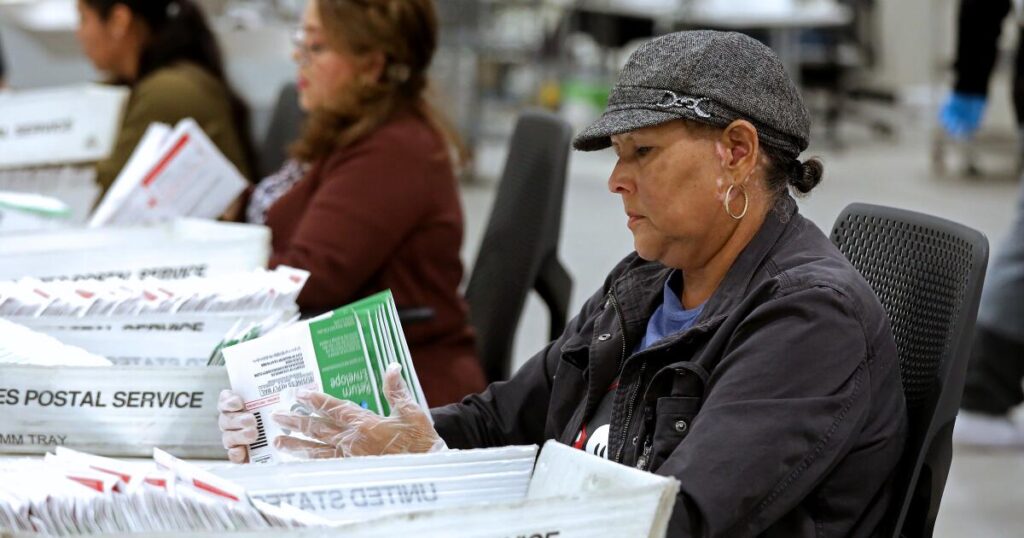
In particular, the expansion and popularity of universal vote-by-mail has created more steps to count and confirm ballots. Unlike in-person voting, where verification happens upfront, mail-in ballots must be inspected and have signatures verified. If a voter’s signature is missing or does not match the signature on file, California law requires elections officials to notify that voter and give them an opportunity to fix the problem, which can also delay the process.
Ballots are also accepted for up to seven days after the election if they are postmarked on or before election day, so in extremely close races, it can take days just to receive all relevant ballots.
But election watchdogs are universally clear that although results come in slower, it doesn’t inherently point to any problems or fraud — in fact, they say the opposite.
“We allow people lots of different avenues to vote, and as a result it takes longer to count up all the votes,” said Jessica Levinson, a law professor at Loyola Marymount University. “And that’s how it should be. … It’s an argument in favor of making sure the process runs correctly — not quickly.”
“It’s healthy,” Hernandez said, “and it should result in more Californians being able to vote.”
L.A. County has become known for its exceptionally slow election results, but experts said that’s simply because of how many ballots it handles.
“There is no unit, no vote counting [system] anywhere in the country that is counting more votes and more elections than L.A. County — by far,” said Fernando Guerra, founding director of Loyola Marymount University’s Center for the Study of Los Angeles
But on top of the systemic factors that slow down election results in California and L.A. County each year, this primary season has seen a push against early voting and a high rate of undecided voters, both which are expected to further delay when ballots are cast, and therefore, received and verified.
Those voting patterns could also skew the outcomes from the first batches of election results, which county registrars will begin sharing a few hours after polls close at 8 p.m. Tuesday. The first tranches typically include ballots received before election day, from vote-by-mail ballots and early voting locations, and then votes cast on election day.
This year, those first results will probably skew more conservative — despite California’s strong liberal slant — because of messaging from the Democratic Party to wait to vote because of concerns about the too-wide field of governor candidates, said Zev Yaroslavsky, director of the Los Angeles Initiative at UCLA Luskin and a former county supervisor.
He pointed to the last L.A. mayoral election, which initially showed developer Rick Caruso in the lead over Mayor Karen Bass,before late voters and mailed-in ballots began to be counted. After seesawing results for almost 24 hours, Caruso conceded the race to Bass on Wednesday night.
“We need to accept the first ballots that are counted aren’t always those that are most representative,” Levinson said.
So … when will we know?
There’s no concrete timeline for when races will be called.
The Associated Press has become the gold standard for calling election outcomes — The Times typically relies on its expertise — and such announcements usually come well before all votes are counted. But the news agency does so only when it is “fully confident a race has been won — defined most simply as the moment the trailing candidates no longer have a path to victory,” according to an article about its process.
Several experts who spoke to The Times said there’s a good chance the runoff candidates for governor and L.A. mayor won’t be confirmed by the end of the night Tuesday, even if there might be a clear front-runner.
It “may be a desperately unfulfilling cliff-hanger of a night,” Levinson said. “It’s entirely possible we could be looking at days not hours.”
Technically, local election officials have 30 days to process and certify all ballots, though it rarely takes that entire time to declare a winner.
There has been a growing push, however, to speed up election results — without reducing voting options or security — gaining support from Gov. Gavin Newsom and many in the State Capitol. Last year, legislators passed a new law that requires votes to be tabulated by the 13th day after ballots close, though it doesn’t change the 30-day deadline for official results and provides several exceptions.
“We have access, accuracy, security — now the challenge is to maintain all of those values while accelerating the count,” said Kim Alexander, head of the nonpartisan California Voter Foundation.
Even though longer vote counts don’t signal fraud or mistakes — despite some politicians peddling such falsehoods — she pointed to studies that have found that voter confidence does slide as results from elections drag on.
She called it a “false choice” that the vote can’t be well done and fast: “We can get it right and do it faster, and we should,” Alexander said. She has called for policy changes and more funding that could help expedite and streamline the election process.
But others argue lengthier results are just a product of a working democracy that’s likely here to stay.
“People have to be patient,” Guerra said. “Instant gratification doesn’t have to run your life.”
And that’s something with which candidates are also having to grapple.
“Increasingly we’re seeing more ‘Keep hope alive!’ campaign rallies rather than election parties,” Levinson said of election night gatherings. “Maybe ‘campaign watch party’ might be a better term than ‘victory party.’”
The post Vote count for California governor, L.A. mayor could be painfully slow. Don’t expect ‘instant gratification’ appeared first on Los Angeles Times.