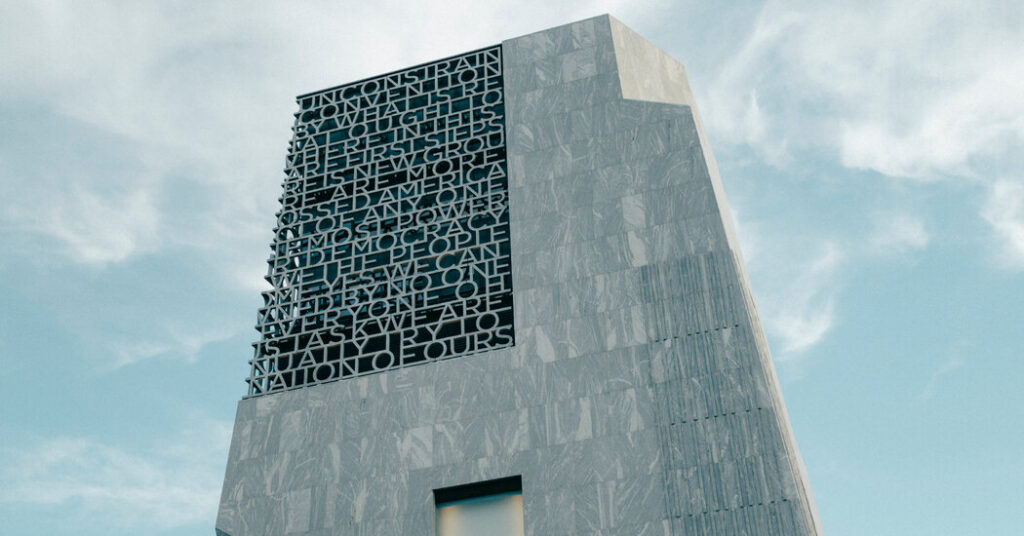
The Obama Presidential Center has dropped on Chicago’s South Side. Its signature building is a blocky, granite-clad museum tower that the former president wanted to look like four upraised hands.
Maybe it’s me but I don’t see it.
I see a boulder in a park.
The center arrives after years of planning, $850 million in private fund-raising, spasms of community blowback, and eye-rolling about the glamorous, brooding, unapologetic 225-foot-tall “Obamalisk.”
The architecture is certainly ambitious and formidable. The center is built for the ages to celebrate the nation’s first Black president.
It’s also the tallest monument yet to presidential self-glorification, although the current occupant of the Oval Office is contemplating a post-presidential billboard on the Miami skyline that would be several times taller.
The center’s mixed messaging is incarnated in the Janus-faced facade of the tower whose eccentric cuts and grooves from some angles can bring to mind the heroic architecture of Louis Kahn or a Noguchi sculpture. When sunlight after a rain turns the gray stone pink, the building can look like a beacon.
But from other angles, it’s cold and forbidding.
That’s a jarring vibe for a project whose most groundbreaking ambition is to reimagine the presidential library as a warm, welcoming community hub.
The Obama Center aspires to remake a historically poor, Black neighborhood across 19.3 acres of storied Jackson Park. There are ball fields, playgrounds, barbecue grills and picnic tables. There’s a teaching kitchen, with a fruit and vegetable garden, overseen by the Chicago Botanic Garden.
And there’s a building called the Forum, containing recording studios and meeting rooms for public use, along with a fan-shaped 291-seat auditorium fit for a presidential debate.
There is even a branch of the Chicago Public Library, a single-story gem, opposite the Obamalisk on the campus’s stony, corporate-coded plaza. All of it is free, save for a cafe, a restaurant, a shop selling Obama-themed merchandise and admission to the presidential museum inside the tower.
The architects are Billie Tsien and Tod Williams, New York veterans known for openhearted projects like the Barnes Foundation in Philadelphia and the Logan Center for the Arts at the University of Chicago. You see their attention to detail and texture in the tower’s ornamental lobby staircase, its sculptured stone piers and art-friendly spaces.
They teamed with Michael Van Valkenburgh, the landscape architect behind Brooklyn Bridge Park, who has reimagined all the parkland. Moody Nolan, one of the largest Black-owned architectural firms, designed an athletic facility at the campus’s southern end, called Home Court, where After School Matters, a Chicago youth-oriented nonprofit, will organize programming.
The Obama Center opens to the public June 19 in an America much changed from the one Barack Obama led. President Trump is pursuing his own architectural ambitions, including a gilded ballroom where he summarily demolished the East Wing of the White House, and various plans to remodel the nation’s capital.
The museum at the Obama Center is a reminder of an earlier time. Its exhibition starts with a section on abolition and civil rights, spiraling up several floors through the lives of the Obamas and their years in the White House to a display called “We the People,” which turns the spotlight back onto ordinary Americans.
Democracy is a collective responsibility, is the exhibition’s takeaway theme. We’re in this together.
The tower’s top floor, called the Sky Room, opens onto panoramic views of Chicago through granite letters carved into two sides of the building’s facade. The words are culled from a presidential speech in 2015 commemorating the march on Selma, Ala.
That ascension up through the building turns the tower’s verticality into a kind of spiritual metaphor for democracy — a motif underscored by the artist Julie Mehretu’s cathedral-like window.
But little of this uplifting messaging is made explicit on the outside.
From the street the carved granite words from Selma are illegible, the lettering bunched together like Cheerios in a box. Standing just below it in Jackson Park, the tower looms like a castle keep, its mass and height in tension with the park’s pastoral beauty and origins.
Jackson Park dates back to the 1870s. Olmsted and Vaux, the geniuses behind Central Park, were its original designers. During the peak of urban renewal, in the 1960s, when the South Side was in free fall, a road inside the park called Cornell Drive was expanded to a six-lane highway. That marooned acreage the Obama Foundation arranged with the city to use and maintain.
Turning prized public parkland over to a private foundation irked local community groups who argued there were better locations for the center, including vacant lots bordering Washington Park, another Olmsted creation to the west, which needed the investment more.
Jackson Park won out because the Obamas reportedly preferred its proximity to Lake Michigan and the Museum of Science and Industry. Local groups also pressed the Obama Foundation to enter into community benefit agreements to safeguard affordable housing in the area and forestall gentrification. The foundation declined.
But the foundation has delivered on other commitments it made to improve Jackson Park and to bring perks to the neighborhood.
And these are remarkable and significant.
That highway is now gone, replaced by lovely walking paths and a bike lane. Predictions of Carmaggedon circulated by Chicago drivers have not materialized.
The highway’s removal allowed Van Valkenburgh, Williams and Tsien to knit Jackson Park together again and to weave the Obama campus into it. The museum tower glowers like the Eye of Sauron but other buildings on campus are skillfully masked from Jackson Park. The Forum and the branch library tuck into a new topography of mounds, lawns and trees.
The library’s roof supports the fruit and vegetable garden. An underground garage provides a base for a sledding hill that borders a wetland retreat that can retain storm water during heavy rains. I can imagine children playing there, and, its tower loved or not, the center becoming a South Side staple and a beehive for local residents.
Earlier, I called the center a presidential library, but it isn’t. Obama is the first president not to have the National Archives and Records Administration operate a library on site as presidents have done for years. The Obama Foundation has argued that its presidential records are digitized and will be available online, while the Obama administration’s actual papers and other physical materials are saved, stored and publicly accessible at a facility that the Archives oversees in Maryland.
But some historians wonder about architectural precedents being set. In an age of bitter political divides, the Obama Center’s ennobling blend of neighborhood redevelopment and civic engagement with the usual in-house hagiography nudges the institution of the presidential library that much further away from its original, custodial, F.D.R.-era roots as a research center for public history.
Trump has criticized the Obama Center’s social agenda, but his library foundation is pointing to Obama’s project as it lays out its own vision of a privately managed, recreational-leaning, skyscraping memorial divorced from the National Archives. Trump has said he doesn’t plan to turn over his records to the federal government.
He is already fund-raising for a tower that he said may include a luxury hotel and other commercial ventures on a parcel in downtown Miami, given to the Trump library foundation at the behest of Florida’s governor, Ron DeSantis.
Eric Trump released what looked like some A.I.-assisted slop in March. The video showed the skyscraper with a gilded statue of Trump and a golden escalator.
Michael Kimmelman is The Times’s architecture critic and the founder and editor-at-large of Headway, a team of journalists focused on large global challenges and paths to progress. He has reported from more than 40 countries and was previously chief art critic.
The post Obama Center’s Two Sides: A Lovely Park and a Forbidding Tower appeared first on New York Times.