In 1949, shortly after “Death of a Salesman” premiered on Broadway, Arthur Miller wrote an article in The New York Times titled “Tragedy and the Common Man” that began, “In this age few tragedies are written.” He suggested that this was thought to be due to a “paucity of heroes among us,” which has led people to view tragedy as an archaic form, fit only for the “kings or the kingly.” But, he argued, “I believe that the common man is as apt a subject for tragedy in its highest sense as kings were.”
More than 75 years later, that same aversion to tragedy that Miller identified persists. In fact, as we slowly emerged from the pandemic, this anti-tragedy sentiment felt powerfully amplified in the theater world. Among producers and artistic directors, there was a distinct pushback against “trauma-based” plays — plays that examine characters through the prism of tragic events or histories.
This backlash was easy to understand: In our throbbing moment, can we just get some relief? Do we really have to sit with more pain? And at these ticket prices? Can’t we just offer a nice evening at the theater?
But there’s danger in the nice evening at the theater. When you ask narrative to always deliver a sanitized product — a pleasant evening, a happy outcome, a fun spectacle — you’re asking it to lie. You’re asking it to obscure the difficult truths and complex failures that define our past and our present.
Arthur Miller’s best work never lied or obscured hard truths — as proof, look no further than the current revival of “Salesman” on Broadway, directed by Joe Mantello and starring Nathan Lane and Laurie Metcalf. When I attended the opening night in April, I was curious to see how audiences would receive the play: Would it be embraced solely as a museum piece, resting on its laurels as an American classic?
Personally, I didn’t know if I should expect anything new from a play I’ve known since I was a teenager, written by a playwright who died just after I graduated from college. But I was startled by how modern its concerns are. Mr. Mantello’s production invites the audience in with the comfort of an American classic, but then drops the play into a contemporary context in terrifying ways. It feels urgently timely to witness a middle-class man, facing obsolescence, ultimately taking his own life so that his life insurance payment can provide his family with financial security. Willy Loman is caught in ideas of masculine worth that resonate just as loudly today as they did in 1949.
In one of the more bracing scenes, Willy is dismissed by his boss, Howard, who is clearly more interested in new gadgets than in human beings — in 1949, the gadget in question was a tape recorder, though now it could just as easily be A.I. — and the modern resonance is underlined by Howard sporting a tech-bro vest and clutching a latte.
Miller called for a tragedy of the common man, and he also wrote one. “Salesman” uncomfortably reminds us that sometimes the truth isn’t happy, but — as a giant billboard for “Salesman” above the Winter Garden Theater reads — attention must be paid.
This isn’t new territory for me. My own plays often aim to offer hard-won hope while not shying away from tragedy. From older plays like “The Whale” to newer ones like “A Case for the Existence of God” and “Little Bear Ridge Road,” I’ve always been interested in stories about people on the losing end of American life. This reliably engenders polarized reactions. I’ve had audience members hug me in thanks afterward, even as others have declared — sometimes out loud during performances — that the play was “too sad” or “too bleak.”
Hegel’s definition of tragedy is an idea that has shaped my work for decades: two noble impulses that cannot coexist. In “Salesman,” those conflicting noble forces live inside Willy Loman — he wants to take care of his family but he also insists on his own dignity. These forces drive a character who opens the play with a failed suicide attempt and ends it with a successful one, even as he ultimately saves his family financially.
This is what great tragedy does: It reflects us back to ourselves in ways that are both timely and timeless. Miller repeatedly refused to soften the play’s tragic punch or to offer easy answers or facile hope. The producer Kermit Bloomgarden wanted Miller to change the play’s downbeat title to the more upbeat “Free and Clear,” but Miller stood his ground. He wanted to illuminate what it means to be human, in all its raw ugliness. He wasn’t concerned with the likability of his characters or in reassuring his audience.
In that same 1949 article, Miller was quick to dispel a common misconception that is still alive today: that “tragedy is of necessity allied to pessimism.” Tragic characters represent hope. They push through the darkness, even at their own peril. What’s more optimistic than believing that, through suffering, one can achieve grace and redemption?
I can enjoy a purely fun night of theater just as much as anyone. But when reassurance and uplift becomes the sole expectation — when we’ve lost the capacity for new stories that are uncomfortable, sad, perhaps even tragic, and even so, hopeful — then we’ve lost the plot.
Samuel Hunter is a playwright whose “Little Bear Ridge Road” is nominated for a Tony for best play.
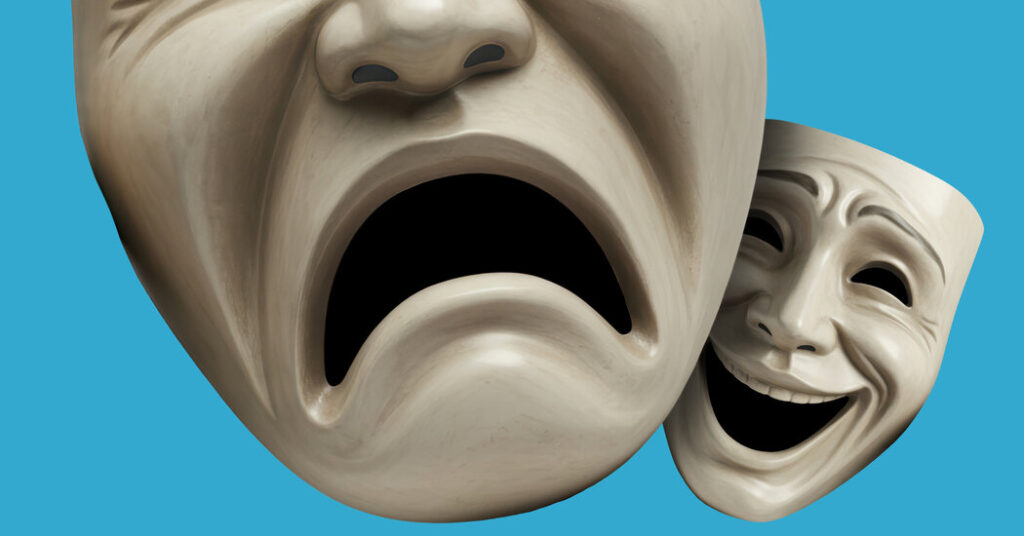
Source images by Bogdan Nicolaescu/Getty Images
The Times is committed to publishing a diversity of letters to the editor. We’d like to hear what you think about this or any of our articles. Here are some tips. And here’s our email: [email protected].
Follow the New York Times Opinion section on Facebook, Instagram, TikTok, Bluesky, WhatsApp and Threads.
The post In Defense of Sad Plays appeared first on New York Times.