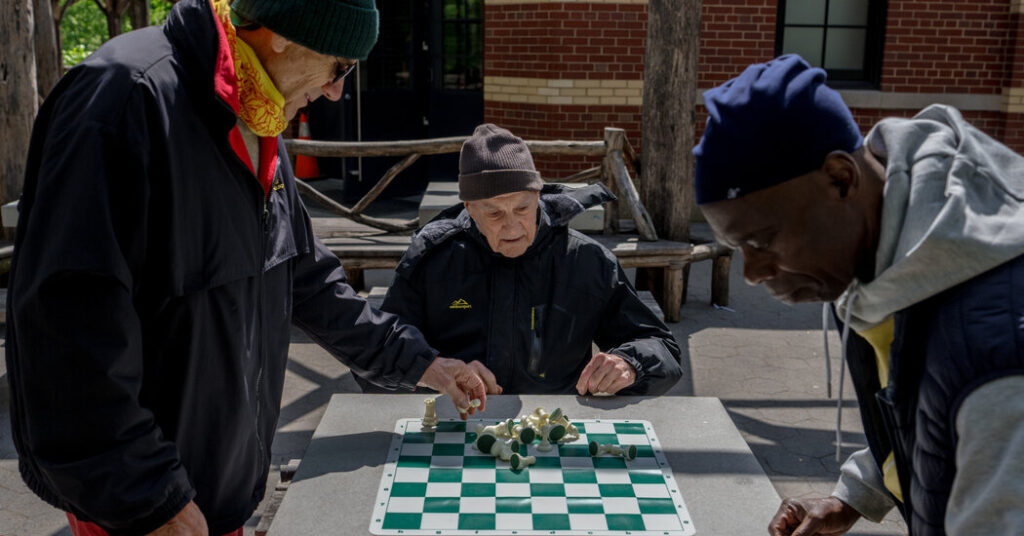
They began as strangers playing chess in Central Park. Frank was a scholar of South Asian textiles, known to friends as a guy who will lend a hand. Lincoln was homeless, living on a sidewalk on 59th Street. Paul was an older man living alone, in an apartment across the street from the Dakota, one of New York’s storied addresses.
They formed the kind of casual friendships that can happen over a chessboard.
Last year, when Frank realized that he had not seen Paul around in a while, he started asking people if they knew what had happened to him. No one knew. So one day in September, he went to Paul’s apartment to check up on him, not knowing what to expect.
“He opened the door, and the smell that came out would have killed a herd of elephants,” Frank said. Paul, 87, was incoherent and ragged, and the place was filled with rotting food and rat feces. Paul had not urinated in days; he did not know how many.
“I’m calling 911,” Frank told him. “You’re going to the hospital.”
For the three men — Frank Ames, Paul Trahan and Lincoln Cyrus — that day last September began an unlikely chain of events that would ultimately save one life, maybe two.
For Frank, it started with a simple moment of recognition.
“I see what happens to old people when they’re alone, when they get shut off from the world, when their hearing goes and they become infirm,” he said. “And I could be one of those people.”
The Chess House
None of them can remember when they first met, but it was at least a decade ago, at the Chess & Checkers House, an airy structure in Central Park where players of all abilities can find a game.
Lincoln, who is now 64, had played with both Paul and Frank, favoring a self-taught style he called “confused chess.” A native of St. Vincent and the Grenadines, he was a talented artist, a graduate of the city’s competitive High School of Art and Design. He was gregarious and approachable, someone who got along with the various characters drawn to the Chess House.
He was also homeless, sleeping nights under an overhang on East 59th Street, even in the winter. He had a history of demons. How he became homeless, it would turn out, was a complicated story involving a curse.
In 2021, with the Chess House closed because of Covid, Lincoln bought a half-dozen chess sets and folding tables and set them up on the mall in Central Park, with a sign reading, “Donations $5.”
He let everyone play, even those who could not afford the $5. Some gave him much more. One woman asked him to tutor her young son, a phenom with a rating close to that of a master. On a good week, Lincoln could clear $1,000.
It was a job, a life.
He rented a storage locker for his tables and chess sets. Every morning he would wake up early, carry his sleeping bag, cardboard and other things to the storage locker, pick up his chess sets and tables, then cart them to the park. After dark he would repeat the process in reverse.
He showered at a city recreation center downtown, $75 for six months.
Frank, almost two decades older than Lincoln, noted the way he carried himself. Even in such dire straits, Frank said, Lincoln did not seem to be focused on the money. He played with billionaires or people without a dime, making everyone welcome.
“He just loved the social interaction,” Frank said. “I find that a rare quality. Here’s somebody who’s sleeping on the street, homeless, but clean, presentable and a nice guy to boot. You know, unbeatable combination, and just genuine.”
The day after the ambulance took Paul last September, Frank visited the hospital and found him looking better but still disoriented. When Frank asked what state they were in, Paul answered, “Florida.” His recovery, it seemed, would be a long process, mostly in a rehab facility, and it was unclear how much of his mental function would return.
But Frank was bound for India in a couple of months, to do research for a book on Kashmiri scarves, his fourth. He couldn’t help Paul through a long recovery. He called Lincoln, telling him, “I want you to come and meet Paul.”
Lincoln remembered Paul from the Chess House, before the pandemic. Paul had been a strong player at first, formally grounded, until he started losing and he stopped coming around.
“I used to hear the guys saying Paul went crazy,” Lincoln said. “He’s walking around, talking to himself everywhere.”
At Frank’s urging, Lincoln started to visit Paul three times a week in the rehab facility, sometimes four, bringing snacks and a chess set. Paul started to regain his bearings, though he still had trouble with his memory and had lost much of his hearing.
For Lincoln, the approach of winter meant another season of sleeping out in the elements. Yet there was an apartment sitting idle, half a block from Central Park. Paul’s rent for the apartment, a small studio, was frozen at $486 a month.
The apartment was also uninhabitable. Frank needed a gas mask just to look at the mess. The floor was trashed, the window didn’t close and there were rat holes in the walls.
Frank gave Lincoln $500 to buy cleaning supplies, including a hazmat suit, and he contacted Paul’s sister, Marilyn Makela, who lived in Arkansas and had not been in touch with her brother for years. Frank sent her photos of the apartment, and asked her for $2,000 to pay Lincoln to clean it.
“I was thinking that these are a couple of con guys that are really trying to take my money,” she remembered. When she went to the bank to wire money to Frank, she said, the clerk told her, “Marilyn, I really think it’s a scam.”
But over the coming weeks, Frank reassured her and helped her get power of attorney to make financial and health care decisions for her brother. She wired the money.
“I took out 96 bags of garbage,” Lincoln said. Much of it was rotting food that Paul had hoarded from the nearby senior center and soup kitchens. Most of the furniture and the rug had to go. Paul’s sister persuaded the landlord to make repairs and paint the apartment.
With her blessing, Lincoln started staying in the apartment in November, putting his sleeping bag on the floor because he’d had to throw out the bed.
Frank left for India in December, hoping Paul and Lincoln would get along, knowing that Paul could be difficult. If anyone could handle him, Frank thought, it was Lincoln.
Things were touch and go. During Lincoln’s visits to the rehab center, Paul would blow up over something minor or imagined. Frank, calling from India, would then have to smooth things over with Lincoln, dreading the next, and perhaps final, eruption.
As winter moved toward spring, the rehab facility made plans to discharge Paul. Either Frank or Lincoln saw the logical next step: for Lincoln to become Paul’s live-in home health attendant, under a Medicaid program intended to keep people out of nursing homes. It would give Lincoln a secure home and an income, and it would keep Paul safe from the conditions that nearly killed him.
It was risky: The apartment was just one room, and Paul could be volatile, Lincoln quick to react. And Frank was still half a world away in India. But what was the alternative?
Lincoln joined a home care agency, and after a one-day course and fingerprinting, he got a company uniform, an ID badge and time sheets with detailed orders for Paul’s care: seven duties — shower, mouth care, dress, etc. — on each shift.
When Paul came home in March, Lincoln got something else: a salary of nearly $500 a week, for 23.5 hours.
‘Spiritual Matters’
Shortly after Paul’s return, I visited him and Lincoln at the apartment. The place was spotless, with neatly made twin beds on opposite sides of the room, and a table with a chess game in progress. At age 87, after six months in rehab, Paul spoke with a booming voice, in part to compensate for severe hearing loss. He looked robust, preparing to go out to gather food. I asked him what had caused his decline.
“Well, this gets into spiritual matters,” he said. He looked at Lincoln. “Is it OK to talk about it?” Lincoln nodded.
Paul said he still did not know whether his mind was functioning correctly. “I don’t feel like I’m completely cured,” he said. “But then again, I might be, and don’t even know it.”
He had grown up in Houston, where he was assessed as “borderline genius” in high school, his sister said, but would not work at anything he didn’t like. He moved to New York in his 20s to be an actor. But after a few small roles in commercials or soap operas and some extra work in films, his career fizzled, and he lost interest. He never pursued another line of work.
When he had no income, he moved into the apartment with an older woman whose name remains on the intercom downstairs. She put a curse on him, Paul said. “I was told by a spirit medium that in a previous lifetime I had known her, and we had had a friendship, and she wanted to make it a lot more serious than I did, such as marriage,” he said. “And that’s what prompted her to do what she’s done to me in this lifetime, preventing me from succeeding at anything, not only chess, but any endeavor.”
Though the woman died almost 20 years ago, Paul said, the curse remains in effect.
Now that he was back home, he was having some restless nights, keeping Lincoln up by talking out loud with spirits that visited him. Some were “high spirits” who wished him well, and others “low spirits” that told him to prepare for death.
Lincoln had a theory about Paul’s restive states. “Ice cream is a trigger for him,” Lincoln said. “It gives the negative spirits some kind of power over him. So he acts out, and he doesn’t know that his spirit now is taking control over him.”
Lincoln said he understood Paul. He, too, had spirits trying to control him. “What Paul is going through,” he said, “I experienced some of that too.”
‘I Saw Some Kind of Demon’
When Lincoln was in his early 30s, an acquaintance from high school had offered to help him get rich, and led him through a ritual that included smoking cinnamon and other substances. Afterward, the acquaintance told him to look in the mirror, and he’d see the spirit that was inside him.
“What I saw was some kind of monster, some kind of demon,” Lincoln said. “So I dropped the whole mirror. It smashed up. I was afraid to look in a mirror again.”
After that, his life began to spiral downward, through more negative spiritual encounters, until in 1996 he became homeless, living at first in one shelter, then another.
At the shelters, clinicians proposed psychological explanations and treatments for his problems. But he saw these as spiritual, not psychological, and the voices in his head as real, not imagined.
“They want to give it a name — schizophrenia, bipolar, mental health,” he said. “I don’t believe in these things.”
At one shelter, he said, he saw a psychiatrist, but he refused medication. “I said: ‘I’m telling you the truth, what happened to me, my experience, and you’re telling me I’m crazy. I don’t want to talk to you no more.’ And I just got up and walked out.”
But the shelter staff workers understood, he said, especially those from the Caribbean or Africa. “They knew what I was talking about,” he said. “They knew I was telling the truth.”
Eventually, Lincoln gave up smoking cannabis and eating meat and eggs, and he shaved his dreadlocks — all nutrients or triggers for the spirits bedeviling him, he believed. These measures weakened the spirits, he said, but did not remove them.
As March progressed, Paul and Lincoln continued learning how to live together. Paul made daily rounds of the nearby senior center and soup kitchens, gathering free food to take home. He went to church most days, where he said voices told him, “You’ve become a higher spirit than you were before.”
Who these voices were, he did not know.
Several times he blew up at Lincoln, once accusing him of causing him to miss Mass.
Lincoln learned not to react. “I understand that that’s not Paul,” he said. “Because I know Paul is a nice guy. Paul is a very peaceful guy. He don’t bother nobody. So when he acts out like that, I know that it’s triggers.”
Paul’s sister advised Lincoln not to try to stop Paul from bringing excess free food into the apartment, just to throw anything out after three days.
Paul, too, adjusted to Lincoln.
“Just two men living alone in the same small apartment are going to be head-bumping all the time,” Paul said. “But he keeps house better than any man I ever met. And he also is a damn good cook.”
Trying to Make It Work
The winter that Lincoln stayed in the apartment, at least 20 New Yorkers, many of them homeless, died in 18 days during a brutal cold snap. For Lincoln, having a steady home provided not just physical security, he said, but also spiritual grounding.
“It’s progress,” he said. “Being here is an opportunity for me now to live a normal life, because I don’t feel affected anymore.” Though he still had demons trying to control him, he said he had taken steps to weaken or neutralize them, including washing his body and the apartment in a dilute solution of ammonia and bleach.
Frank, returning in March from his three-month trip to India and Uzbekistan, visited the apartment to see how things were going. It was his first time seeing the place cleaned up. Paul and Lincoln were getting along better than he might have predicted, and he noted the chess game in progress on the table.
“It feels good,” Frank said. “It just feels good.”
Then in April, Paul became more and more belligerent with Lincoln, especially after trips to church. Paul’s sleeptalking — which he never remembered — became more aggressive, with complaints about Lincoln throwing out his food.
Finally it became overtly threatening. In a nocturnal rant recorded by Lincoln, Paul channeled one of his spirits, speaking in a rasp unlike his usual voice. “Lincoln has gone far enough for you, Paul,” the voice said, calmly. “There are countless numbers of people like me who want him dead. You cannot imagine how much hatred he has incited for himself by countless other people.”
Paul woke up very confrontational, yelling in Lincoln’s face. Lincoln said that even then, he was not afraid for his safety. But he hid the knives, and called Frank for help. The two called for an ambulance. When a battery of police officers and emergency medical technicians came to put Paul in an ambulance, he went without argument. Lincoln joined him.
Over the coming days, Lincoln took Paul to the psychiatric unit at Metropolitan Hospital, where he was given a prescription for an antipsychotic drug, quetiapine, to be used only when he became agitated. If he was given a diagnosis, neither Paul, Frank, Lincoln nor Paul’s sister knows what it is.
By May, the blowup appeared to be behind them. Paul did not remember it, and Lincoln ascribed it to Paul’s demons, not to Paul. Lincoln was still optimistic about his ability to care for Paul, in part because he was experienced in dealing with spirits. “I have something under my belt that a lot of people need to have under their belt,” he said.
Asked about their future together, each said he enjoyed the other’s company. “We have our differences, but all things considered, I think it’s a good thing that he’s here for me,” Paul said. “And I think it’s a good thing that he’s here for him, because this is a good situation for him, too.”
Chess had brought the three men together, despite their vast differences. It was one of the remarkable things about the game, Frank said. You sit over a board, black pieces on one side, white on the other, and your differences — billionaire or pauper, globe-trotter or homeless man — disappear. Kings and queens don’t care. Everybody’s knight moves the same crooked way.
Frank was reluctant to claim much for his role in the tale. Instead he thought about Paul and Lincoln, who had taken his prodding and turned it into something much more — a New York story that could have all gone so differently.
John Leland is a reporter covering life in New York City for The Times.
The post How Three Chess Friends Battled Demons and Saved Two Lives appeared first on New York Times.