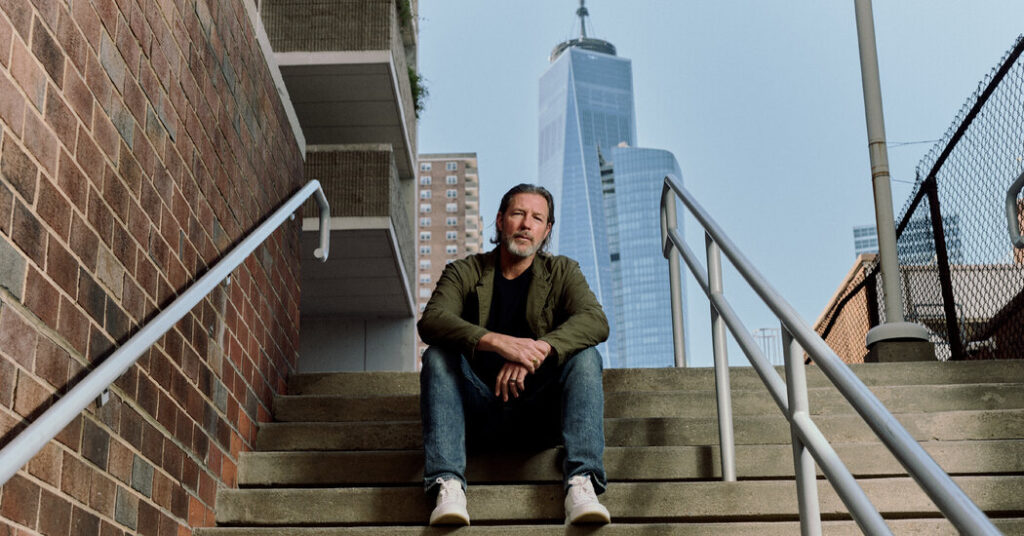
For the actor and filmmaker Edward Burns, the Tribeca Festival has never been just another stop on the festival circuit.
Almost a decade after coming into the limelight with the 1995 indie hit “The Brothers McMullen,” which he made for about $25,000 and premiered at the Sundance Film Festival, Burns premiered “Ash Wednesday” at Tribeca’s inaugural festival in 2002. He has since returned eight more times with character-driven films and has grown alongside the downtown institution as both Tribeca and independent filmmaking have evolved.
This year, Burns, 58, who lives in TriBeCa, returns with “Finnegan’s Foursome,” his first film shot and produced abroad. The comedy follows two competitive Irish American brothers and their children as they travel to Ireland after the death of their father, a well-known professional golfer, to scatter his ashes and continue the family’s long-running golf tournament in his honor.
Burns’s relationship with Tribeca also reflects the festival’s larger role within the independent film world. Over more than two decades, the event has screened more than 5,000 films, including over 2,000 world premieres, serving as a boon for emerging filmmakers.
Early Tribeca debuts played a prominent role in introducing several now-prolific names. They include the Academy Award winner Ryan Coogler, who made his directorial debut there with the short film “Locks” in 2009 before going on to direct “Black Panther”; Damien Chazelle, the filmmaker behind the six-time Academy Award-winning “La La Land,” whose feature debut “Guy and Madeline on a Park Bench” premiered at the festival in 2009; and Jessica Kingdon, an Academy Award–nominated director, who made her debut at Tribeca in 2021 with the documentary “Ascension.” With his numerous appearances, Burns ranks as the festival’s most frequent returning filmmaker.
Ahead of Tribeca’s 25th anniversary, Burns discussed the festival’s role in his career, what he has learned about sustaining an independent filmmaking career, and why festivals still matter for the next generation of creatives in film. This interview has been edited and condensed.
What does Tribeca represent to you at this point in your career?
Tribeca is a festival for cinephiles but also for movie lovers and has been a much more inclusive film festival than a lot of other film festivals. It’s almost like the city itself: big, inclusive, ever evolving. But at the end of the day, the festival is fun. I’ve had all sorts of different films here. I’m a New York guy born and raised, so I feel like it’s my home court. I am playing to a crowd I think really kind of appreciates my stuff, and it’s my favorite festival hands down for all these reasons.
Do you remember what that first Tribeca experience felt like? At the time, did you have any sense that the festival would become such a long-running part of your filmmaking life?
I was acting in a movie in Prague, and I could not attend my own screening for “Ash Wednesday.” My next screening, in 2004, was a movie called “Looking for Kitty,” which is a tiny movie we made for $250,000. That was like a little bit of a homecoming. This was a weird movie that didn’t exactly work; it wasn’t a great film. Based on the screening that night, you would have thought we were heading to the Oscars. The crowd laughed from start to finish and gave us a standing ovation.
There was no way to know back then that [Tribeca] would be such a big part of my life.
Your career has been tied to independent filmmaking. How has Tribeca helped shape or sustain that path for you over the years?
If Sundance [with “The Brothers McMullen”] started my career, Tribeca restarted my career. In 2011, I was in director’s jail for a little while. I made a couple of movies that did not perform well. Bad reviews, no box office [hits]. You do two of those back-to-back, and then suddenly Hollywood stops returning your phone calls. So my producing partner, Aaron Lubin, and I, decided to go back to our roots and try and make another microbudget movie like “McMullen.” We made “Newlyweds.”
I was in a panic and didn’t think I was going to work again. I had heard that you could shoot film on a Canon 5D so I bought a camera for $5,000. My director of photography and I went to the Live Well gym, in TriBeCa, and we shot one half of a phone conversation from this script I had. We went back to my office, looked at the footage and said, ‘OK, let’s go make a movie.’ Then over the course of two or three months, we shot every inch of TriBeCa.
The point is, Tribeca not only accepted that movie, but we were their closing-night film. Then it was one of the first films they picked up when they started their distribution company . So I went from director’s jail to suddenly having the closing-night film at a major festival. From there, my career took off again. It was a major boost that I needed at a very critical time.
What’s something you’ve learned about storytelling that you wish you knew when “Ash Wednesday” premiered?
In film school [at Hunter College], I fell in love with Hollywood movies and loved traditional story structure. I was never interested in reinventing the wheel. My early films abided by that. Probably around “Ash Wednesday,” where I don’t know if I got lazy or arrogant, but I stopped doing the hard work of making sure that I was hitting the beats of a three-act structure. The four films I made after that, I was undisciplined.
“Newlyweds” and another movie called “Nice Guy Johnny” were probably the first films where I said, ‘I need to go back to my old notes from college and pay more attention to doing the hard work before sitting down and writing a screenplay.’ And I think that’s why “Newlyweds” works. So I wish that before “Ash Wednesday,” I reminded myself of the importance of classic story structure.
You’ve made films across budgets and at different moments in the industry. What has the festival circuit taught you about surviving as a filmmaker over the long term?
Survival in the indie film biz is hard. I’ve said before, you don’t need to be the most talented. You need to be the most tireless. You just need to be willing to outwork the next filmmaker.
A lot of younger filmmakers look at your career as proof that there’s still a way to make films outside the studio system. What advice do you give emerging directors or writers premiering work at Tribeca?
That you’ve got to take advantage of this moment. You’ve got to try and do whatever you can to get the word out there. Festivals are a great opportunity for you to grow awareness for yourself.
Also, there are never any guarantees your film is going to find an audience or that you are going to get your money back, which is why you’ve got to try and figure out a way to make your films as inexpensively as possible, so that you have a greater chance of breaking even and getting your financiers’ money back. They might cut you another check and you get to continue to do this.
Indie film is all about compromise. You’re never going to get the money you want, the time you want. You’re going to have to make changes to your screenplay that you don’t want to make. But here’s the alternative: You’re sitting at home not making a movie.
You’ve returned with “Finnegan’s Foursome.” What keeps bringing you back creatively?
People talk about Knicks fans being the most knowledgeable fans in the league; they know the game better than anyone else. You get a similar audience at Tribeca. They know movies, they appreciate movies. They recognize a great festival, and that’s why I keep coming.
As Tribeca marks its milestone anniversary, why do you think festivals still matter?
When you look at the theatrical business for indie films, nobody goes to the movie theater anymore to see smaller character driven films the way they used to. I would say the vast majority of the art houses that my films played in over the last 30 years are all gone.
So, if you’re a young filmmaker and your dream is to sit in the back row of a theater and see your film projected on a massive screen and hear the audience laugh with you or scream with you or cry with you, that is no longer available to you unless your film gets into a festival. It’s important for young filmmakers when they have their first films here, speaking to that experience with my first film here, is that you have to show so much gratitude that there is an audience who still loves movies enough to pay money to go to a festival.
Also, as a filmmaker, you don’t get to meet filmmakers in the way that, as an actor on set you meet other actors, directors, the screenwriter, people on the crew. Festivals are great for us directors and filmmakers to hang out with one another.
What do you hope Tribeca continues to be for the next generation of filmmakers?
As our business continues to evolve, I hope that Tribeca, like it’s done for 25 years, evolves with the business. Young filmmakers are figuring out different ways to tell stories. I guarantee you, at some point in the near future, we’re going to be watching some form of a vertical [short dramas for smartphones] at this film festival just because some kid out there is going to tell such a compelling story in that format that we have to pay attention to it.
The post Edward Burns on What It’s Like to Be a Tribeca Festival Veteran appeared first on New York Times.