Scott Hodge is a tax and fiscal policy fellow at the philanthropy Arnold Ventures, and author of “Taxocracy: What You Don’t Know About Taxes and How They Rule Your Daily Life.”
Cody Detwiler, who performs on YouTube as “WhistlinDiesel,” is known for reckless stunts involving souped-up cars and trucks. He may have topped the reckless meter when he accidentally set his $400,000 Ferrari ablaze while off-roading through a cornfield in 2023 — then posted a video of the episode on his YouTube channel. In a later clip, he acknowledged that he used a Montana business to avoid paying thousands of dollars in sales tax on the car.
As the Ferrari burned, Detwiler yelled, “I just lost a half-million dollars.” It turns out, he may have lost a lot more than that when police in his home state of Tennessee arrested Detwiler in November on two counts of tax evasion.
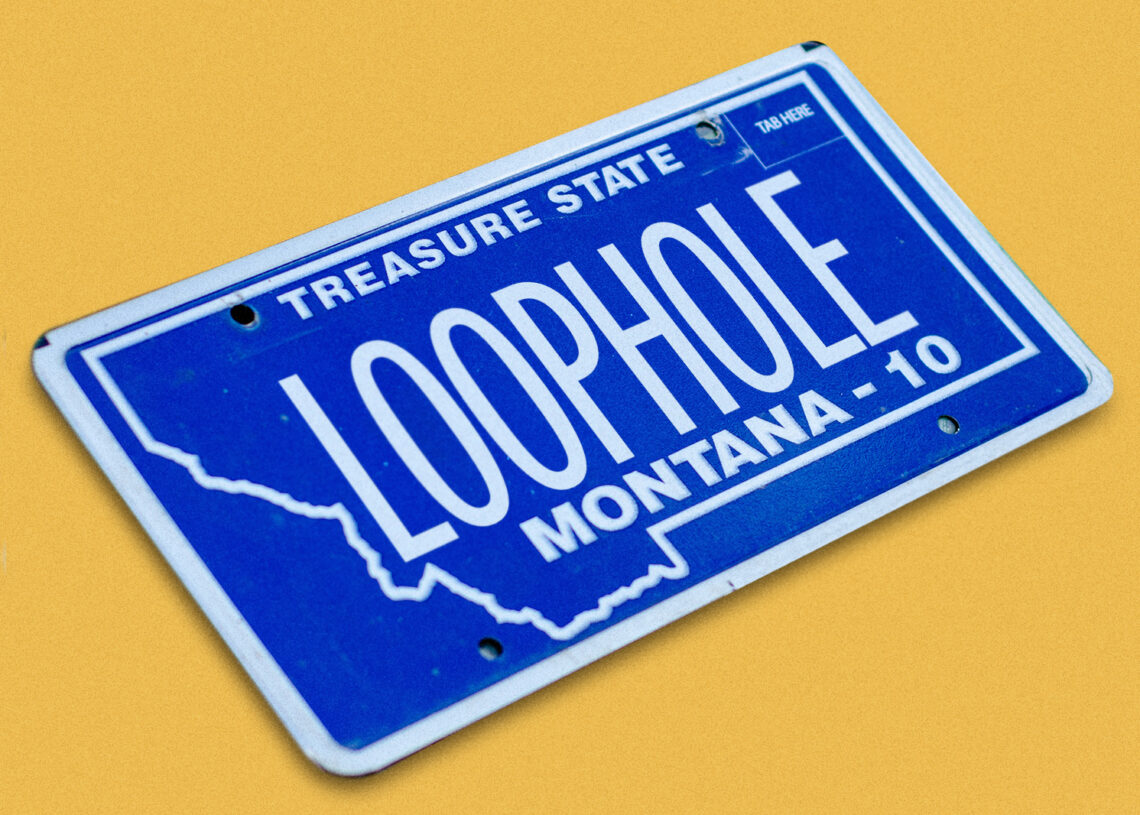
You see, Detwiler did what many wealthy car aficionados have been doing for years — form a Montana LLC and purchase the car through their new shell company. Montana has become sort of a Cayman Islands tax shelter for car collectors because it levies no general sales tax, and lawmakers created rules to allow tax-free vehicle purchases by LLCs. Thus, Detwiler avoided paying Tennessee sales taxes on his Ferrari. After paying a small registration fee, out-of-state owners are sent Montana license plates for what is now considered their “company” car.
And Detwiler’s video showing the Montana plate on the back of his burning Ferrari may have tipped off Tennessee authorities, because while the LLC registration is legal under Montana law, it is not necessarily legal in the state where the car owner actually lives.
Besides Tennessee, California and Utah have launched campaigns to identify and collect back taxes from the owners of these shell company vehicles. Last year, Utah Gov. Spencer Cox (R) signed legislation to create a data-sharing network to locate and assess residents driving vehicles with Montana license plates. The Utah effort could yield up to $100 million in back taxes.
Similarly, the California Department of Tax and Fee Administration “has identified close to 500 California dealers involved in more than 2,500 sales since 2023 to customers claiming to use the vehicle in Montana. These sales, many of which involve luxury or exotic cars, cost the state more than $10 million a year in lost tax revenue.”
Tennessee is making an example of WhistlinDiesel, but there are bigger lessons here.
First, such strategies should not be surprising because people will go to great lengths to avoid taxes. The Justice Department accused Ford of importing its delivery vans fitted with fake rear seats to avoid a 25 percent tariff on light trucks, known as the “chicken tax” because it was first levied by the Johnson administration in retaliation for European tariffs on U.S. chickens. “Passenger vans” faced only a 2.5 percent tariff. Once off the boat, the seats were allegedly removed and, presto, the vehicle emerged as a delivery van. In 2013, U.S. customs officials accused the company of tariff manipulation. After losing lengthy appeals, Ford agreed to pay a $365 million fine in 2024 but admitted no liability.
Next, there is a fine line between illegal tax evasion and legal tax avoidance. Former automaker DaimlerChrysler used a less deceptive way to get around the chicken tax. It assembled its Sprinter delivery van in Germany, then took out components such as the engine, transmission and wheels, and sent them as parts to a factory in South Carolina, where they were reassembled into a finished van. Thus, “Made in America.”
The Montana LLC structure is closer to illegal tax evasion when residents of other states effectively falsify their records to dodge their state sales taxes. Car owners are being aided in the deception by a cottage industry of firms willing to help set up a shell company for a fraction of what they would otherwise pay in sales taxes.
But there is a lesson in this for states too — especially states such as California with high sales taxes or those such as Virginia with high personal property taxes on cars. When tax rates hit very high levels, it can encourage tax avoidance and evasion. For example, after Los Angeles enacted the so-called mansion tax on high-end properties, it was reported that couples could split the ownership of a home to stay under the $5 million threshold for paying the tax. California’s sales tax on automobiles, along with burdensome emissions standards, has also contributed to a climate of evasion.
According to the California Department of Tax and Fee Administration, the highest number of cars purchased by Montana LLCs was in Beverly Hills, which is in Los Angeles County. It may be no coincidence that the combined state and local sales tax on autos in Los Angeles County is 9.5 percent. Even if I could afford a $1 million Lamborghini, I might balk at a $95,000 sales tax bill.
The nation’s 50 states have 50 different tax systems. Tax competition rewards taxpayers at the expense of states that fail to improve their tax codes. New York snowbirds retire to Florida to escape the weather and high taxes. Massachusetts shoppers will drive to sales tax-free New Hampshire to buy expensive consumer goods.
States such as Tennessee, California and Utah believe they are losing millions in sales taxes because of the Montana LLC loophole. They have a right to chase down scofflaws. But the volume of evasion is also a sign that their tax and regulatory structures are uncompetitive at best and punitive and harmful at worst. Instead of focusing on enforcement alone, they should make their tax and regulatory climates less onerous to reduce the incentive to cheat in the first place.
The post The Montana license plate loophole is a warning appeared first on Washington Post.