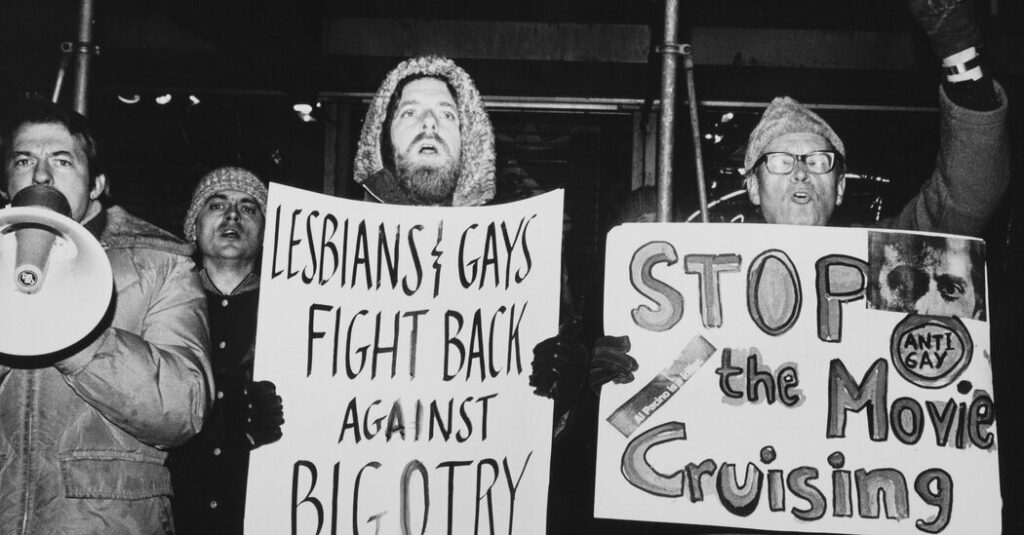
When the film “Cruising” opened on Feb. 15, 1980, almost nobody celebrated on Christopher Street, the gay enclave in the West Village.
The film was a Hollywood thriller about the kind of gay men who had kinky sex at New York City S&M clubs like the Mineshaft and the Anvil. The director was William Friedkin, with “The French Connection,” “The Exorcist” and “Boys in the Band,” a screen adaptation of a darkly camp play set during a gay birthday party, under his belt. It starred Al Pacino, an A-lister with multiple Oscar nominations, including for “Dog Day Afternoon” as a character who today might consider himself queer.
“Cruising” landed with an angry thud. Many gay men condemned its depiction of the city’s leather community as a demimonde of violence and depravity. The film flopped at the box office and mostly received poor reviews; Vincent Canby, a critic for The New York Times, called it a “homosexual horror film.”
For people who loved Addison Verrill, a gay man whose murder inspired “Cruising,” it was a slap in the face.
The film’s troubled legacy is the subject of“Mineshaft: The Cruising Murders,” a documentary that will debut at the Tribeca Festival, which runs Wednesday through June 14.
Schwarz, whose previous documentaries are mostly in a gay milieu — he profiled the actor Tab Hunter, the drag maverick Divine and the film historian Vito Russo — said he spent almost 10 years making a movie about “Cruising” because of his love-hate relationship with “this forbidden, creepy movie.”
“It’s this fascinating time capsule snapshot of New York and New York gay men at a very specific time that is long gone,” said Schwarz, who was a 10-year-old in Bayside, Queens, when the film came out. “I understand why people today still might find it icky, but I also love it.” (“Cruising” is available on several streaming platforms.)
Pacino plays a straight New York City cop who goes undercover to investigate the grisly murders of gay men. The killing scenes still shock, not only because they are as graphic as anything at the grindhouse, but also because even 46 years later in the Grindr era when things feel safer, gay men still fear that a hookup can go horribly wrong.
Many of the sexual situations looked straight out of an X-rated movie, and no wonder: Leathermen and gay porn stars were extras. By today’s standards, though, “‘Cruising’ is a lot tamer than a lot of the stuff we see on ‘American Horror Story,’” Schwarz said.
More than a rewind, Schwarz’s film is also an elegy for Verrill, a Variety reporter who was murdered on Sept. 14, 1977, at his West Village apartment. His killing chilled gay New York, as did the still-unsolved deaths of six gay men whose dismembered bodies were found in trash bags in the Hudson River around the same time.
Eventually, Paul Bateson was convicted of killing Verrill, whom he had met earlier that night at the Mineshaft. (The film points out that in a macabre happenstance, Bateson is in a scene with Linda Blair in “The Exorcist.”) Bateson served 24 years in prison, and died in 2012.
One of the people interviewed in “Mineshaft” is Verrill’s sister, Pamela Verrill Walker, who said she appreciated that Schwarz’s film provided “a much broader perspective” on the making of “Cruising” and on her brother’s life.
“Friedkin attempted to monetize this sensational story about Addison’s death but by doing so ignored the human tragedy for the gay community in general and for Addison’s family and friends,” Walker said. “He lost sight that a bright journalist with a loving family and a host of friends was murdered in a very tragic way.”
The gay community had good reason to be suspicious of “Cruising.” Outside of European cinema and the queer underground, by the time the film came out, Hollywood had mostly treated gay men as foppish monsters (“The Maltese Falcon”)or killers (“Rope”) or as prone to suicide (“Advise and Consent”).
Rage over “Cruising” started to boil in 1979 after the screenplay was leaked to the gay Village Voice reporter Arthur Bell, who complained that Friedkin was making what “promises to be the most oppressive, ugly, bigoted look at homosexuality ever presented on the screen.” Thousands of people protested, disrupting Friedkin’s location shoots in downtown Manhattan.
Jim Hubbard, a filmmaker and gay rights activist, remembered protesters blocking traffic for dozens of Manhattan blocks.
“Hollywood learned that it needed to present homosexuality and what we would now call queer culture in a more complex light,” said Hubbard, whose Super 8 footage of the protests is included in “Mineshaft.”
Despite the outrage, United Artists released the film, pleasing Friedkin but infuriating Pacino, who, according to Schwarz’s film, was so angered by the finale’s suggestion that his character might be a killer — an ending Pacino did not know was coming — that he refused to do any publicity. In his 2024 memoir, Pacino called “Cruising” “exploitative,” and said he donated his pay from it to charities.
Fast forward to 2026: “Cruising” has “to some degree been completely rehabilitated,” said Eugenio Ercolani, a film historian and a co-author of a book about the film. Among its fans are those who appreciate the film’s unflinching look at New York’s gay sexual underground, a microcosm that AIDS eventually decimated. In 1985, the Mineshaft was among the first gay venues that New York City shut down as part of its AIDS prevention measures.
Schwarz said he was hopeful that his documentary would further the already decades-long reappraisal that “Cruising” has had, and deserves.
“It’s still a terrifying movie,” he said. “And we’re still talking about it.”
The post A New Documentary Examines a Once Reviled ’80s Gay Thriller appeared first on New York Times.