Raymond Berry, a Hall of Fame wide receiver who played an integral part in the Baltimore Colts’ National Football League championships in 1958 and 1959, and who later coached the New England Patriots to their first Super Bowl appearance, died May 25 in Murfreesboro, Tennessee. He was 93.
His death was announced by the Pro Football Hall of Fame, which inducted Mr. Berry in 1973, his first year of eligibility.
Renowned for his tireless, meticulous preparation and laser focus, Mr. Berry, a lowly 20th-round draft pick, overcame his athletic limitations — lack of speed, spindly build, poor eyesight and a sometimes gimpy knee — to emerge as what many pundits believed to be the premier wide receiver of his era.
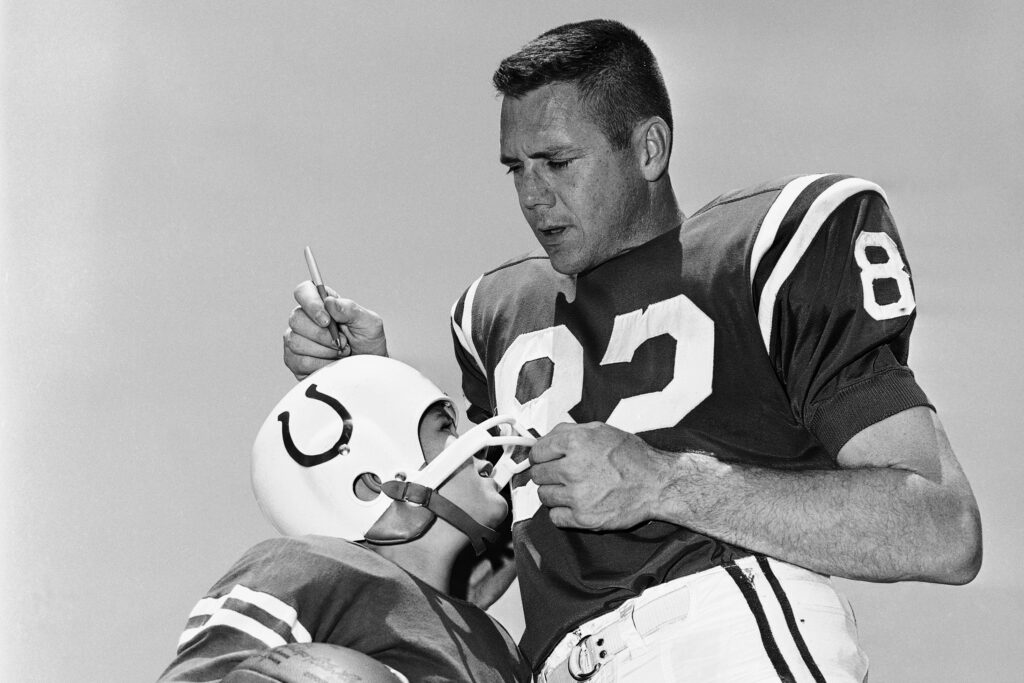
For much of his 13-year career, he was the favorite target of the Colts’ Hall of Fame quarterback Johnny Unitas. Mr. Berry caught 631 passes for 9,275 yards, both NFL records at the time, and scored 68 touchdowns. He was a six-time all-pro selection and was named to the NFL’s 75th Anniversary All-Time Team in 1994. The Colts retired his number, 82, in 1968, the year after he retired as a player.
In the electrifying 1958 NFL Championship game, well before the advent of the Super Bowl, Unitas and Mr. Berry led the underdog Colts (then of Baltimore, now of Indianapolis) to a sudden-death overtime victory over the powerhouse New York Giants in what became known as “the Greatest Game Ever Played.”
With 60,000 fans in the stands at Yankee Stadium and a national television audience of 45 million, the game had the most viewers of any NFL contest to that point. It was credited with triggering an explosion of pro football’s popularity and strengthening its hold on the nation’s sports fans.
Mr. Berry turned in one of the greatest performances by a wide receiver in league history, catching 12 passes for 178 yards and a touchdown and hauling in key catches during the dramatic game-tying drive at the end of regulation play.
“Few fans have understood that the key to victory in that game was not its celebrated coaches nor any of its marquee stars but an ungainly wide receiver who lacked the pure athletic ability to play pro sports and whose peculiar obsessions made him an oddball to his teammates,” Mark Bowden wrote in a 2008 Sports Illustrated article about the game. “He was, nevertheless, the prototype of the modern football player.”
Mr. Berry had an unspectacular college career at Southern Methodist University in Texas and was nearly overlooked in the 1954 draft. Few expected him to make the Colts let alone become a stellar receiver, but his drive and desire made him an elite player.
“Raymond just didn’t think there was any detail too small to be ignored or overlooked,” Don Shula, who coached the Colts during part of Mr. Berry’s career, told Investor’s Business Daily in 2013. “Those are the things he worked on. Those were the things that made him great.”
He was so focused on the details of his physical and mental well-being that he carried his own bathroom scale on road trips to monitor his weight. At 6-foot-2, he believed that his ideal playing weight was 186, and he was careful not to deviate from that number.
“I’m not as fast as some of these guys and not as big or tall as others, and there’s nothing I can do about that,” Mr. Berry wrote in a 1959 Sports Illustrated article. “You can’t grow and you can’t run faster than your physical equipment lets you. All you can do is squeeze the very most out of what you have.”
He had large, strong hands that rarely dropped a pass (he squeezed Silly Putty relentlessly to strengthen his grip) but it was his intelligence and indefatigable study of his opponents that made him nearly impossible to defend.
Before rule changes adopted to protect receivers, defenders could hit them all the way down the field, making each route like a run through a gantlet. Mr. Berry might not outrun a swift defensive back, but he would outsmart him and inevitably demoralize him with an acrobatic over-the-shoulder catch of a pinpoint Unitas pass on a dead run.
Starting in his rookie season, in 1955, he filled countless notebooks with detailed notes about opponents’ defenses and the routes he should run. He studied game films so assiduously that he insisted that the Colts buy him a film projector when he signed with the team. “I must be the only player whose contract included his own Bell and Howell projector,” Berry told the Baltimore Sun in 2009. “People thought I was nuts.”
He also benefited greatly from arriving in Baltimore just a year ahead of Unitas, an unheralded quarterback who had been cut by the Pittsburgh Steelers in 1955. Known for his crew cut and black high-top cleats, Unitas found a hardworking soulmate in Mr. Berry.
“John was struggling to stay in the league too and loved playing football as much as I did,” Mr. Berry told Investor’s Business Daily. “We were so highly motivated it was off the charts.”
He and Unitas spent hours discussing games and play calling. They would work in the dark on passing routes after practice had ended, and they came to define the modern pro game. In an era dominated by Unitas’s strong, accurate arm and Mr. Berry’s precision route-running, they made the passing game the centerpiece of offensive play, a trend that continues to this day.
“Unitas and Raymond changed the passing game in pro football forever,” Upton Bell, former personnel director for the Colts and general manager of the Patriots (as well as son of Bert Bell, NFL commissioner in the 1940s and 1950s), said in a 2023 interview for this obituary. “Despite all the bigger, faster, stronger receivers in the game today, Raymond will always be in my top 10 of all time.”
Coach’s son
Raymond Emmett Berry Jr. was born in Corpus Christi, Texas, on Feb. 27, 1933, and grew up in Paris, in East Texas near the Oklahoma border. His father was a teacher and football coach, and his mother was a homemaker.
As a scrawny teen, Mr. Berry did not start on his high school team, coached by his father, until his senior year. He later said he became obsessed with the 1953 biopic “Crazylegs,” starring the Los Angeles Rams halfback and receiver Elroy Hirsch as himself. He saw the film five times and, he recalled, “I decided then that the thing I wanted to do most in the world was to catch passes for a professional football team the way Hirsch did.”
After a stint at a junior college in Kerrville, Texas, the only school to recruit him, Mr. Berry went to SMU in Dallas, where he caught 33 passes in three seasons and played mostly defensive back. Nonetheless, the Colts plucked him late in the draft.
At SMU and later with the Colts, Mr. Berry understood the value of studying film of his opponents. What he learned about their tendencies helped him anticipate what they would do to guard him. “I was, in a sense, reading their mail,” he told Investor’s Business Daily.
His wife, the former Sally Crook, also lent a hand, throwing passes to him in the park. He honed his skills on those errant throws, diving and leaping to catch them.
So sure were his hands that he was charged with losing just one fumble in his NFL career. And Mr. Berry was convinced that the referees blew the call. He insisted that he hadn’t caught the ball that they ruled he had fumbled.
In addition to his wife, whom he married in 1960, survivors include three children, Suzanne, Ashley and Mark; and nine grandchildren.
After retiring from the Colts after the 1967 season, Mr. Berry worked as an assistant coach with the Dallas Cowboys, the University of Arkansas, the Detroit Lions and the Cleveland Browns. He joined the New England Patriots as an assistant coach in the late 1970s.
When the Patriots fired head coach Ron Meyer eight games into the 1984 season, Mr. Berry took over. The following season, he led the Patriots to a wild card berth in the playoffs. They won three straight road games on the way to their first Super Bowl, in January 1986, a 46-10 drubbing by the Chicago Bears.
Mr. Berry was fired by the Patriots in 1990 — after disagreements with the team’s general manager — even though he was then the winningest coach in the team’s history. His record of 48-39 has since been obliterated by Bill Belichick. Mr. Berry coached quarterbacks for Detroit and Denver before retiring in 1992.
According to Sports Illustrated, Mr. Berry said he knew — even before the Colts had won — that his career would forever be defined by the 1958 championship game against the Giants.
In preparation, he had pored over 25 pages of handwritten notes. He reminded himself to use head fakes to fool defenders and to focus intently on the football as it arrived in his hands. Each page was divided into segments with bold and starred commands: “Watch footing on starts!”; “Be bulldog on your block”; “Know snap count!”; “Do your job!”; “Be best competitor on field!”
At his induction into the Pro Football Hall of Fame, Mr. Berry was presented by Weeb Ewbank, who coached the Colts to their 1958 and 1959 NFL titles. Calling his former player “pro football’s most feared receiver,” Ewbank added, “Raymond and Raymond alone turned himself into the receiver he became.”
The post Raymond Berry, sure-handed Hall of Fame receiver for the Colts, dies at 93 appeared first on Washington Post.