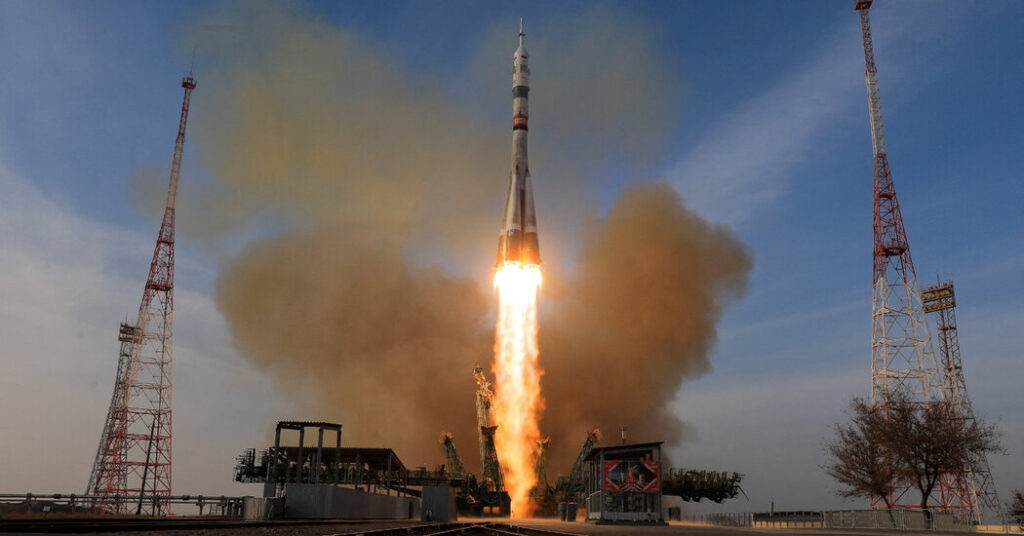
The launchpad Russia uses for sending astronauts and cargo to the International Space Station is out of commission after a mishap last week during the liftoff of a Soyuz rocket.
The rocket itself headed to space without incident, taking three astronauts — Sergey Kud-Sverchkov and Sergei Mikaev of Russia and Chris Williams of NASA — to the space station. But the force of the rocket’s exhaust shoved a service platform used for prelaunch preparations out of its protective shelter. The platform fell into the flame trench below.
Photos and videos of the launch site the next day showed the platform out of place and mangled.
“It’s heavily damaged,” said Anatoly Zak, who publishes RussianSpaceWeb.com, a close tracker of Russia’s space activities, “and so probably it will have to be rebuilt. Maybe some of the hardware can be reused. But it fell down, and it’s destroyed.”
This is the latest embarrassment for the once-proud Russian space program, which the United States relied on from 2011 to 2020 to get NASA astronauts to orbit. The incident also raises questions about the future of the International Space Station if the launchpad cannot be quickly repaired.
In a statement issued on Friday, Roscosmos, the state corporation in charge of the Russian space program, confirmed unspecified “damage” at the launchpad.
“All necessary parts needed for repairs are at our disposal, and the damage will be dealt with in the near future,” it said.
What is clear is that Roscosmos will not be able to launch any astronauts to the I.S.S. until the pad is fixed.
“This has been the only launchpad serving the Russian part of the I.S.S. program since 2019 — that means Russia today lost its ability to launch humans into space, something that has not happened since 1961,” Vitaly Yegorov, a space commentator, said in a post on Telegram.
Other spacecraft, like SpaceX’s Dragon, could provide transportation for astronauts and cargo. But only a Russian Progress cargo vehicle, lifted to orbit by a Soyuz rocket, can carry propellant that is used by the thrusters on the Russian segment of the space station. The thrusters are a critical system for maintaining the attitude, or orientation, of the space station so that it is lined up correctly for dockings and to prevent it from spinning out of control.
The next Progress launch is scheduled for Dec. 20, but it will almost certainly be delayed.
NASA issued a statement that also downplayed the mishap. “Station has sufficient capability for reboost and attitude control, and there are no expected impacts to this capability,” it said.
Russia’s Soyuz rockets and capsules have proven highly reliable for more than half a century. But they rely on antiquated technologies and procedures. The service platform, which rolls from its position beneath the rocket into the shelter about an hour before launch, may have been dislodged because someone forgot to put in a stopper to prevent it from rolling back out.
“They were supposed to have brakes on those rails,” Mr. Zak said. Technicians install those brakes manually, Mr. Zak said, a step that has been routinely performed for more than 1,600 Soyuz launches. It is also possible that a mechanical failure caused the mishap, he said.
Some analysts tie such problems to Russia’s invasion of Ukraine, which has diverted money and resources from its space program. Sanctions imposed by Western countries because of the invasion have also added hurdles.
“How committed is the Russian leadership to fixing that launchpad and continuing the contributions to the International Space Station program?” asked Jeff Manber, a senior official at Voyager Technologies, one of the American companies developing private space stations to replace the I.S.S. “It’s going to be extremely interesting to see how indeed they respond.”
A quarter century ago, Mr. Manber worked with the Russians to try to turn Mir, an earlier Soviet-era space station, into a commercial venture. Back then, “there would be no doubt they could fix that, fix any errors in the launchpad and the pit very quickly,” he said.
But now, “we have to see what the capabilities are,” Mr. Manber said.
Mr. Manber said the Soyuz launchpad stumble also highlighted the fragility of the aging International Space Station and the need for NASA to plan for what comes next. “This should be a wake-up call,” he said.
The launchpad is in Kazakhstan, at the Baikonur Cosmodrome. Russia leases the site from Kazakhstan, a former Soviet republic, and that could complicate the logistics of repairs.
Russia has other launchpads for the Soyuz, but those are too far north to launch spacecraft to the space station. It is possible that Roscosmos could try to use the service platform from a mothballed launchpad — the historic one at Baikonur where Yuri Gagarin launched to become the first human to reach space — or from a more distant Soyuz launchpad.
The Kommersant newspaper on Saturday quoted Aleksandr Khokhlov, a member of the Russian Astronautics Federation, a St. Petersburg-based nongovernmental organization, saying that the repairs might take from as little as six months to over a year.
Mr. Zak said that if a new service platform was required, that could take a couple of years to manufacture. In the interim, Roscosmos could use temporary structures that would be destroyed during launch, he said.
In the 1950s and 1960s, the Soviet Union beat the United States to many firsts the space race: the first satellite with Sputnik in 1957, the first human in space with Mr. Gagarin in 1961, the first woman in space in 1963 with Valentina Tereshkova, the first spacewalk by Alexei Leonov in 1965 and the first space station, Salyut, in 1971. The Soviets also sent robotic probes to the moon, Mars and Venus.
But the Russian space program is now a shadow of its former glory.
The final years of the Mir space station were plagued with near disasters, including a fire in 1997. In 2018, a Soyuz rocket carrying three astronauts failed as it headed to space; the emergency abort system carried the three to safety. In 2022, a Soyuz spacecraft docked at the space station sprang a leak after it was apparently hit by a meteorite, an unlucky mishap similar to what a Chinese capsule docked at Tiangong space station suffered recently.
Construction of a new launch site in the far east of Russia was hampered by delays and cost overruns, and it remains barely used. The last successful robotic mission was more than 50 years ago. During its most recent attempt in 2023, the Luna-25 spacecraft crashed into the moon as it prepared for landing.
Nataliya Vasilyeva contributed reporting.
Kenneth Chang, a science reporter at The Times, covers NASA and the solar system, and research closer to Earth.
The post Russian Launch Site Mishap Shows Perilous State of Storied Space Program appeared first on New York Times.