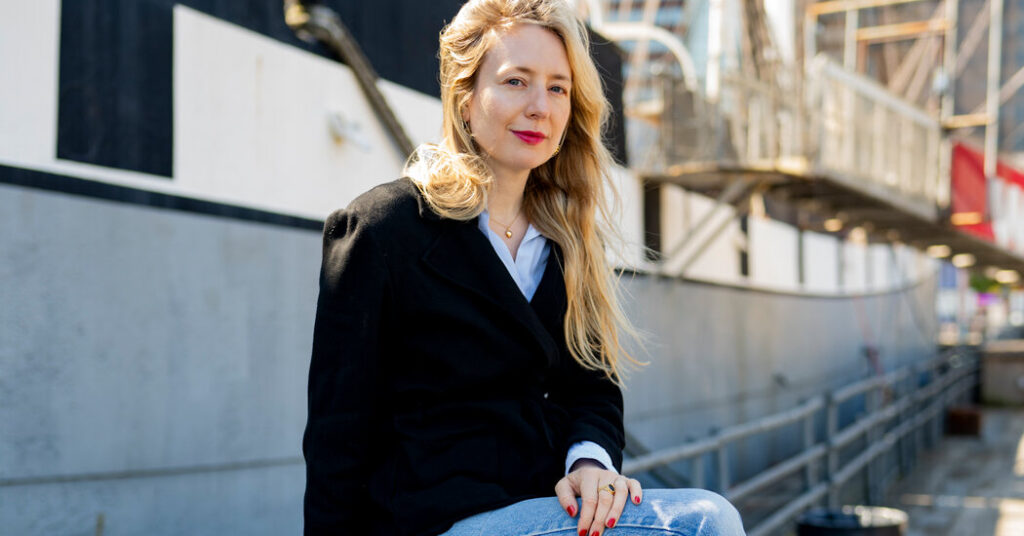
Down in the bones of old New York, in the historic waterfront district of Lower Manhattan, Joana Avillez clutched her tattered copy of “The Bottom of the Harbor,” a 1959 book by Joseph Mitchell filled with tales of the neighborhood’s fishmongers, bearded sailors and giant rats.
Avillez, a 39-year-old illustrator who grew up here along the brackish East River, sipped an iced coffee as she roamed the cobblestone streets, telling me about this vanished world.
In place of the joggers on the promenade and tourists in the plaza, fishmongers once barked out prices for halibut from the pungent stalls of the Fulton Fish Market. Steps away from a McNally Jackson bookstore, there was Sloppy Louie’s, a seafood restaurant where Mitchell had kippered herring with scrambled eggs for breakfast.
Avillez was retracing Mitchell’s footsteps, but also her own. She spent the past six years illustrating a new Modern Library edition of “The Bottom of the Harbor,” a collection of stories that first appeared in The New Yorker, where Mitchell was a fabled staff writer. “Sometimes I feel like I’m chasing Mitchell’s ghost, or that he’s following me,” she said. “I’m always seeing him down here.”
Walking down Water Street toward Peck Slip, she watched some teenagers skateboarding on the square.
“When I was a girl, this was part of the Fulton Fish Market, and there were still burning trash cans,” she said. “I saw the last breaths of the world Mitchell wrote about. I still remember the early morning shouts of the fishmongers. My father used to buy clams at the market to bring home. I stepped over crabs to get to the school bus, and the kids would say, ‘Pee-yoo!’”
“I think drawing this area also has lots to do with my father for me,” she continued. “He’s not alive anymore, but we were kindred spirits. Drawing was our secret language. We would say we drank from the same water.”
While trying to bring new life to “The Bottom of the Harbor,” Avillez went deep into the world captured by Mitchell. To illustrate “Mr. Hunter’s Grave,” she visited the lonesome Staten Island cemetery at the heart of the story. For “The Rivermen,” Mitchell’s study of shad fishermen, she rode ferries up and down the Hudson to sketch the Palisades.
The work also became a Proustian undertaking, as Avillez found herself excavating memories of her 1990s seaport girlhood and the death of her father, Martim Avillez, who taught her how to draw.
A native of Lisbon, which straddles the Tagus River, Martim was drawn to this waterfront neighborhood when he immigrated to New York. Having fought in the Portuguese Colonial War, he struggled with alcoholism and post-traumatic stress. When Joana was 16, he had a bad fall in the stairwell of the building where they lived, on desolate Front Street. After that, he was never the same.
“Mitchell’s book shows me things I can’t ask him about,” she said.
In the rear of the Fulton Stall Market, she heaved open a service door, which was still stamped “Sloppy Louie’s” on the back. She moved through the crumbling remains of the Fulton Ferry Hotel, which Mitchell depicted hauntingly in “Up in the Old Hotel.” But the place dearest to Joana was the building on Front Street, where she had grown up in a rent-regulated loft apartment.
At the entrance door, she slid a MetroCard into the crack. She jimmied the lock, and we were in. A mailbox in the tiny vestibule still bore her father’s name and that of Lusitania Press, a culture and politics journal he founded in the 1980s. She approached the narrow staircase.
“These are the stairs he fell down,” she said. “There was blood in his brain after that. I guess the trauma of my childhood is all right here. Sorry to get so intense on us.”
At the top, she pushed open the door to the roof. She went to the ledge and looked out at the East River.
“I think he was always suffering after the war, but he found some peace down here by the water. I think he was running from something when he got to New York. He could try to get away from it, but he couldn’t.”
Finding Her Subject
In the early 1990s, Martim bought a loft in the nearby Tribeca neighborhood, which he converted into an office for Lusitania Press. Joana moved into it when she was in her 20s and now lives there with her husband, Sean Fabi, a Legal Aid Society lawyer, and their 4-year-old son, Nino.
On a recent evening, Nino’s toys littered the floor next to her drafting table, where she was finishing an illustration for The New Yorker. Strewed across her desk were party invitations and drawing commissions she had done for New York media figures like Emily Sundberg and Risa Heller. The library contained books she had illustrated, including “Not That Kind of Girl” by Lena Dunham, a childhood friend of hers.
“I was at the party for Lena’s new book last night, at the Algonquin Hotel,” Joana said. “The spritzers were nonalcoholic.”
Beside her pens and erasers was a framed photograph of Joana and her father. It showed them drawing together at a beach cafe in Portugal when she was 8.
“There’s a part of me that’s always avoided the seaport,” she said. “I almost don’t even want to remember all the details about what happened. I guess Mitchell’s book lets me imagine more about my father’s life.”
In the 1960s, Martim was drafted into the Portuguese army and served in West Africa as a lieutenant. Later, he fled the dictatorial regime of António Salazar to study art at the Cooper Union in Manhattan. He moved to the seaport in the late 1970s and started contributing political drawings to Harper’s and The New York Times. At Lusitania Press, which ran work decrying censorship and fascism, he published writing by Coco Fusco and artwork by Larry Clark and Carolee Schneemann.
“I remember asking him how often he thought about the war,” Joana said, “and he immediately replied: ‘All the time.’”
Martim met Gwenn Thomas, a photographer and painter, in the downtown art scene. They married, and she moved in with him on Front Street when she was pregnant with Joana. At their parties, their daughter would crawl through the legs of artists and intellectuals like Joan Jonas and Sylvère Lotringer, the publisher of Semiotext(e). Tucked into bed, Joana would stare up at the old wooden beams to read the messages — “You Are No Good, Jim Dillon” — scrawled long ago by Irish sailors. To lull her to sleep, as tugboat foghorns bellowed from the East River, her mother read her the books of Beatrix Potter, and her father read her William Steig.
Martim’s demons emerged at night. He would drink until last call at Carmine’s, an Italian restaurant down the street. Sometimes, she would overhear him talking about the war in feverish phone calls to friends in Portugal.
“The tide would swing for him,” Joana said. “At night, I’d hear the key turn, and I just knew.”
Her mother also remembered Martim’s struggles.
“He was the most fantastic father to Joana, always drawing with her, and he’s the reason she became an illustrator,” Gwenn said. “But after she was about 15, he grew more and more challenged by, as she says, his ‘demons.’”
“Martim wouldn’t talk to me much about the war, but there was one thing that happened to him that he did talk about,” she continued. “He was maybe 22, stationed in Guinea-Bissau and leading a group that had to cross a bridge. He saw some blades of grass sticking up very stiff, which he knew was the sign of a land mine. He had to deactivate that land mine with his bare hands. He saved the lives of 30 men. He was awarded a medal, but he didn’t want to accept it.”
After Martim’s fall in 2001, he underwent brain surgery for a hematoma. Gwenn and his siblings eventually moved him to a veteran’s rehabilitation center near Lisbon. He died at 70 in 2014.
Much like her parents decades earlier, Joana fell in with a downtown crowd, a scene filled with rising talents including the director Josh Safdie, the fashion journalist Chloe Malle, the entrepreneur Audrey Gelman and Dunham, who was starting to write “Girls.”
Joana’s subject matter — like Mitchell’s — soon became the city. She would roam the streets with pen and pad, sketching the people she saw. It wasn’t until the coronavirus pandemic froze New York that she discovered “The Bottom of the Harbor.”
Reached by phone, Nora Mitchell Sanborn, a daughter of Mitchell who oversees his estate, considered the idea of a young illustrator falling under the spell of her father’s work.
“Well, I think he would be happy to hear his writing has helped her,” she said. “He would be moved to know that his writing was still helping someone — so long as the person wasn’t a yuppie.”
The Graveyard
When things get too much for me, I put a wild-flower book and a couple of sandwiches in my pockets and go down to the South Shore of Staten Island and wander around awhile in one of the old cemeteries down there.
So begins Mitchell’s 1956 story “Mr. Hunter’s Grave,” which tells of George Hunter, one of the last survivors of a Black oystering community known as Sandy Ground. The piece is a rumination on mortality told through the poetic ramblings of Hunter, who speaks of his plan to be buried with his wife in the local cemetery.
Joana spent many hours in the graveyard when she was drawing it. Early on a recent spring morning, with her work on the book finished, we boarded the Staten Island Ferry to see it again.
“I brought sandwiches, just like Mitchell,” she said.
From the St. George Ferry Terminal, we didn’t take a bus to Sandy Ground, as Mitchell had, but ordered an Uber. Through the car windows, we saw a landscape of suburban houses in place of the swamps, goat farms and meadows described in “Mr. Hunter’s Grave.”
We arrived at a lonesome old chapel, the Rossville A.M.E. Zion Church, and wandered a while until we found Crabtree Avenue. Soon, we came upon a tiny burial ground enclosed by a rusted fence. No one else was there.
We followed a weedy trail to the grave, which lay near the foot of a sassafras tree. Joana sat on a rock and unwrapped a tomato and sprout sandwich.
“Like so many Mitchell stories, ‘Mr. Hunter’s Grave’ is about getting closer to death,” she said. “About how life is death. How life and death coexist. Hunter’s talking about his grave, his wife’s grave, his son’s grave. All this death — wait, there’s an ant on my sandwich.”
She flicked it off.
“I know I’ve been talking about my dad so much, and I’ve been thinking about it,” she continued. “Maybe I didn’t really feel Mitchell as the ghost. I mean, I felt he was with me but — is Mitchell my father?”
She took a bite of her sandwich.
“Being here makes me think about how his ashes are in Portugal,” she said. “They’re in a little tomb, in my family’s village, not far from Lisbon, where they’re in a canister on a shelf, with my grandmother. I’ve always wanted to get them and bring them back to New York.”
“I think about death now,” she added. “Having a kid does that.”
She stood up and dusted off the dirt. Then she looked at Hunter’s grave.
“I wish I’d brought flowers,” Joana said. “I’ll have to bring them next time.”
Alex Vadukul is a features writer for the Styles section of The Times, specializing in stories about New York City.
The post An Artist Revisits the Ghosts of Her Waterfront Childhood appeared first on New York Times.