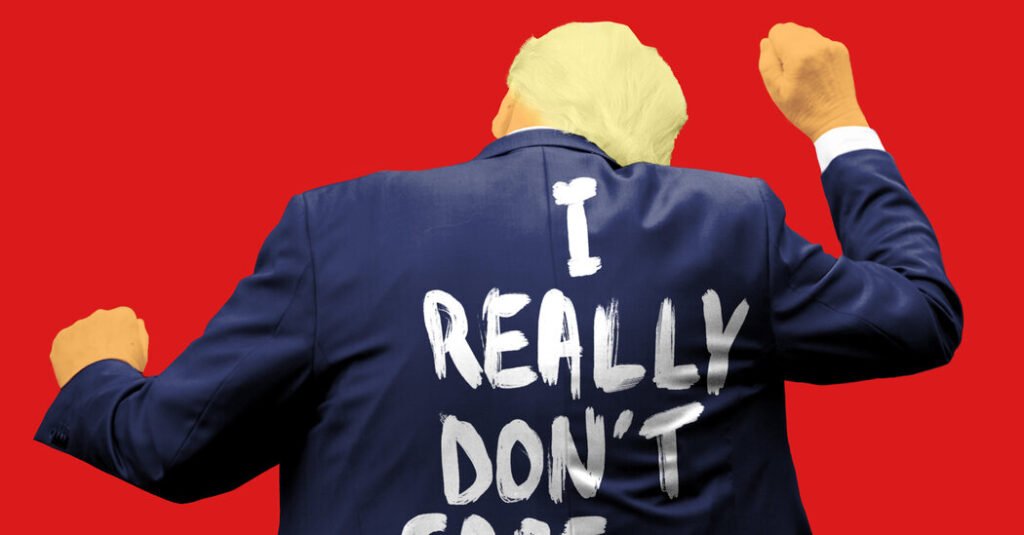
Ever the performer, President Trump has lately been putting on a show of indifference.
The congressional elections on Tuesday, Nov. 3? Farthest thing from his mind. “I don’t care about the midterms,” he said during a cabinet meeting last week. Democrats exulted. Members of the commentariat gasped, as if watching political seppuku.
Stratospheric gas prices? “This is peanuts,” he said about two weeks ago, minimizing the pain felt by less affluent Americans as he bragged about the extravagance of the new ballroom he’s trying to build. It’s a shame he didn’t live two and a half centuries ago, in France. He and Marie Antoinette would have gotten on like a palace on fire.
Trump’s imperial airs, blasé banter and self-indulgent decisions — such as his endorsement of Ken Paxton, who is now the Republicans’ hugely vulnerable nominee in the crucial U.S. Senate race in Texas — create the impression of a president unshakably confident and blissfully unconcerned about voters’ looming judgment.
Don’t be fooled. He may be too arrogant and insulated to fret as much as he should, but there are reasons for his public nonchalance. There are also plenty of exceptions to it.
The most obvious evidence of his intense interest in the midterms is how hard he has tried to stack the deck in Republicans’ favor. The rash of Republican gerrymandering over recent months — with redrawn congressional districts in Texas, North Carolina, Florida and more — didn’t just happen organically, with state-level Republicans beseeching him to support the effort. He ordered them to undertake it. Bullied them, in fact. And he brutally punished any insubordination, as the Indiana Republicans who recently lost their primaries to Trump-endorsed challengers can attest.
The success of this campaign of intimidation has no bearing on the presidential contest in 2028 or on Senate races this year. It’s all about the House, which just so happens to be the chamber most often affected by midterm pendulum swings and the one where Democrats are probably best poised to reclaim a majority. If that didn’t trouble — even terrify — Trump, why all the thundering and threats?
And why insist so furiously on new voting rules nationwide? That’s also not about 2028, when his inability (we pray!) to run for the White House again diminishes his investment in such restrictions. It’s about the midterms. He has been haranguing congressional Republicans to pass legislation that would, among other measures, limit mail-in voting and require people who want to register to vote to provide proof of citizenship. He and his allies clearly believe those changes would more likely depress Democratic votes than Republican ones.
Trump must know that the Senate is highly unlikely to pass that legislation, which the House narrowly approved. But his overwrought assertions of the need for it serve his favorite fiction: Democrats steal elections, so Republicans must go to great lengths to defend themselves and the country against that. The unflagging energy he devotes to this nonsense reflects the undeniable angst he feels about the midterms. He’s prophylactically delegitimizing and challenging any results that repudiate him.
Some political observers have cited the unpopularity of the Iran war — and Trump’s failure to build public support for it before the first strikes — as proof that he’s inadequately attuned to the midterms. But there’s a ready argument against that: His quickie conquest in Venezuela so amped him up and puffed him up that he didn’t sense any need to sweat extensive planning and prepping for his next heady triumph. American pilots would swoop in, speed out and sprint home in time for the victory parades. By all signs, Trump didn’t decide to risk the closing of the Strait of Hormuz and a subsequent spike in what Americans would pay at the pump. He just didn’t envision those possibilities.
And when he talks now about his willingness to suffer whatever political price he must to eliminate Iran as a nuclear threat, that’s not high-minded, farsighted, selfless leadership. (Have you met Trump?) It’s damage control. “I don’t care about the midterms” is what you say when you may have botched them and are trying to alchemize incompetence into valor.
Besides, Trump and his attendants don’t fully accept polls, which have underestimated him before. He knows better than the experts and the critics. Many of them said he couldn’t win in 2016, but he did. Many said he couldn’t come back in 2024, then he showed them. If they’re saying now that Iran is his albatross, then maybe it’s his ascot.
And his supporters stick. That’s the lesson he learned from a criminal conviction that didn’t slow him down one bit and from fans’ interpretations of his crudeness as authenticity, his cruelty as boldness, his thievery as entrepreneurial genius. On the one hand, it would be prudent to wait until after the midterms to insist that he be protected from any tax audits and that the Justice Department put $1.776 billion of taxpayers’ money into a fund with which he can reward his loyalists. On the other, his longstanding mockery of ethics has barely nicked him, so why shouldn’t he do as he wishes when he pleases?
Which is his preference anyway. What’s the point of all his power if he hesitates to flex it? Propelling Paxton into the winner’s circle did that in a way that backing Paxton’s rival in the primary, Senator John Cornyn, wouldn’t have. It drew more notice, caused more upset and had everyone buzzing about Trump’s potency with his base. He wasn’t deaf to the voices that recommended Cornyn as the safer strategy. But his desire to shatter expectations and his impulse for mischief spoke more loudly. He chose the naughty, self-inflating course. He usually does.
At a Republican retreat at the start of the year, Trump acknowledged to his party’s lawmakers that often “when you win the presidency, you lose the midterm.” That’s what happened to him halfway through his first term. He told them: “You got to win the midterms because if we don’t win the midterms, it’s just going to be — I mean, they’ll find a reason to impeach me. I’ll get impeached.”
That doesn’t sound like denial. It sounds like distress. And while the five months since then may have blurred Trump’s focus and left him even more estranged from reality than he typically is, they haven’t knocked him unconscious. Beneath all that bluster and makeup, he’s sweating.
Forward this newsletter to friends …
… and they can sign up for themselves here. It’s published every Monday.
What I’m Reading and Watching
-
My affection for Lauren Groff’s novel “Fates and Furies,” which I recommended in a previous newsletter, led me to her most recent collection of short stories, “Brawler.” Its prose is less showy but equally effective. Groff excels at dribbling out information in a manner that alters your initial perceptions of her characters and artfully makes the point that no one is easily understood. The standout story, “Between the Shadow and the Soul,” exemplifies that approach, and its praises were perfectly sung in The Atlantic by my friend and former editor Honor Jones, who worked for Times Opinion for many years before leaving us — a pox on you, Honor! — for that terrific magazine.
-
The 2025 movie “Pillion,” a critics’ favorite, begins streaming for free on HBO Max this coming Friday; I watched it on Prime for a rental fee last week. Before I tell you why I admired it so much, a warning: It’s not for everyone. If you’re apt to be put off by explicit depictions of the bizarre (at least to me) ways in which a hunky gay biker turns a quirky-looking wallflower into his servant, sexual and otherwise, steer clear. But if the BDSM rituals and paraphernalia don’t deter you, you’ll find surprising humor and disarming sweetness beneath and beside all the raunch. The movie’s writer and director, Harry Lighton, has transported the arc, rhythms and conventions of a rom-com into a milieu that would seem to be utterly resistant to that, a bold decision that serves one of his themes: No subculture’s exoticism or vulgarity can stamp out relationship dynamics that are in fact universal. And while customs and costumes change from crowd to crowd, the tension between desire and dignity doesn’t.
For the Love of Sentences
In The Dispatch, Kevin D. Williamson explained Texas voters’ preference for their “clownish and scandal-plagued attorney general,” Ken Paxton, over Senator John Cornyn, who lost to Paxton in a runoff last week to be the Republican nominee for Cornyn’s seat: “Texas goes through these phases from time to time. Imagine a rich, middle-aged car salesman who ditches his wife and starts dating a 21-year-old stripper with a meth problem, and then imagine that guy is a state — that’s Texas.” (Thanks to Shellie Lohman of Lindale, Texas, for nominating this.)
In his newsletter, Michael Jochum cringed at the collection of past-peak performers, such as Vanilla Ice, who were included in the announced lineup for Trump’s Great American State Fair on the National Mall: “This isn’t a concert lineup. It’s a clearance rack. A musical yard sale assembled by people who think patriotism means wrapping mediocrity in a flag and turning up the smoke machine.” Jochum’s headline: “The lounge act at the end of the Empire.” (Ralph Hammelbacher, Arlington, Va.)
In her newsletter, Betsy Chasse observed that the cosmetic rebellion against time knows no gender: “A man pumping himself full of testosterone so he can feel masculine again is practically a patriotic act now. Entire podcasts are built around men optimizing themselves into chemically enhanced action figures because God forbid anybody simply age like a mammal.” (Kate Kavanagh, Concord, Mass.)
In The Financial Times, Leo Lewis charted the beginnings of one Asian county’s love affair with a currently maligned material: “Japan became a world leader at pouring maximal creativity into absolute ephemera — the flags, fans, trinkets and tat sold or distributed for free at everything from minor marketing campaigns to major sporting events. Plastic, with its ability to monumentalize the mediocre and provide majesty to the mundane, was absolutely at the center of all of this.” (Frank Packard, Tokyo)
In The Wall Street Journal, Richard Snow noted that “American Patriarch,” a new biography of George Washington by H.W. Brands, captured the first American president’s mix of wishfulness and realism: “If he was naïve to think he could prevent the factions that he loathed from hardening into political parties, he was certainly right in his conviction that, once established, they would cook up a devil’s broth of ill feeling.” The book, Snow wrote, also underscores the unlikeliness of this nation’s birth and boom, providing “a tonic reminder that, from its very beginnings, our republic has exhaled a whiff of the miraculous.” (Raymond F. DuBois, Washington, D.C.)
In The New Yorker, Thomas Mallon seized the occasion of a new biography of Mary Todd Lincoln, “An Inconvenient Widow,” by Lois Romano, to question whether the need to see her husband “as a savior and a saint — especially in times as rotten as the present — gives us a motivation, perhaps subconscious, to vilify Mary.” “Each reiteration and exaggeration of Mary’s bad behavior is another civic stroke of the chisel that perfects the monumental Lincoln in our collective imagination,” Mallon wrote. “The task is advanced by our malice toward one, and that one is Mary.” (Amy Michael, Burlingame, Calif.)
Also in The New Yorker, Marella Gayla described the recent meeting of the Park Slope Food Co-op, a grocery store in Brooklyn, that led to its boycott of Israeli products: “It had a quality that you can only find on a nearly seven-thousand-person Zoom call, which is to say that it was baroquely inefficient, searingly passive-aggressive, rived with procedural manipulations, and occasionally inspiring.” (Jack Waggett, Ten Mile, Tenn.)
And Caleb Crain pondered geography and destiny: “If Meriwether Lewis and William Clark hadn’t gone up the Missouri River in 1804 and then down the lower Columbia River in 1805, there might today be less United States and more Canada. Lately, I have been having trouble imagining how that could be seen as a bad thing.” (Jenna West, Iwakuni City, Japan)
To nominate favorite bits of recent writing from The Times or other publications to be mentioned in “For the Love of Sentences,” please email me here and include your name and place of residence.
Read past editions of the newsletter here.
If you’re enjoying what you’re reading, please consider recommending it to others. They can sign up here.
Have feedback? Send me a note at [email protected].
The post Don’t Be Fooled. Trump’s Sweating the Midterms appeared first on New York Times.