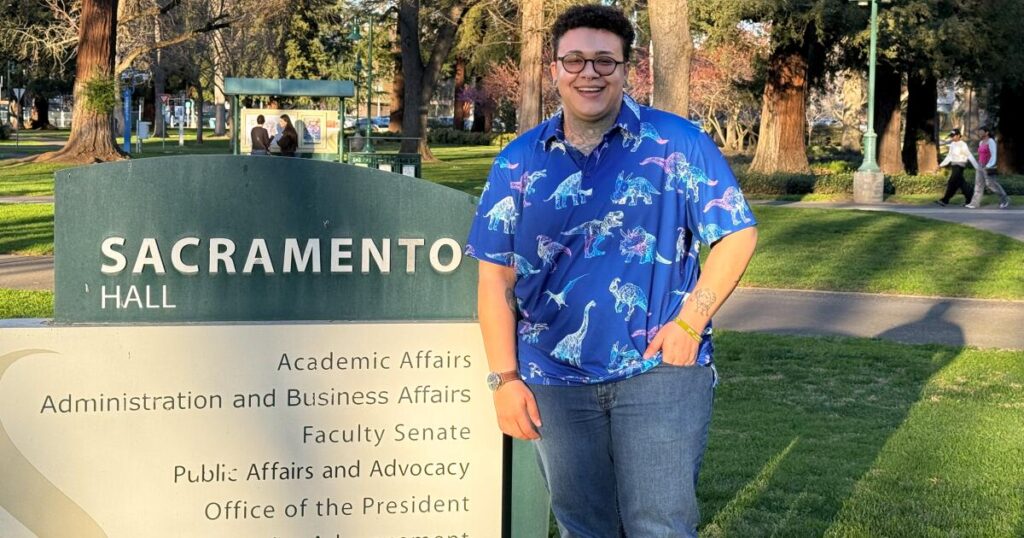
As a teenager in California’s child welfare system, Jarred Holloway bounced between foster families and group homes. He went to three high schools and never felt he had someone in his life to encourage him to prioritize his education, let alone go to college.
“It felt like sometimes you’re just looked at like ‘Oh, this person is not really going to go anywhere,’ ” he said.
Now 26, Holloway is studying business at Sacramento State and plans to graduate with a bachelor’s degree next spring.
To get there, Holloway relied in part on the university’s Guardian Scholars Program.
The program at Sacramento State is one of hundreds around the country designed to help former foster youth succeed in college and beyond. It offers a window into policies that work — from scholarships to housing help to social connections for emotional support — at a time when the federal government has begun focusing renewed attention on these students and holding out the promise of more investment in them.
Last month, the Administration for Children and Families announced an online platform called Fostering the Future where young people will be able to find resources related to their education, job training, housing and healthcare. The platform, scheduled to be available this fall, was developed in response to an executive order issued in late 2025.
In Congress, several bills related to former foster youth are progressing, including one that would more than double the amount that students could get through the Chafee Foster Care Program’s Education and Training Voucher, increasing it from $5,000 to $12,000.
“I think that things like modernizing the child welfare system, recognizing the unique needs of transition-age youth, increasing flexibility in Education and Training Vouchers are really important. They’re a huge success in this executive order,” said Rebecca Louve Yao, chief executive of the National Foster Youth Institute, a nonprofit that aims to improve the child welfare system and empower foster youth.
Former foster youth — meaning anyone who has spent time in the child welfare system, typically due to abuse or neglect — have some of the lowest college graduation rates of any demographic group. An estimated 8% to 11% of former foster youth go on to earn any college degree, compared with 49% of adults overall, according to one analysis. They also typically have lower rates of employment and lower earnings than their peers with similar levels of education.
Experts attribute the students’ struggles in higher education to instability and trauma they experienced growing up, inadequate academic preparedness and a lack of social and emotional support systems in college.
Leaders at Sacramento State say they are trying to give these students the best chances at success. Last fall, they began offering guaranteed admission to former foster youth as long as they graduated from high school with a GPA of 2.5 or higher and completed California State University’s series of minimum course requirements for admission.
Once students are in the program — which began 20 years ago and is funded by a combination of private and public dollars — they get special scholarships, help paying for textbooks, priority registration for campus housing and courses, academic and financial advising and even emergency cash grants if needed.
Even so, university data show that of the 11 students who entered the Guardian Scholars Program as freshmen in 2019, one graduated within four years and five graduated within six years. Eight of the 12 former foster youth community college transfer students who enrolled in 2021 graduated in four years, and eight of the 25 who enrolled in 2023 graduated in two years.
“We’re nowhere near where I want to be,” said J. Luke Wood, the university’s president. The program has grown from 52 students in fall 2021 to 248 students in fall 2025, largely because of a 2022 boost in state funding.
Despite the program’s support, many students have to work one or two jobs to pay for their living expenses, which can slow them down or cause them to drop out.
Christiano Quinones, for example, had dropped out of high school, aged out of foster care and was working as a pastry chef when a co-worker mentioned a program offering two years of free tuition toward an associate degree for first-time college students. After earning his GED, he received that associate degree from Fullerton College, then transferred to Sacramento State.
He had housing lined up, but it fell through, and last fall he and his partner slept in their car when they were broke, or in hotels when they’d saved enough money from their financial aid refunds and jobs. Over winter break, Guardian Scholars staffers helped Quinones get into a dorm for the spring semester. He’s had to take out student loans to pay for it.
Despite the housing struggles, Quionones said being part of the Guardian Scholars Program has given him a sense of belonging.
“Coming from not a very stable familial group, not really having any friends, moving around, and you know, being in and out of care, it made it really, really hard to have that sense of ‘somebody believes in you,’” Quinones said.
Wood, who grew up in foster care, has taken a special interest in the program, calling Guardian Scholars students his “brothers and sisters.” A few years ago, he moved the program’s office to the same building as his own, and regularly shares conversations — and plays music — with students like Holloway.
After all the disruption he experienced in high school, Holloway enrolled at Cosumnes River College, a two-year college in Sacramento, with support from people at his church. There he joined a group for students from historically underrepresented backgrounds and another group for former foster youth, where he learned about financial aid and other supports for higher education. When he transferred to Sacramento State, he immediately got involved with Guardian Scholars.
He now works in the Guardian Scholars office, helping out with events and trying to make the office a place of community where other former foster youth can take their minds off their challenges.
He spends a lot of time there, even when he’s not working. Sometimes he’s doing homework; other times, he’s playing Mario Kart on the Nintendo Switch or strumming a blue guitar. “There’s joy and playing together and working together and having fun,” he said.
It makes a big difference when students have “somebody on campus that really understands the unique and complex needs of former foster youth, that’s helping former foster youth build community with each other and find resources on and off campus,” Louve Yao of the National Foster Youth Institute said.
She hopes that the online Fostering the Future platform, which is designed to help connect former foster youth with appropriate resources, will help, especially since it can help students outside of work hours: “If all of your people in your life are professionals from 9 to 5 Monday through Friday, who do you reach out to on the weekend?”
Sanchez writes for the the Hechinger Report, which produced this article and is a nonprofit, independent news organization focused on inequality and innovation in education.
The post Former foster youth face low odds of college or job success. Some are trying to change that appeared first on Los Angeles Times.