Warren Gorlick is a retired policy adviser at the Treasury Department and attorney at the Commodity Futures Trading Commission.
The Washington Commanders are coming home to RFK Stadium — a welcome development that could catalyze investment, create jobs and bring long-overdue attention to Ward 7. But before D.C. taxpayers are handed a staggering bill for the redevelopment, the city deserves an honest accounting of what that money buys, who should be paying for it and whether the plan on the table is adequate to the task.
The Washington Metropolitan Area Transit Authority’s proposed transit solution is shockingly expensive. The agency estimates that a new Metro station at the RFK site would cost about $1 billion, and even that option has been ruled out as impossible to complete before the stadium’s 2030 opening. The fallback plan — upgrading the Stadium-Armory Metro stop and launching a “Gold Line” bus to Union Station — still carries an estimated price tag of $300 million to $400 million. The Metro board’s proposal pins the District with the cost.
The agency attributes these figures to engineering constraints. The RFK site has no flat stretch of track where a train could safely stop; the curved geometry would require a restructuring of track alignment, support structures and platforms before building could begin. Metro’s CEO put it plainly: “It’s a billion dollars to change our track alignment, our structure, everything … to even allow a station to happen.”
Comparison with similar projects abroad is revealing. Madrid is extending its Line 11 subway with five underground stations, at a cost of roughly 671 million euros — well under $200 million per station. Spain’s capital is excavating deep-bore tunnels and building two of these stations from scratch for a fraction of what the Metro says it needs to expand a mezzanine and add escalators to a station that already exists.
To be fair, this isn’t only a Washington problem. Transit construction costs across the United States are chronically inflated by fragmented project management, excessive consultant layering, slow environmental reviews and procurement rules that favor process over outcome. But acknowledging that pathology is not the same as accepting it. Before District leaders commit hundreds of millions in taxpayer funds, they must demand independent scrutiny of whether the estimates reflect necessity — or a cost culture that has never been questioned.
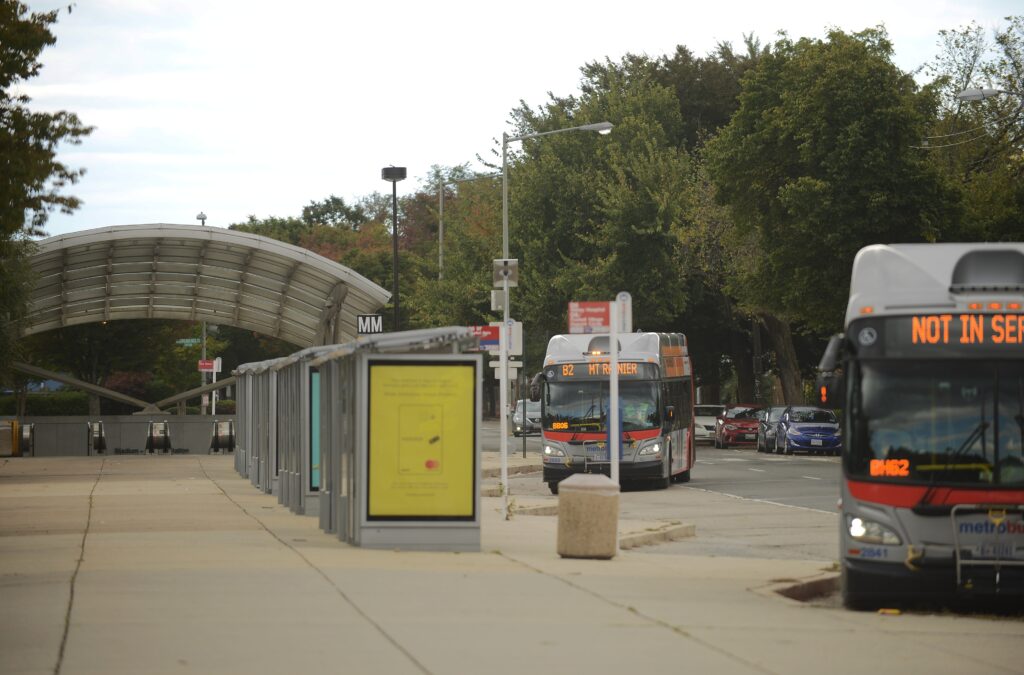
The operational reality of the plan also raises concerns. The Metro’s strategy relies on the new Gold Line bus, running from the stadium to Union Station via H Street and Benning Road. On paper the concept has appeal: bus lanes, frequent service and connections to Metro, MARC, the Virginia Railway Express and Amtrak.
The arithmetic, however, is troubling. The new stadium will hold roughly 65,000 fans while offering only 8,000 parking spaces. The Metro board projects that up to 40,000 attendees will depend on public transit, which will funnel them through two primary choke points: an upgraded Stadium-Armory station and the Gold Line corridor. H Street is a narrow, commercially active strip, not a grand boulevard. Carving out bus lanes means stripping away traffic lanes or parking. The resulting congestion will not stay on H Street; it will spill into the surrounding neighborhoods of Northeast Washington. Without improvements, Metro officials warn that clearing the stadium after a typical game could take over two hours. Whether the proposed upgrades can handle playoff-level crowds remains an uncomfortably open question.
Which brings us to the ultimate question: Who pays?
RFK Stadium is not an amenity for D.C. only; it is a regional magnet. Virginia and Maryland residents will fill seats every autumn, and the Metro lines serving the site carry federal employees, tourists and suburban commuters every weekday. The transit upgrades that make the stadium viable are regional infrastructure, not a local nicety.
There is a workable blueprint for this kind of shared investment. The funding for the Silver Line to Dulles International Airport was assembled from federal grants, Virginia state appropriations, toll road revenue and Loudoun County contributions, with each beneficiary carrying a proportionate share. The project was not simple — it required political will and sustained negotiation — but it worked.
The same logic must govern the Commanders’ return — and extend to the team itself. The franchise stands to reap enormous rewards from a new stadium in the nation’s capital: premium ticket revenue, lucrative naming rights and decades of appreciation on a premier urban site. It is not fair for the Commanders to celebrate this homecoming while leaving District taxpayers to absorb the transit bill. They should be at the table as a contributor, not a passive beneficiary.
If the federal government, Maryland, Virginia and the Commanders are unwilling to share the cost of the transit infrastructure the stadium requires, then the District should be equally unwilling to fund the improvements alone — and should say so. The Commanders are worth bringing back. But D.C. should not foot the bill by itself.
The post Why the Metro’s RFK Stadium plan is troubling appeared first on Washington Post.