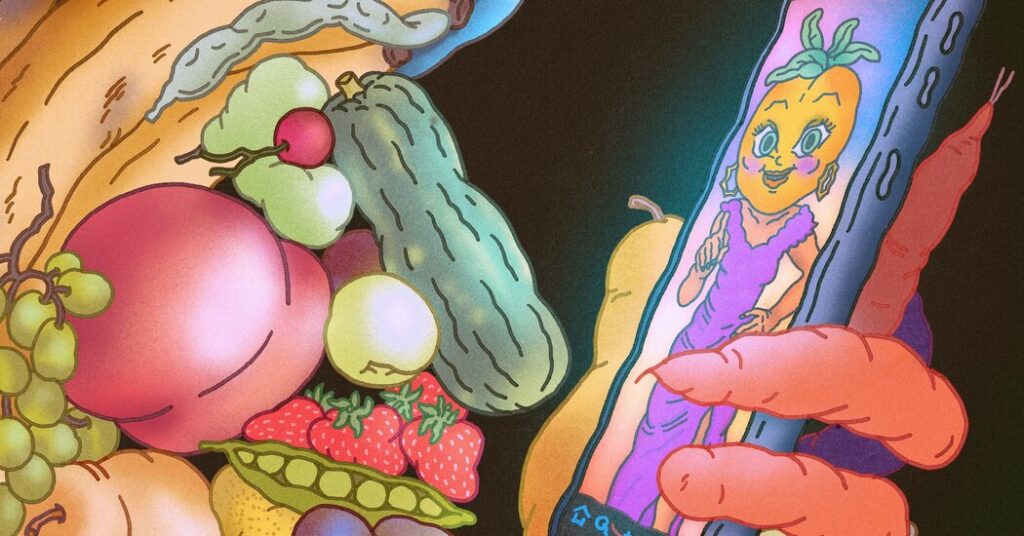
In March, a TikTok account called ai.cinema021 published 20-plus episodes of an A.I.-generated “dating” show about humanoid fruit called “Fruit Love Island.” The fruits are aggressively sexualized, with ripped abs or large breasts. Their dialogue is clichéd yet alien at the same time, like how a TV might learn to talk by watching other TVs. For example:
Bananito: I’m here to have fun and probably break a few hearts. Orangelo: [Laughs.] Bro said the quiet part out loud.
It feels quaint to point out the many continuity errors: From cut to cut, the fruits wear different clothes or appear at different locations and times of day. Many episodes involve them gratuitously doing backflips.
This description will not seem remarkable to readers who have consumed a sufficient amount of A.I.-generated content, colloquially called slop. What is remarkable is that “Fruit Love Island” achieved what was arguably slop’s breakout moment. Amid the deluge of anonymously produced and forgettable short-form videos online, this series went so viral that each of its installments surpassed 10 million views — making it prominent enough to spawn an entire subgenre of videos about the sex lives of produce, including “Fruit Paternity Court” and a drama about pregnant broccoli. This virality suggests two possibilities: that people loved “Fruit Love Island” and reposted it, or that they found it enraging and reposted it. My assessment is that the series activated negative emotions of the sort that would compel you to show it to someone else and say, “Look how everything sucks now.” Either way, the result was the same: The algorithm detected interest and served it to users around the world.
I am not alone in thinking that these fruit videos constitute a new low for internet culture. For many, the shock of “Fruit Love Island” was in how it took “Love Island” — a reality show that was already a concerning indicator, culture-wise — and made it even dumber. “Think ‘Love Island’ Is Bad?” read a BBC News headline. “Wait Until You See the A.I. Fruit Version.” “Fruit Love Island” repackaged the crass vapidity of reality TV for even shorter attention spans, which perversely made it ideal fodder to be clipped and mentioned on other media, including TV.
This phenomenon brings us to the one potentially useful thing about A.I. slop. Social media is overrun with it, from shrimp Jesus to protean monsters to Iranian propaganda in the style of Legos, and people hate it. Identifying an image, song, book — or TikTok series — as made by A.I. is one of the surest ways to turn social media users against it. And so the inescapable visibility of slop, combined with a unified public response to it, is reconstituting a shared cultural base line. That is a necessary thing for a society to have. In its ubiquity, A.I. slop has the potential to give back something that the internet was supposed to have taken away: a monoculture.
Remember monoculture? It was the phenomenon by which TV, movies and music were consumed by enough people at the same time to transform culture into a shared experience. You could have an opinion about, say, the character of Steve Urkel on “Family Matters,” and other people would recognize and respond to it in a way that has since been lost in the algorithmically personalized entertainment landscape of today. I miss that feeling, even though the monoculture of my youth was mostly dumb and unsatisfying (see: Steve Urkel), and while I was in it I complained about it constantly.
The high point of monoculture was the reign of network television — from the 1950s to the 1990s or so — when three or four broadcast channels were watched by tens of millions of households every night. At least until TiVo, you had to get your entertainment from the same shows at the same time as everyone else. These shows were meant to hold the attention of the largest possible audience, and the better they were at that, the worse they tended to be artistically.
When I was growing up, contempt for TV was an aspect of how I saw myself in relation to others: I considered myself part of a counterculture that rejected television (except “The Simpsons,” which all my friends loved until Season 9) in favor of weirder, more sophisticated media, the same way I rejected the Backstreet Boys in favor of the Vandals. The sense that most other people settled for entertainment that I considered feeble was the primary way I enjoyed monoculture: as a thing I could define myself against.
All that ended somewhere between 9/11 and Instagram Reels, a period during which streaming supplanted broadcasting as the primary mode of distribution, and scrolling — particularly short-form videos — supplanted pretty much everything else. Culture isn’t dead, of course, but its influence has become fragmented rather than unifying. Even the meme-level virality of the kind that made Harambe a household name barely happens anymore; platforms have become more siloed and algorithms more specific in ways that inhibit crossover on a broad scale. The experience of watching the same thing at the same time as everyone else in the country is rare now, reserved for sports and certain political events.
“Fruit Love Island” was an exception to this rule: An old-fashioned viral craze that overwhelmed the personalized algorithm. The most popular episode got more than 38 million views, which is not exactly the Super Bowl but is, for example, more than 20 times the average number of people who watch a given episode of “The Tonight Show Starring Jimmy Fallon.” This comparison is imperfect, because some of “Fruit Love Island”’s views probably come from people who watched the same video multiple times, and an additional portion of Fallon’s audience watches on YouTube and TikTok, but it is still striking. The numbers lay bare how the reward mechanisms of the internet elevate A.I. content that is 10 percent as good as human-made media but can be generated for less than 1 percent of the cost.
So far, no A.I. account has put up numbers that compete with those of the most popular human creators; MrBeast has 128 million TikTok followers and, in April, posted a video that got 89 million views, which is good by his standards but by no means his most successful work. But just as a YouTube creator’s show is cheaper to produce than the “Tonight Show,” making slop presents far lower barriers to entry. Anyone with access to a generative A.I. tool can make a video and upload it. And because A.I. tools work by combining elements based on how likely they were to appear in videos from the past, the outputs of generative A.I. tools end up eerily similar. The characters in “Fruit Love Island,” for example, have the same bug-eyed, overly expressive faces as seemingly every cartoon downstream from Pixar, plus processor-melting amounts of lighting texture. In theory, cheap tools and open platforms should yield a variety of A.I.-generated video; in practice, it all kind of feels the same.
As a result, slop has invaded social media in ways that make it feel like an oppressive force: all vaguely familiar, all pitched to an audience dumber than anyone you actually know, entertainment that numbs the spirit rather than expanding it, imposed by economic forces no one can control. This reality has inspired a demographic of people to react strongly against it — much as I once rejected network TV. Ai.cinema021, the creator of “Fruit Love Island,” revealed in several posts that have since been deleted that viewers inundated TikTok with requests to take down the show and left a stream of angry comments on each episode. Eventually the account itself was deleted. Perhaps slop is everywhere right now because it offends a larger audience than anything that has come before.
Smartphone-enabled social media has taught us a sobering lesson in the power of entertainment to set an intellectual level, individually and collectively. “Fruit Love Island” is provocative because it points to one possible future, in which A.I. slop supplants the influencer ads, clips and iterative joke videos that now dominate social media, replacing them with even more stupefying content that will shape the sensibilities of a younger generation of internet users who don’t know any better than to accept it. The word “dystopia” gets thrown around a lot, but that’s what a dystopian future looks like to me: a culture whose idea of entertainment is this viral slop video in which a malevolent fat woman smashes a glass bridge and sends a toddler falling into the river below, to be saved by a golden retriever.
Another possibility is that we will decide we want something more than the narrative arc from horny fruit to angry fruit, or drowning toddler to heroic dog. In April, OpenAI abruptly shut down its video-generation app Sora as a result of the enormously expensive computing power it used and its low user-retention rate. That outcome gives me hope that the plan to produce cheap videos with hyperexpensive server farms may not pencil out. Culturally, the long-term consequence of A.I. slop may not be to degrade future audiences so much as to finally establish a base line that internet users refuse to sink beneath. Perhaps A.I. slop will lose its capacity to shock us, along with its ability to monetize our indignation, and then it will simply go away.
Dan Brooks writes essays, fiction and commentary from Missoula, Mont.
The Times is committed to publishing a diversity of letters to the editor. We’d like to hear what you think about this or any of our articles. Here are some tips. And here’s our email: [email protected].
Follow the New York Times Opinion section on Facebook, Instagram, TikTok, Bluesky, WhatsApp and Threads.
The post Algorithms Ruined Mass Culture. Slop Filled the Void. appeared first on New York Times.