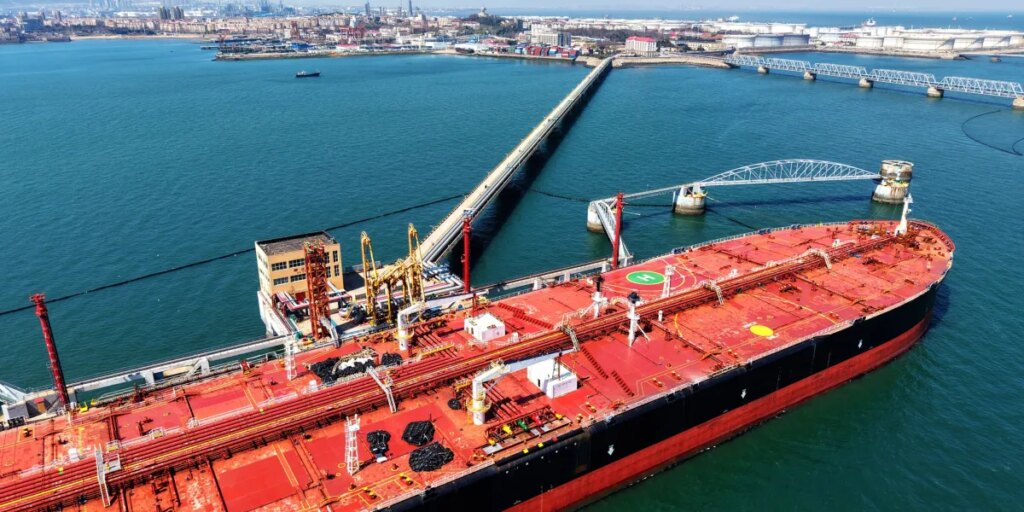
China has quietly emerged as the global oil market’s stealthy swing consumer, potentially holding off doomsday a while longer.
For months, investors wondered why crude oil prices failed to reach worst-case scenarios, even as a fifth of the world’s supply remained bottled up in Persian Gulf.
To be sure, Saudi Arabia diverted exports to bypass the Strait of Hormuz, economies in Asia imposed rationing, and the world’s biggest oil-consuming countries coordinated releases from strategic reserves.
But the efforts haven’t fully offset the missing Mideast oil, with the shortfall estimated at more than 10 million barrels a day. At the same time, the U.S. naval blockade on Iran removed took more barrels off the market.
As a result, the ongoing stalemate between the U.S. and Iran on reaching a lasting ceasefire deal that reopens the strait has stoked increasing panic from a growing chorus of voices.
“We’re approaching unheard of inventory levels,” Exxon Senior Vice President Neil Chapman warned at an industry conference on Thursday. “I mean really, really low levels. You can debate whether that’s going to hit those really low levels in two weeks or three weeks. Once you get to that point, then you’ll see price shoot up.”
Analysts have predicted the moment of truth—when global inventories reach critically low levels—could arrive as soon as June. But markets have less visibility into China’s vast stockpiles, which are estimated at around 1.4 billion barrels.
Meanwhile, China’s crude imports plunged 20% in April to 9.4 million barrels per day, representing the biggest drop since the pandemic, and data for May suggest a steeper dive to 7 million.
Due to Beijing’s cap on fuel exports, Chinese refineries are consuming less oil. In addition, China appears to have eased off its earlier oil hoarding while also releasing some of its enormous reserves.
“Taking a step back, weakness in China’s crude imports could delay the crunch point for the global oil market,” Hamad Hussain, climate and commodities economist at Capital Economics, said in a note on Friday.
He previously estimated that Brent crude prices would hit record highs by the end of June, assuming market conditions and drawdown trends persisted.
But the latest evidence suggests Chinese refiners more aggressively drained inventories in May compared to April, absorbing a greater share of the global oil shock, Hussain added.
“Back of the envelope calculations suggest that if China’s demand for crude in May were to be repeated in June, the ‘tipping point’ in the global oil market could be pushed back from June and into July,” he wrote.
Such relief couldn’t come any sooner.
JPMorgan has warned that commercial oil inventories in the developed world could “approach operational stress levels” by early June.
Chevron CEO Mike Wirth said Thursday that oil prices will likely soon jump as the market’s “shock absorbers” are depleted, weakening its ability to continue absorbing the disruption.
“Over the next few weeks, we’re likely to see those pressures flow through more directly to physical prices and there’s more upward pressure that I would expect as we get into June and certainly into July,” he added.
Analysts at UBS said earlier this month that oil inventories are approaching record lows, warning that “buffers have now largely been exhausted.”
As stockpiles go even lower, UBS said oil prices could become more volatile and highlighted the “risk of panic buying if physical dislocation intensifies and the Strait of Hormuz remains closed.”
But for Robin Brooks, senior fellow at the Brookings Institution, the lack of a disastrous spike in oil prices hasn’t been a mystery as he has consistently dismissed such dire predictions.
Instead, he argued oil markets have more wiggle room than thought, pointing out that South Korea pivoted away from Saudi Arabia and began importing more oil from Canada, Malaysia and elsewhere.
South Korea’s total oil imports still fell, and it paid a hefty price top obtain alternate supplies. But the lesson is that markets are more resilient and resourceful than they get credit for, Brooks explained in a Substack post on Tuesday.
“The bottom line is that this supply shock really wasn’t all that traumatic,” he concluded. “That’s also why oil prices didn’t have to rise to apocalyptic levels. There just wasn’t all that much demand that needed to be ‘destroyed.’”
The post Wall Street may have solved a nagging mystery in global oil markets as doomsday scenarios have yet to arrive appeared first on Fortune.