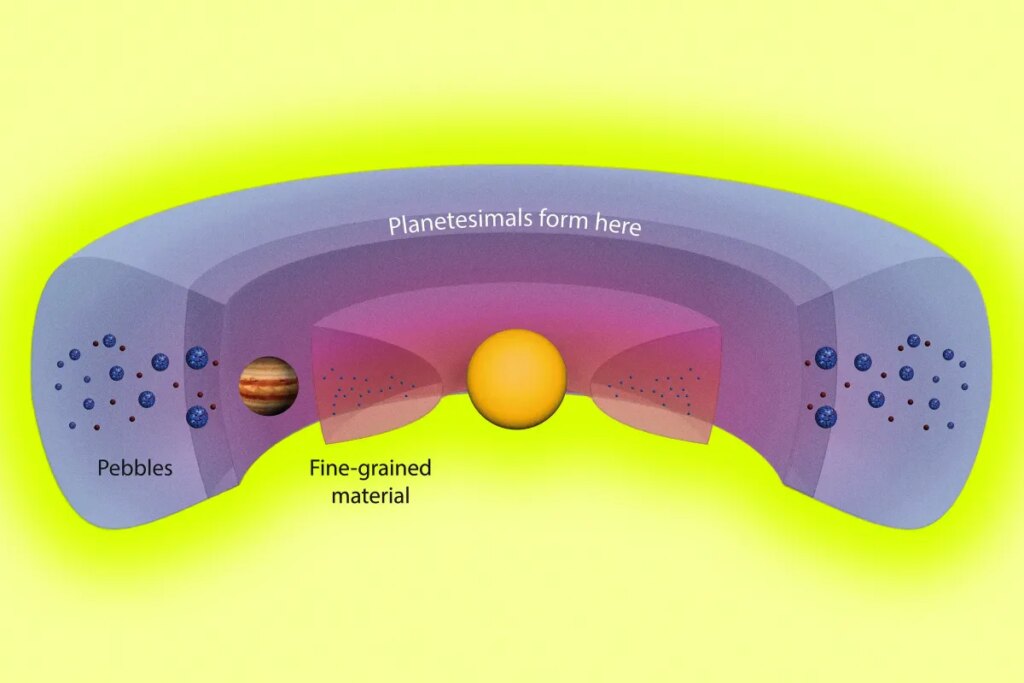
Astronomers have spotted a “planet factory” in space that could explain the origins of bizarre meteorites scattered across the Earth.
Lurking beyond Jupiter’s orbit, the ring-shaped region is packed with gas and dust that may have allowed it to serve as a breeding ground for so-called planetesimals, mile-length solid masses that can become the building blocks planets, when the solar system was in its infancy.
But that’s not all. In computer simulations described in a new study published in The Astrophysical Journals, the team found that the region also produced planetesimals of different compositions, perhaps making it one of the most influential planet-forming regions in our star’s domain.
“Different types of planetesimals apparently formed in the same region of the early dust and gas disk, only at different times. The region just outside Jupiter’s orbit offered excellent conditions for this,” study coauthor Joanna Drążkowska, an astrophysicist at the Max Planck Institute for Solar System Research, said in a statement about the work.
The mystery stems from a class of planetesimals called carbonaceous chondrites that formed around two to four million years after the solar system first came together. Though most planetesimals are thought to have been ejected as the solar system matured, traces of these survive as meteorite fragments that frequently bombard our planet, and it’s the rarer and unusually carbon heavy ones — our aforementioned chondrites — that prove most intriguing. They’re composed of distinct dust grains, but the proportion of these grains varies dramatically over time, with one generation made of notably crumbly grains, and others sturdier grains. What region could’ve formed such a medley of planetesimals in a short window was unknown.
A so-called “dust trap” just beyond Jupiter provides a tidy explanation, the researchers found. When the Sun was young, it was encircled by a huge disk of material in which the planets eventually formed. When Jupiter came along with its incredible mass, it sucked up most of the planet-forming material around its orbit, creating a gap in the so-called protoplanetary disk. A knock-on effect of this was that it also created a ring of higher pressure gas outside the neighborhood it cleared, trapping dust grains that clumped together into pebbles, which could eventually birth planetesimals.
In simulations modeling both microscopic particle collisions and large-scale movements in the protoplanetary disk, the researchers demonstrated that some particles could become trapped in certain regions, like the one near Jupiter. Further underscoring the planet’s role, they also found that it acted as a barrier for larger, more sturdy particles than smaller ones. This was all occurring as already-forming planetesimals sucked up some of the free-floating material. Over time, these dueling processes helped create planetesimals of two distinct generations. In the first 500,000 years, the abundance of crumbly grains dropped before rising over the next million years.
These findings, if borne out, could have broader implications for our understanding of the solar system’s evolution.
“There is strong evidence that dust traps were the preferred birthplace of planetesimals in our solar system,” Drążkowska said.
“For the first time, we have succeeded in accurately reproducing the results of laboratory studies of meteorites using computer simulations of the early solar system,” added coauthor Thorsten Kleine, Max Planck cosmochemist. “The meteorites serve, so to speak, as a touchstone for theories of planetary formation.”
More on space: Scientist Suggests That 3I/ATLAS May Have Seeded Life as It Careened Through Our Solar System
The post Scientists Spot What Appears to Be a Ring-Shaped “Planet Factory” Deep Out in Space appeared first on Futurism.