OBEID, Sudan — Its illicit journey begins in the blood-soaked orchards of central Sudan before being spirited to ports across Africa and then to the U.S. and Europe.
By the time it ends up in everything from M&Ms to medicines to makeup, few consumers or businesses know they’re contributing to the world’s worst humanitarian disaster.
Gum arabic, a resin that comes from the acacia tree, is as ubiquitous as it is unglamorous, virtually unknown despite being a vital ingredient in hundreds of products. Its importance as a thickener and stabilizer — with no real substitute — should make it a boon for Sudan, once responsible for up to 80% of the world’s supply.
Instead, gum arabic, like so much of the country’s gargantuan wealth, now provides both the reason and resources for its staggeringly ruinous civil war.
That war, now in its fourth year with little sign of abating, has killed hundreds of thousands, displaced some 14 million people and left almost 20 million facing acute hunger. It has also co-opted the economy, so that Sudan’s many riches bankroll the belligerents even as most Sudanese are impoverished.
The gum trade — which earned Sudan $183 million in 2022 and supports some 5 million people, economic experts say — provides an instructive case:
The fighting began in April 2023, pitting Sudan’s military against its former ally, the Rapid Support Forces or RSF, a paramilitary group. With front lines mostly stalemated, the country has been essentially split in two, leaving the government in charge of the capital of Khartoum and Sudan’s east, while the RSF dominates the west.
The flash point between the two sides is Kordofan, the central Sudanese region that forms the heart of the “gum arabic belt,” a verdant strip of acacia trees stretching across the country.
Since last year, when the RSF overran parts of Darfur and Kordofan, the militia has commandeered the gum trade, integrating it into its smuggling empire and further starving government coffers.
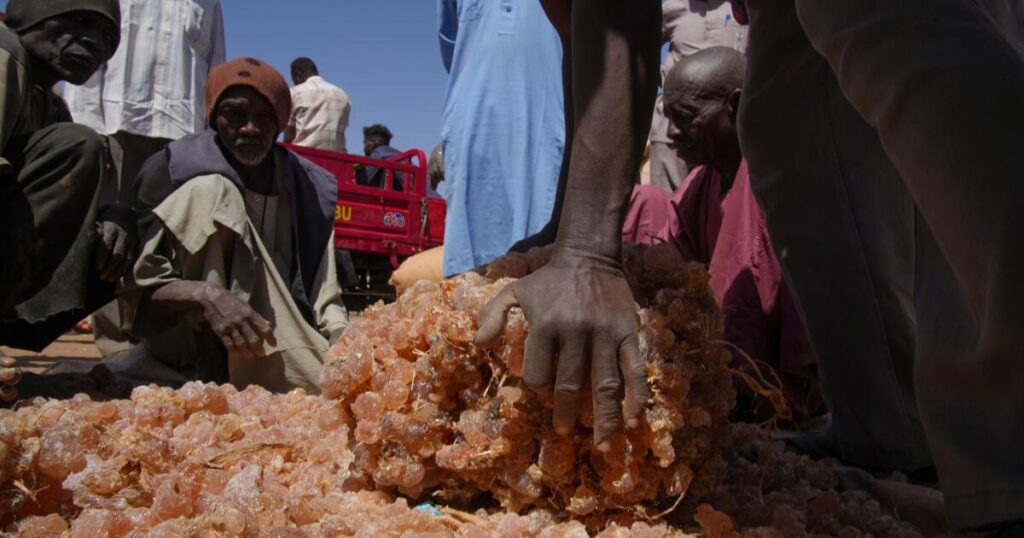
The fallout can be seen in Obeid’s central market. It was once home to the world’s largest gum arabic exchange. Trucks wobbling under piles of amber-colored globules would make the twice-daily trek from Al-Nahud, a town 120 miles west of Obeid and an agricultural hub for the most prized variety of gum arabic, Hashab.
“Now we’re lucky if we can bring a donkey cart’s load; that’s six bags, barely half a ton,” said Adam Ahmad, a 47-year-old farmer from a village near Al-Nahud who would regularly deliver seven tons to the market.
Everything changed, he said, when the RSF overran Al-Nahud last May. The militia, which has created a rival government based in Darfur, banned all agricultural shipments to government-held areas such as Obeid and seized control of supply routes. It also imposed heavy taxes on trucks carrying gum arabic, sometimes reaching higher than $2,000.
Leaning on a burlap bag brimming with gum arabic, Ahmad pointed to a map on a journalist’s phone to show the circuitous path he took to get here.
It had taken more than a week, he said, much of it a white-knuckle gantlet dodging RSF patrols who might accuse him of pro-government allegiances, take his cargo and kill him, or demand exorbitant fees, take the cargo when he couldn’t pay and then beat or kill him.
Harvesting isn’t easy, either. Before, Ahmad could tap — meaning to cut incisions in the acacia trees, which exude sap that a few weeks later hardens into nodules of Hashab gum — four orchards in one go. Now he would risk only one or two orchards at most, for fear of RSF harassment.
Nearby, a group of men sat cross-legged on the ground in a circle, shielding their eyes from errant flakes as one of them hammered chunks off a large clump of gum. When a chunk fell near them, they worked it with their hands, separating it into individual globules that they tossed in a growing pile.
Casting his discerning eye on the pile was Ahmad Mastour, a gum trader with Afritec, a Sudanese gum-processing company.
“What you’re seeing here in this market isn’t even 10% of what we could find before,” he said. Afritec used to handle thousands of tons of gum, he said, but the last two years have been difficult.
RSF militiamen looted the company’s warehouses in Al-Nahud, taking 3,000 tons of gum, along with trucks, tractors and even generators. Other manufacturers in Al-Nahud weren’t spared, either; more than $125 million worth of gum was estimated to have been taken.
A U.N. Panel of Experts said in a 2025 report that the looting was condoned by RSF commanders as compensation for fighters.
“This year we had to completely stop production. It’s a huge, huge amount of damage, a disaster for me and the main company,” Mastour said.
Other Sudanese commodities have become part of each side’s war machines, especially gold, the mining of which actually increased during the conflict as prices surged worldwide. (So profitable is the trade that gum harvesters complain of not finding enough laborers to work acacia orchards since young people can make more money mining gold.)
Observers estimate the RSF and its associated government are raking in anywhere from approximately $1 billion to $2 billion annually from selling various commodities, making RSF-held areas arguably the top non-state economy in the world. Those proceeds — along with looting — are used to pay fighter salaries, and lavish the RSF with an arsenal of cheaply made, high-tech drones.
Like with gold, the RSF smuggles gum arabic through border points it controls to neighboring countries, including Libya, Chad, Central African Republic and South Sudan. Once there, it’s mixed with local gum to circumvent sourcing policies of international gum processing companies, which aim to curb import of gum from conflict-ridden areas.
Parts of Sudan are under a United Nations arms embargo. A U.N. report earlier this year said the RSF’s action in Darfur — especially in El Fasher, where its militiamen are thought to have massacred 70,000 people — had the “hallmarks of genocide.” The government has also been accused of war crimes, including indiscriminate shelling of civilian areas.
To combat smuggling, industry leaders such as the French firms Nexira and Alland & Robert say they buy only gum arabic certified by the Sudanese government in Port Sudan.
But they have also bought from neighboring countries that are masking Sudanese gum as local, traders say.
“These nations, before the war they didn’t export a lot of gum, especially Hashab. But in the last two years, we’ve seen large amounts come out of them,” said Mahmoud Abdul-Raouf, chief executive of Gezira Group, a gum processing company based in Port Sudan.
Merchants and farmers interviewed in Obeid said the bulk of stolen gum is being taken to Chad, sold at bargain prices, then re-exported through seaports such as Douala in Cameroon.
“If a ton of gum arabic is $5,000, in Chad they’ll sell it for $2,000. They don’t care because they stole it; it’s all profit for them,” Mastour said.
Since the war, government customs figures from Chad and France show Chad overtaking Sudan as the lead supplier of gum arabic to the U.S. and almost doubling its exports to France, an increase many attribute less to a surge in productivity than to looting from Sudan.
Foreign sponsors of Sudan’s war have also got in on the game, observers say. Saudi Arabia, which supports the government, and the United Arab Emirates, the RSF’s top backer, have both become re-export hubs for gum, processing it into goods exported to Asia and Europe. (The UAE denies backing the RSF, but its influence has been well documented.)
Because battles in Darfur and Kordofan have disrupted farming, prices of gum arabic along with other agricultural goods have spiked. But less and less of that windfall reaches the millions of Sudanese it once sustained.
“Everyone here is affected by the war, from the smallest farmer to the largest merchant,” Mastour said.
“And there’s no sign it will end soon.”
The post The secret ingredient tying your candy, makeup and medicines to Sudan’s war appeared first on Los Angeles Times.