The statue showed up out of nowhere.
On the morning of March 20, 2022, passers-by in the South Indian town of Bodhan were taken aback to find that an almost 10-foot statue of a 17th-century Hindu warrior king had been erected without authorization at a busy intersection.
By the time the police arrived, a few dozen men, both Hindus and Muslims, were pelting stones at each other. The local authorities, worried about a full-blown riot, swiftly imposed a ban on public gatherings.
It didn’t take long to find who was responsible. Gopi Kishan, a member of an extreme Hindu right-wing group, had pulled off the brazen act — involving weeks of planning and a motorcycle convoy — out of frustration. The authorities had informally blessed his petition to erect a statue, Mr. Kishan said, but dithered in giving him the necessary papers, citing the potential for what he called a “law-and-order problem” in a city with a large Muslim population.
But Mr. Kishan said he didn’t intend to incite violence. He simply wanted to give the respect he thought was due to Shivaji, who built an empire from scratch and became legendary for the military cunning with which he fought the Muslim Mughal dynasty that dominated much of present-day India for around 200 years.
“Had he not fought against the Mughals then, the word Hindu would not have existed today,” Mr. Kishan said.
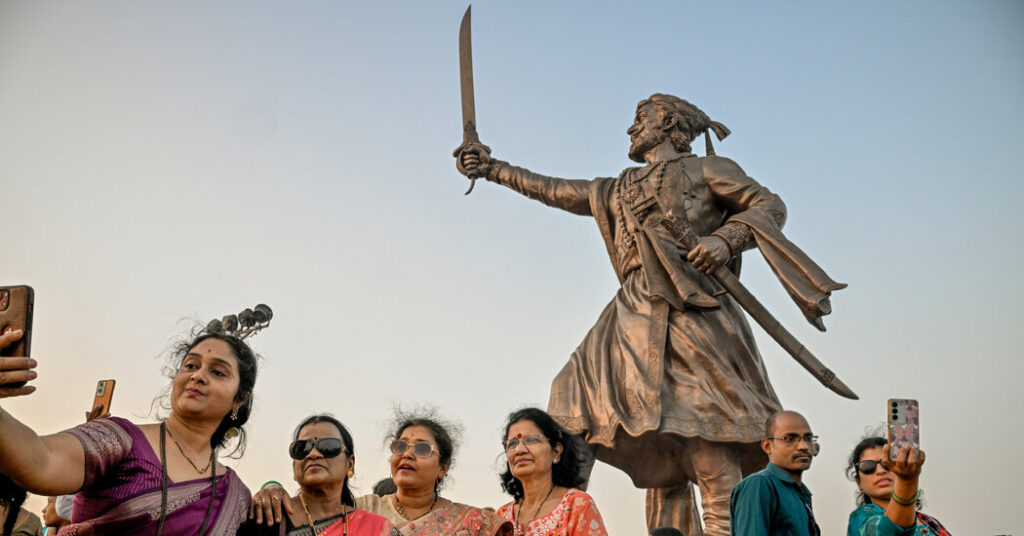
India is in the throes of Shivaji fever. Across the country, hundreds of statues of the king — usually on horseback, brandishing a sword — have begun studding the broader landscape, popping up in the country’s port cities and along its disputed borders with China and Pakistan. Such tributes to the king, a staple of school history textbooks, had previously been mostly found in Maharashtra, the Indian state dominated by the Maratha community — a broad grouping of Hindus that Shivaji was born into, and that includes farmers and warriors, some of whom are considered lower caste.
These efforts are often backed by Hindu nationalists who promote Shivaji as a self-made, pan-Indian martial hero. They try to fit his story into a seamless narrative in which his defense of his land was also a defense of Hinduism against invaders — the Mughals from the east and western colonialists from the sea.
Prime Minister Narendra Modi of India, whose leadership style merges the ideas of self-reliance and self-rule with a muscular Hindu nationalism, has lauded Shivaji’s bravery in keeping foreign invaders at bay. The statues are visual markers of the progress the Hindu-first movement has made in dismantling the secular and democratic principles India was founded on.
Several states where Mr. Modi’s political party holds power have committed funds to projects promoting Shivaji’s legacy. The Indian Navy has adopted a new ensign that takes inspiration from Shivaji’s seal. The Army has said it would study his military strategy closely. There’s even Shivaji merch for sale online, from T-shirts to wristwatches.
But critics say that the legacy of the Maratha king, who died at 50, has been twisted to suit the goals of those who want to remake India into a Hindu nation. Many writings from the period cast Shivaji as a practical leader, who included Muslims in his court and at times fought with Hindu rivals. He was an underdog and a wily warrior who carved out territory to found an empire.
This isn’t the first time Shivaji’s story has been adapted by different groups to their advantage. Leaders of India’s independence movement found inspiration in the king’s message of self-rule. His martial spirit and Hindu pride — he is said to have invoked the name of a female deity named Bhavani before going to war — have also been celebrated in past centuries by balladeers.
Because he spent most of his life fighting battles, Shivaji left few hallmarks of empire, such as palaces and temples, that would offer a clear legacy, said Ananya Vajpeyi, a professor at the Center for the Study of Developing Societies.
“He’s a protean, mobile, multivalent, polysemic kind of figure,” said Professor Vajpeyi, who has written about India’s independence movement. By calling him a self-made king, she said, “you can do a lot with him, depending on what you’re after.”
Military Icon
Chhatrapati Shivaji Maharaj, as he is formally known, has long been worshiped in Maharashtra, the core of the Maratha empire that ruled over a large swath of what is now the Indian subcontinent for around 150 years. For the Maratha community, which makes up roughly a third of the state, he is a cultural icon and a source of pride.
Born in 1630 of a lower caste, Shivaji is often called the “father of the Indian Navy.” He employed guerrilla warfare to fight the mighty Mughal army under its leader, Aurangzeb. His political shrewdness, military acumen and innovative weaponry, such as metal claws worn over knuckles, have been topics of both scholarly research and legend.
The Maharashtra government has begun funneling more money into projects that promote the Shivaji legacy, including outside the state. It set aside around $5 million in its latest budget to build a Shivaji memorial in Agra, previously a Mughal stronghold from which the Maratha king once made a daring escape. It has also spent or earmarked far more for Shivaji theme parks and other projects.
Leaders of several states where the Bharatiya Janata Party, the political party of Mr. Modi, is in power, including Uttar Pradesh, Bihar and Chattisgarh, plan to build more Shivaji statues.
Maharashtra has also pushed to preserve forts built by Shivaji. One of them is Sindhudurg Fort, which rises above the Arabian Sea in the town of Malvan. A short boat ride from the shore, the fort has multiple lookout points within its 30-foot stone walls, from which soldiers scanned the horizon for Portuguese, Dutch and other enemy ships trying to capture profitable trade routes. Inside the fort, there are footprints and handprints on stone said to be Shivaji’s.
Small boatloads of tourists often visit the fort, chanting “Chhatrapati Shivaji Maharaj ki jai!” (Long live Chhatrapati Shivaji.) In the distance, a 91-foot statue of the king, at the nearby Rajkot Fort, is also visible. (The original statue, inaugurated in 2023 by Mr. Modi, collapsed owing to shoddy construction, and was rebuilt almost three times as high.)
Shivaji’s warrior legacy is increasingly being promoted as inspiration for India’s modern military. To mark the country’s 75th year of independence in 2022, the Indian Navy unfurled a new flag that incorporated Shivaji’s stamp as a tribute to his “visionary maritime outlook” and creation of a naval fleet capable of protecting the coastline. The Indian Army has said it will study Shivaji’s guerrilla warfare when planning its own battlefield strategies. And an Army regiment has erected Shivaji statues over the past few years in towns close to the country’s borders with China and Pakistan, with support from governments and civil groups.
One statue stands by Pangong Tso — a lake in eastern Ladakh, which is a territory of India that borders China, and where 20 Indian soldiers died in a border skirmish with Chinese forces six years ago. It faces China, sword out, as if ready to attack.
Repurposing Shivaji
For the Hindu nationalist movement, which is often seen as representing upper-caste interests, Shivaji is a unicorn — a lowborn king who fought against Muslims, expanding his appeal as a defender of Hinduism as a whole, researchers said. That recasting allows the movement to paper over a divisive caste system that often pits more privileged groups against poorer and less-educated ones, said Dhirendra K. Jha, a historian who has written on the topic.
The Rashtriya Swayamsewak Sangh, a Hindu ideological organization at the heart of the nationalist push, can thus call itself an “inclusive” movement for all Hindus, Mr. Jha said.
That strategy has also helped the Bharatiya Janata Party, the political arm of the R.S.S., increase its grip on the nation. The B.J.P. has wooed lower-caste groups in traditional strongholds of other parties, especially in places like northern Telangana state, which borders Maharashtra.
“Shivaji would be highly confused by modern allegations that he was fighting for Hindus,” said Audrey Truschke, a professor and the Asian Studies director at Rutgers University-Newark. Texts from Shivaji’s time show that he sought upper-caste status rather than accepting the lower caste of his birth, undermining the notion that he embraced a unified Hindu identity, Professor Truschke said.
Lone Rangers
For some admirers, the national embrace of Shivaji is not happening quickly enough.
Chandhrashekharr Chavan, a self-described “devotee” of Shivaji, has been trying for more than three years to build popular support to declare the king’s birthday, which is already a holiday in Maharashtra, a national holiday. A petition he created in support of the cause has gathered 152,000 signatures.
To Mr. Chavan, 51, a day of remembrance for the entrepreneurial king who built an “empire from nothing,” is a no-brainer.
“Whenever we take his name, goose bumps we always get,” he said.
Mr. Kishan, who erected the statue in Bodhan, in the state of Telangana, had waited for three years to get the official go-ahead to install it, but it never came.
So he picked a date and time for the operation: Three o’clock in the morning on March 20, 2022, which marked the anniversary of Shivaji’s birth according to the Hindu calendar.
He sketched out a guerrilla-style undertaking involving roughly a dozen people, all members of the Bajrang Dal, a Hindu militant organization that is part of the R.S.S. The men had previously stored the statue in a truck, which they parked in fields about 15 minutes from their chosen spot. When it was time, they traveled in a convoy, with two motorcycles leading the way and two bringing up the rear. It took no more than 10 minutes to set up an iron plinth and raise the fiberglass statue onto it with ropes, Mr. Kishan said.
His chest swelled with pride as he took selfies with Shivaji in the background. Mr. Kishan, who used his own money to buy the statue, said he wasn’t afraid of the consequences.
“I had made up mind to go to jail,” said Mr. Kishan, who spent a few days in a cell for causing a disturbance. “Whatever happened to me after putting the statue there, I didn’t care.”
Anupreeta Das covers India and South Asia for The Times. She is based in New Delhi.
The post India’s Hindu Right Has a New Hero: A 17th-Century Warrior King appeared first on New York Times.