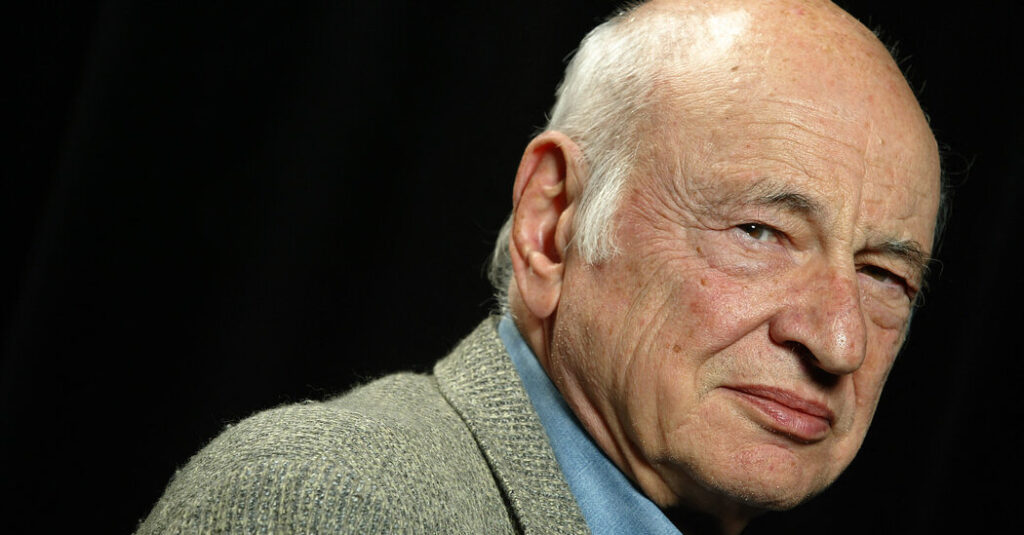
Edgar Morin, a French sociologist, anthropologist, ecologist, philosopher and filmmaker whose work spanned epochs and disciplines, dazzling his countrymen with his erudition and life lessons learned in the Resistance, died on Friday in Paris. He was 104.
Mr. Morin’s death was confirmed by the French president, Emmanuel Macron, who saluted him in a post on X as a “soldier of the Resistance, fighter and free spirit, a defender of nature and humanity,” and called him “humanism personified.”
He was the last survivor of a generation of intellectuals shaped by their experiences during the Nazi occupation of France during World War II, giving his books and pronouncements a distinct moral authority in his country. Until his death, Mr. Morin’s voice and his presence on France’s intellectual stage remained constants.
His passage through, and engagement in, the previous century’s most turbulent moments gave him a credibility matched by few. “He is the grandfather of all the French,” the newspaper Libération wrote of him in a profile celebrating his 100th birthday in 2021, “the memory of the preceding century.”
His last book, one of nearly 120 he wrote or co-wrote, was just published. His first, published nearly 80 years ago, was a keen-eyed portrait of Germany reduced to rubble by the war.
In between, he published dozens of works — of autobiography (he was one of his own favorite subjects), anthropology, sociology, philosophy, epistemology, cinema studies, biology, ecology, history and political science. The torrent of books was testimony to one of his favorite doctrines: Academic disciplines should converge toward synthesis. “I’ve never understood why all this knowledge should be cloistered off,” he once told a television interviewer.
Though few of his works were translated into English, he was widely followed in the Mediterranean world and in Latin America, where university research centers have been named for him.
There is no equivalent in America: Mr. Morin traversed much of the 20th century and a quarter of the 21st as both participant and critical observer. First, he was a teenage antifascist in 1938, helping put together packages of food and clothing for Spanish Republicans. Then, hunted by the Nazis during the war, he was in overlapping Resistance networks with the writer Marguerite Duras and the future French president François Mitterrand.
The Germans, he said in the 2020 French TV film “Edgar Morin, Journal d’une Vie,” had “three reasons to kill me: Jew, Communist, Gaullist. They couldn’t have asked for better.” He acknowledged, though, that his Resistance activities were somewhat desultory, consisting mostly of daubing anti-collaboration slogans on walls.
After the war, he was a publicly repentant ex-Communist and anti-Stalinist; a pioneer of cinéma vérité with the groundbreaking 1960 documentary “Chronicle of a Summer,” and, for many of his subsequent years, an autodidact sharpshooter at the edges of academia in France.
Though he held an official position at the French National Center for Scientific Research after 1950, he became a stubborn critic of the succeeding fashions and “isms” that swept over French academic life in the 1960s, ’70s and ’80s: structuralism, Maoism, Marxism and deconstruction. This opposition limited his appeal on American campuses.
Each of these systems, he was convinced, reduced the complexity of the world. “I have a permanent sense of the mystery of all things, of the incomprehensible. I still have no idea why I was born, why I exist, why I am sitting in this room, talking to you,” he told an interviewer for Le Monde when he reached 101. It was one of Mr. Morin’s favorite ideas: Complexity to him meant interlocking, inseparable methods of thought.
His fellow citizens, particularly those on the left, remained hungry for his words until the end, and Mr. Morin’s pronouncements on everything from Israel and the Palestinians to the environment, to French politics, to cinema, could be found without difficulty, month after month, in much of the French media.
A Jew who was skeptical of Zionism, he told a television audience he was “outraged by the fact that those who represent the descendants of a people who were persecuted for centuries for religious or racial reasons” had, after the massacre of Oct. 7, 2023, “engaged in a real massive slaughter on the populations of Gaza.”
Mr. Morin sometimes complained that few people had actually read what he considered his major work, “La Méthode” (“Method,” not translated, 1977-2004), a six-volume philosophical treatise on knowledge, the nature and meaning of thinking, and a “meditation” on “what it means to be human,” the philosopher Roger-Pol Droit wrote in Le Monde in 2001. The work is about “the organization of reality, its nonlinear advancement, and its recursiveness,” Mr. Droit wrote in 2004.
Instead, Mr. Morin seems most likely to be remembered for a frank autobiography detailing his split with the French Communist Party, along with two works of sociology dissecting France’s fractures during its years of postwar prosperity, and his breakthrough documentary film probing that theme.
All these works questioned the status quo from the outside and uncovered turbulence beneath France’s outward calm. His perspective was formed in the Resistance, as he told Le Monde in 2022.
“I waged an internal fight against my fear and my wish to hide,” he said. “Then, I understood the difference between living, and just surviving: Living means, when it’s necessary, risking one’s life. That day, I became an adult.”
Mr. Morin’s account of his break with the Communists, six years after the war’s end, “Autocritique” (1959, not translated) was called “the best and perhaps the most influential autobiography by an ex-Communist intellectual” by the historian Tony Judt in his book “Past Imperfect.”
When much of the French intelligentsia was still in the grip of Soviet dogma, Mr. Morin’s sharp rebuke of Communism made waves. “Ignorance and religiosity determined a particular kind of euphoria that wasn’t only, or simply, stupidity, but also the mystical beatitude of the believer,” he wrote.
Two years later, inspired by his own academic studies on film culture, he teamed up with the ethnographic filmmaker Jean Rouch and interrogated people on the streets of Paris and elsewhere in France, asking whether they were happy.
“Chronique d’un été,” or “Chronicle of a Summer,” is disarming in its goal of effacing the significance of the filmmaker by making sure the spectator never forgets his presence. Writing in The New York Times in 2013, the critic Dave Kehr observed that “the influence of ‘Chronicle of a Summer’ can be felt in practically every fiction film with a pretense to realism.”
Two works of sociology by Mr. Morin in the following decade attracted wide attention. One, “Commune en France, la Métamorphose de Plodémet” (1967), was a study of social transformations in a village in Brittany on the eve of the explosion of student demonstrations and civil unrest in May 1968. In 1970, it was published in English as “The Red and the White: Report from a French Village.”
The other was about how an ugly antisemitic white-slavery rumor spread in the town of Orléans, “La Rumeur d’Orléans,” 1970, (“Rumour in Orléans,” 1971). In The Times, the author Richard Elman praised Mr. Morin for highlighting “the lingering tradition of antisemitism in France, and how it has undergone little transformation since the time of the Dreyfus affair.”
The decades after were taken up with the writing of what he considered his major work, “La Méthode,” whose goal, as he put it in the 2020 TV film, was to make his readers “capable of thinking across incertitude and contradiction,” telling his interviewer: “If I succeed, it will be to show that everybody can understand the world.”
Edgar Nahoum — he later adopted his Resistance pseudonym, “Morin” — was born on July 8, 1921, in Paris, the son of Vidal Nahoum, a Jewish immigrant from Thessaloniki, Greece, who owned a women’s clothing store, and Luna Beressi.
He attended schools in Paris, reading voraciously. His mother died when he was 10, a shock he later described as formative. After the Germans invaded in June 1940, he took refuge in the unoccupied southern zone of France and became a student at the University of Toulouse.
He joined the Resistance, informally, at the beginning of 1942, distributing tracts in the streets of Toulouse and Lyon, joined the Communist Party while underground, and took an active role in the liberation of Paris, explaining in his autobiography that he was reluctant to execute two suspected traitors, as he was ordered. “The vanquished deserves compassion,” he told Le Monde, “because he is humiliated.”
After the war, he earned bachelor’s degrees in history, geography and law from the University of Paris, but he later wrote (in “Mes Démons,” 1994, not translated) that “those four years of war, defeat, occupation, resistance” were “my real school years.”
Mr. Morin was kicked out of the Communist Party in 1951 and became a leading voice against France’s war in Algeria. He helped found the magazine Arguments, later in the decade, and then Communications. He continued to comment on contemporary events until the end, telling the online publication Le Grand Continent in 2019 that the “Yellow Vest” uprising in France’s cities “crystallized a thousand real aspirations.”
Survivors include his wife, Sabah Abouessalam; and two daughters, Irène Nahoum-Léothaud and Véronique Nahoum-Grappe, from his first marriage, to Violette Chapellaubeau, which ended in divorce. His second marriage, to Johanne Harrelle, also ended in divorce.
Mr. Morin was the opposite of a mystic. But despite his vast reading and his ceaseless attempts to link disciplines — or perhaps because of them — he suggested in the TV film that there were some aspects of knowledge he couldn’t reach:
“As far as God is concerned, what I want to say is, I don’t have any relations with this chap,” he said, before adding, “I don’t deny there is a mystery in things. We can’t shut up in our minds and reduce to ideas the infinite complexity and the infinite mystery of the world.”
Adam Nossiter has been bureau chief in Kabul, Paris, West Africa and New Orleans and is now a writer on the Obituaries desk.
The post Edgar Morin, ‘Grandfather’ of French Intellectuals, Dies at 104 appeared first on New York Times.