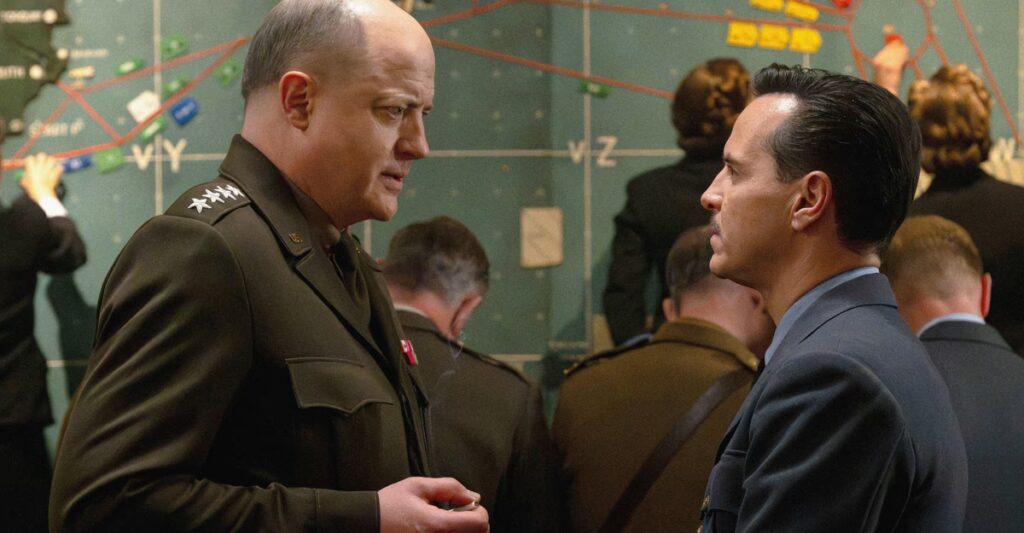
The World War II drama has been a hearty staple of the film industry’s diet for more than 80 years—even as Hollywood has turned away from the kind of meat-and-potatoes offering that the genre represents. And after so many decades, directors somehow still keep finding new narrative nooks and crannies to explore. Take Anthony Maras’s latest movie, Pressure, which asks a question that had never occurred to me: Just how stressful was it to be the person tasked with picking the opportune moment for the D-Day landings? Would anyone be shocked to learn that it was, in fact, incredibly stressful?
Of course they wouldn’t. Indeed, the title works two ways—there’s air pressure, and then there’s office pressure, and this movie has heavy helpings of both. If that feels a little on the nose, then Pressure may not be for you. But it is the kind of straightforward bit of dad-bait I am always happy to see in a theater; it somehow manages to invest real tension in a story that has been told many times on the big screen. Although everyone watching knows that World War II is going to go the way of the Allies, the film makes that feel less like a guarantee.
An adaptation of the playwright David Haig’s 2014 stage play, Pressure dramatizes the story of the Royal Air Force meteorologist James Stagg, who was vital to planning the final stages of D-Day. As with any biopic, it nips and tucks some details, excising a historical figure or two. But the tighter focus is both simple and effective. The film zooms in on the few final days before the Allies landed their troops in Normandy in 1944, as Stagg tried to predict whether their boats would be washed away by a huge storm.
[Read: Nothing prepares you for visiting Omaha Beach]
Stagg is played by Andrew Scott, a versatile actor capable of portraying preening villains, swoon-worthy love interests, and emotional wrecks. Here, his remit is clear-cut: possess the stiffest upper lip imaginable. Stagg is taciturn, data-driven, and hardly a people person, shuffling between bustling rooms in Southwick House (the headquarters for the D-Day planners) with nary a word to his compatriots. He’s worried about his pregnant wife at home. But just as stressful, as he consults his weather maps, is the legion of military minds breathing down his neck—chief among them Supreme Allied Commander Dwight D. Eisenhower (played by Brendan Fraser).
I confess that my image of Eisenhower, perhaps tinged by his later presidency, is of a slightly reedier and more thoughtful person than the one Fraser embodies. In Pressure, the commander is a seething powder keg, carrying years of experience on his shoulders as he readies for the last big push to win the war. Fraser keeps things mostly nervy rather than fully screamy, yet his Eisenhower is still a big, angry bulldog—he’s intent on getting the answer he wants and befuddled by the stoic, mysterious Brit telling him that the day he’s picked for the Normandy invasion will result in all Allied ships being battered by a disastrous storm.
Although, going into Pressure, I wasn’t very familiar with Stagg, I could not believe how invested I was in the specifics of an event whose conclusion was foregone. The story explores the margins of decision making, through the lens of how a difference of 24 hours ended up being vital to Allied success. Maras, who directed as well as co-wrote with Haig, is wise to confine most of the action to Southwick House; the stakes of World War II are already obvious. Every fraught conversation thus feels life-and-death; Stagg is trying to convince a group of baffled Americans, including a hotdogging meteorologist named Irving P. Krick (Chris Messina), that the Northern European climate can viciously change on a dime—no matter how sunny the skies might look.
[Read: Revisiting the grim heroism of Saving Private Ryan]
As a former longtime resident of London, I nodded emphatically at Stagg’s warnings, tickled by this ultimate manifestation of the Brit who endlessly discusses the varying nastiness of the forecast. That character detail speaks to the mix of styles at the highest levels of Allied leadership—among them Eisenhower’s ruthlessness, Krick’s pugnaciousness, and the wise and moderating affect of Eisenhower’s secretary, Kay Summersby (an excellent Kerry Condon). Pressure, however, is first and foremost a celebration of a particular kind of frosty British calm: a rigid insistence on structure even when one faces the total chaos and terror of war. As a chamber piece set within the grander opera of battle, it’s a comforting watch. And as a fresh meat-and-potatoes dish offered by a type of cinema that will hopefully never expire, it’s satisfying too.
The post How to Make the End of World War II Feel Like a Surprise appeared first on The Atlantic.