It was 9 a.m. on a Thursday at Harmony Elementary School in Buford, Ga., about 45 minutes outside Atlanta. A gaggle of first graders sat on a rug festooned with ladybugs in the school’s bright, airy library. The children were surrounded by walls of books and tables that had been set up with Magna-Tiles and blocks.
“Here is a little toy,” a teacher named Shanaz Lakhani told the children, holding a plastic figurine. “We are going to think about our user, our little toy, and how we can build a sturdy home for her.” She asked the 20 or so students, who were starting to wiggle with restlessness, what sturdy means. A few of them shot their tiny hands in the air. Ms. Lakhani called on one kid, who said, “It means that everything is fine and secure.”
Ms. Lakhani affirmed the answer, and described how a sturdy home could potentially stand up to an earthquake or a very windy day; part of the activity involved students shaking the table to see just how hardy their structure was. She told them to focus on the feelings of the figurine. “She’s our user, right? We’re using our ‘user experience’ where we’re going to think, how can you build a strong home for her?” Ms. Lakhani put the children into small groups, and they scampered off to build their structures.
Behind Ms. Lakhani was a digital whiteboard that explained the challenge, next to an analog whiteboard with six colorful triangles affixed to it. The triangles explained how this activity was part of Harmony’s artificial intelligence learning framework. “User experience” is one side of the light-blue “applied experiences” triangle, along with “A.I. applications” and “robotics.” The other triangles stand for “programming,” “data science,” “mathematical reasoning,” “creative problem solving” and “ethics.”
The children did not seem to be paying much attention to either whiteboard once they began their activity. I saw two girls approach Ms. Lakhani to ask her for a specific doll for their building. I couldn’t discern whether they received the message about “user experience,” or its connection to artificial intelligence, because they are 7.
Harmony Elementary is part of Gwinnett County’s Seckinger cluster of schools, along with Ivy Creek Elementary, Patrick Elementary, Jones Middle School and Seckinger High School. The high school markets itself as “the nation’s first artificial intelligence (A.I.)-themed educational institution.” The other four schools, which are older and more established, feed into Seckinger High. They all follow the same A.I. framework, though it is calibrated for different grade levels.
Gwinnett County, in contrast to many other public school districts, has gained thousands of students over the past decade (though it has lost some from its peak enrollment). The suburban county has grown by roughly 400,000 people since the year 2000. The district decided to make an A.I.-themed cluster after its leaders read reports in the late 2010s from the World Economic Forum and McKinsey Global Institute predicting that artificial intelligence would soon disrupt the work force. They wanted to make their students “future ready.”
The first class of students who have been at Seckinger High School since they were freshmen graduated this month. By now, districts from Boston to Miami have caught the same A.I. fever, vowing to integrate the new technology into their curriculum.
This sounds sensible in theory. Proponents of A.I. in education believe that if the technology is harnessed correctly, it can give children a more precise, dynamic and individualized learning experience, even in big public school classes. Conventional education too often operates on a one-size-fits-all model, they argue, and A.I. can change that. Schools are also trying to respond to the unpredictability of the labor market, and the fear that with A.I., entry-level white collar jobs will become scarcer, and some may disappear entirely.
But in practice, placing A.I. at the center of a school is far more complicated and uncertain. There isn’t a standard definition of A.I. literacy, or a single widely accepted way to measure it. The adapt-or-perish rhetoric is the same kind of argument that tech boosters made about giving every child a laptop, and many years into that enterprise, it’s tough to argue that it’s been a success.
The latest push for schools to keep up with sweeping, societywide technological changes is coming at the same time that American students are struggling. Test scores have been declining for over a decade along with basic numeracy and literacy. There are lots of explanations for why that’s happened, though the two most obvious culprits are the ubiquity of screens and the decline of accountability measures. Covid made it clear that a kind of magic happens in a physical classroom through human connection that cannot simply be replaced by apps. Presumably A.I., even when carefully introduced and overseen by trained educators, risks killing some of that magic.
As a result of these deficits, fewer students appear to be ready for the rigor of college. According to a report from the U.S. Chamber of Commerce and the College Board, 80 percent of hiring managers believe that high school graduates are less prepared to enter the work force compared with previous generations.
There are few high-quality studies on the impact of artificial intelligence on K-12 students and teachers, and the results of the studies that exist are mixed. Stanford’s A.I. Hub for Education recently published a review of over 800 academic papers and found that “A.I. tools may help students complete tasks more successfully in the moment, but those gains do not always persist when students are later asked to perform independently.”
Even as the gains are limited, the pitfalls are mounting. Researchers at the University of Pennsylvania have warned about the risks of “cognitive surrender” to artificial intelligence among the general population, which is when users of A.I. avoid “effortful thinking” and offload a significant part of their decision-making to large language models. What’s more, it is possible that whatever is being taught to schoolchildren today could be obsolete in six months.
When I asked leaders throughout the Seckinger cluster about how they were defining the success of their A.I. pilot, they were refreshingly honest about the rocky terrain beneath them.
Seckinger doesn’t have an ultimate goal it’s trying to meet, or metric it’s trying to measure, said Sallie Holloway, who is the director of artificial intelligence and computer science for Gwinnett County Public Schools and who helped develop the learning framework for the cluster. She started her career as a computer science teacher and instructional coach and stepped into her current role in 2021.
It’s more like a “system of metrics,” she said, that include normal public school student achievement like grades and test scores and whether students are building technological skills and feel positively about the curriculum. The experimental nature of what is being attempted in Gwinnett County reminded me of an oft-repeated start-up maxim: Seckinger is building the plane while flying it.
Before I came to see the Seckinger schools, I struggled to understand what embedding A.I. in every grade would actually look like. In my dark fantasies, I pictured kindergartners having conversations with chatbots instead of one another. I imagined older children plugged into laptops doing an A.I.-personalized set of math problems, while a human teacher sat off in the background, marginalized by bots.
It’s definitely not that. Educators were not sidelined. I was struck by the warmth of all the teachers I observed. I saw a first-grade teacher, Liza Earley, running a literacy activity that was in line with the green “mathematical reasoning” triangle in the A.I. framework. Ms. Earley was showing her students how to observe patterns in words that they hear, like “high,” “tie” and “fly.” She noticed that a few kids were not picking up on the relationship among the words, so she crouched down to their eye level on the rug and gave them further guidance.
In middle school, the activities started using technology I recognized as artificial intelligence. An eighth-grade social studies teacher at Jones Middle School, Kacie Holycross, joked with her kids while they posed as journalists interviewing chatbots Ms. Holycross built on MagicSchool, an A.I. platform for K-12 education.
The chatbots were supplied with biographical information about Richard Russell Jr. and Carl Vinson, two long-dead Georgia politicians who brought lots of military funding to the state during World War II. Ms. Holycross wrote the questions for the children to feed the chatbot. Then the Vinson bot spat out replies like “Georgia’s got the workers, the shipyards and the know-how to build them.”
Ms. Holycross told me that interacting with primary sources using A.I. made the lesson more “student friendly.” But the kids I observed did not seem especially riveted. I asked one student if he planned to ask the bots any follow-up questions. “I could do that,” he said, but didn’t.
Ms. Holycross told me, “Their goal right now is just to kind of focus on the three questions and then summarize what they say.” Some of the students need structured guidance with the chatbots, she explained to me later.
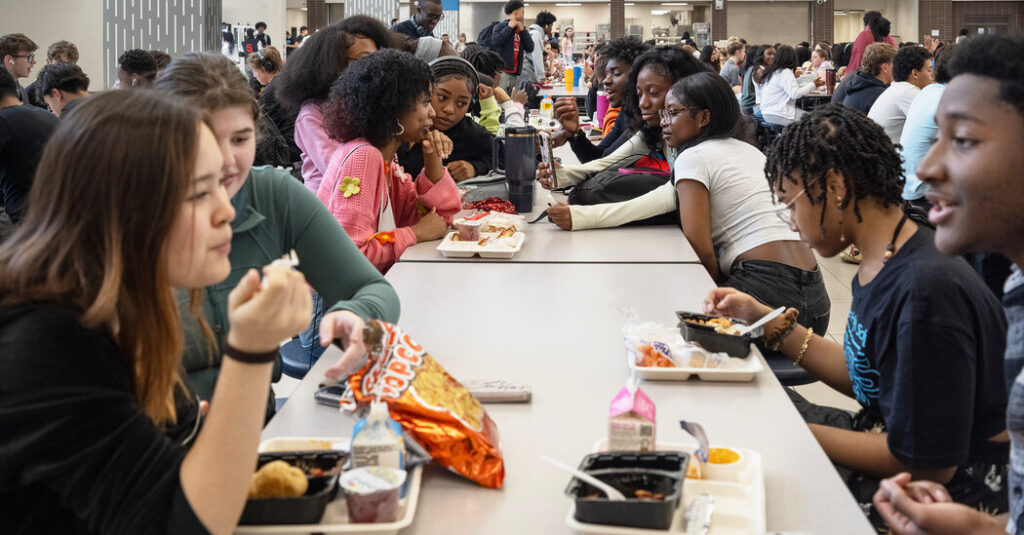
My last stop was Seckinger High School, which is the fanciest public school building I have ever set foot in. I toured state-of-the-art mechanical engineering classrooms and glass-walled student “collaboration rooms.” I spoke to four teachers, three students and Seckinger’s principal about their experiences teaching and using A.I. at Seckinger.
Scott Gaffney, who is head of the social studies department, talked about how students in his A.P. human geography class used a large language model to gather data about a 2014 “snowmageddon” that paralyzed Atlanta. Mr. Gaffney and one of his students described looking up road density data and the number of students who needed to be bused home from school. The kids were instructed to come up with public policy solutions that might have made the storm less debilitating.
Mr. Gaffney said that this year the activity was more efficient than when he first taught it. Now, “kids can look at this data and they’re like, oh, 500,000 without power, 25 people dead, two inches of ice, Atlanta paralyzed, like kids stuck at school,” he explained. The students move more “obviously to a faster conclusion.”
These are remarks similar to the ones Mr. Gaffney made in an interview with CBS News in 2023. Before A.I., he could have had students look up years of traffic data, but it would have taken four to five days for the students to complete the lesson. Few people I talked to when I visited this year seemed to think that there had been any value in that slower kind of research or that there might be cognitive or emotional muscles involved in more painstaking, frustrating work that would atrophy from disuse.
As the day wore on, I kept hearing about how the students used algebraic reasoning to think more deeply about literature, or rebranded simple patterns in words as “algorithms.” They kept circling back to those colorful triangles — ethics, creative problem solving — that didn’t necessarily have anything to do with artificial intelligence.
A visual art teacher, Megan Fowler, described encouraging her students to use ChatGPT to help them free-associate words to get past artists’ block. But wouldn’t they be just as well served by thumbing through a book of paintings, going outside and looking around, or daydreaming?
I thought about Mr. Gaffney’s description of his students moving rapidly through their research assignments, and about introducing the term “user experience” to first graders. Gwinnett County often seemed to be transposing the language and goals of tech corporations onto its schools. In one sense, these goals are not new. The promise of tidy, industrialized efficiency has been central to the argument for bringing tech into schools for at least a hundred years.
In 1913, Thomas Edison predicted that books would quickly become obsolete: “Scholars will soon be instructed through the eye. It is possible to touch every branch of human knowledge with the motion picture.” This is just one example of utopian educational technology boosterism that Larry Cuban, who is a professor emeritus at Stanford, includes in his 1986 book “Teachers and Machines.”
Dr. Cuban describes an “unrelenting cycle” that occurs with every new technology, whether radio, film, television or computers. First, reformers, who tended to be either executives or administrators, would promise to “revolutionize” the classroom with a new device. Money may be included; Seckinger received a grant for over $100,000 from Google.org, the tech company’s philanthropic arm, for A.I. research in 2024. That promise would be followed by breathless press around how any given technology would improve student learning, make the classroom more cost-effective and enhance teacher skills.
These guarantees always ignored all of the other pressures faced by teachers, who still had all the old responsibilities to balance while integrating new devices into their instruction. The next part of the cycle — after the glowing publicity and often uncritical imposition of the technology — is disappointment. Uptake by classroom teachers is inconsistent, often because the tech doesn’t work well. During my visit to Georgia, I observed a music teacher looking anxious as her eager fifth graders could not perform their block-coded melodies for me on their glitchy Padlet app.
Even if the devices work as advertised, they don’t instantly offer the productivity or test-score gains that were initially assured. The last part of the cycle that Dr. Cuban outlines is teacher bashing. Educators tend to be the ones blamed when the unrealistic expectations of administrators don’t materialize.
With A.I., we’re somewhere between Parts 2 and 3 of Dr. Cuban’s cycle, the point he describes as the “fickle romance” between technological innovation and the American classroom. We’re in the middle of a backlash against smartphones and Chromebooks in schools just as districts are starting to contend with the infiltration of A.I. New York City recently paused the creation of an A.I.-focused high school in Manhattan after protests from parents.
Even the founders of educational tech companies are starting to reconsider. In 2023, Sal Khan, the founder and chief executive of Khan Academy, introduced Khanmigo, an A.I. chatbot. “We’re at the cusp of using A.I. for probably the biggest positive transformation that education has ever seen. And the way we’re going to do that is by giving every student on the planet an artificially intelligent but amazing personal tutor,” Mr. Khan boasted in a TED Talk that year.
In 2026, Mr. Khan is softening some of those hyperbolic claims. “For a lot of students, it was a non-event,” Mr. Khan told Chalkbeat’s Matt Barnum in April. An Indiana teacher who was an early adopter of Khanmigo said many of her students found the bot frustrating, in part because it made mistakes, and in part because it didn’t often deepen students’ learning.
This is not what I heard from the teachers at Seckinger High. I asked them if they were concerned about A.I. hallucinations or outright cheating with chatbots, which a majority of teenagers say happens regularly at their schools. Beth Cure, who teaches math at Seckinger, said that she thinks her students have an awareness about when A.I. is helpful and when it’s giving them the wrong answers. They can discern, she said, between “when is it something that’s furthering my understanding, or when am I not thinking at all, I’m requiring something else to think for me?”
My time at the Seckinger schools was so brief and highly choreographed that I was not sure I was getting the full picture. So I spent the weeks after I returned from Georgia talking to several recent Seckinger graduates and current parents of students in the cluster.
Nearly all of them mentioned how much they loved the diversity of the schools and the high quality of the teaching staff. But they also told me they did not use as much artificial intelligence as the marketing brochure for the high school might imply.
Joseph Schrage graduated last year from Seckinger High, which he entered as a sophomore. One of the first things he said about his high school experience was that he was in the marching band, and “our football team sucked.”
When I asked him about how much he used artificial intelligence at Seckinger, he said, “In my experience, we would joke a lot about how Seckinger likes to advertise as being an A.I. school.” Mr. Schrage added, “I mean, you’re a New York Times writer and you’re looking at Seckinger. Yeah, it works.”
He talked about the school’s A.I.-specific pathway and said it incorporated the technology much more deeply, as did computer science classes, neither of which was his focus. Holly Hall, who teaches the three-course A.I. pathway, estimated that about 30 current seniors had taken all three classes, though many more take just the first two. The kids have only so much time in the Jenga of their schedules, she said, and many of them are taking dual-enrollment college classes or Advanced Placement courses.
Mr. Schrage said he felt the school taught him how to use A.I. the right way — ethically and functionally. But he was more of a humanities person, and “the pathway I took, realistically, I’m not doing anything more in A.I. than I would be doing anywhere else.” He just finished his freshman year at the University of Georgia, majoring in political science, with plans to go to law school.
Muhammad Rizwan, who graduated from Seckinger in 2024 and goes to Emory University, echoed much of what Mr. Schrage said: There was a lot of A.I. where you would expect it in, say, robotics classes, but not much of it elsewhere. In language-arts classes, he said, teachers made the kids write essays in class by hand to prevent them from cheating by using ChatGPT.
Mr. Rizwan explained that teachers (whom he described as “amazing”) still had to meet the county’s standards, and teachers were supposed to tweak those standards to add an A.I. component. “Would the teachers really follow this? Not really, but was it expected of them? Yes,” said Mr. Rizwan, who is an anthropology and human biology major on the pre-med track. He said some of the teachers seemed almost offended by the incursion of chatbots.
Is there proof that incorporating A.I., even if it is not ubiquitous, is helping prepare Seckinger students for the world? By the county’s own measures, only 38.4 percent of Seckinger graduates are “college ready,” which means they took the ACT and SAT, and met a selected group of benchmarks; an additional 19.4 percent complete a career, technical and agricultural education pathway. Seckinger underperforms other high schools in the county with similar socioeconomic profiles on both metrics.
In fairness to Seckinger, it is new, and since there is no clear definition of A.I. literacy, it would be difficult to independently assess how well versed its graduates are in the technology. When I asked Bernard Watson, the interim chief engagement officer for Gwinnett County schools, about the comparison with other nearby schools, he pointed out that Seckinger’s graduation rate, at over 95 percent, is among the highest in the district, and he said that is an example of strong student engagement.
I also asked why so many students and parents felt there wasn’t very much A.I. in the curriculum when the cluster labels itself as A.I.-focused. “When we talk about being ‘A.I. ready,’ we understand that some may assume we’re just talking about new software or coding. In reality, our focus is much more human. We’re prioritizing ‘durable skills’ that machines can’t replicate — like creative problem solving, ethical thinking and collaborative leadership,” Mr. Watson said in an email. He added that on some days the school may look traditional, but teachers are always looking for new ways to infuse Seckinger’s A.I. framework into their lessons.
As I walked the halls of Seckinger, I thought about my own public high school experience, from 1996 to 2000. That’s when schools were dealing with the dawn of the internet. I reconnected with one of my favorite teachers, John Hackenburg, who started teaching in New York State in 1964 and retired the year that I graduated.
Mr. Hackenburg, who taught social studies, described several different trends that passed through Irvington High School, in the suburbs of New York City, in his decades of work. He started teaching in Irvington in 1972, and he talked about a push for interdisciplinary teaching in the ’70s and ’80s, then a state requirement that every student take an economics class in the late ’80s, and finally, the installation of a computer lab so that students might become computer-literate.
I have one faint recollection of being in the computer lab to work on the student newspaper, but I have no other memories of using a computer in high school. Mostly I used the internet at home, instant messaging my friends on AOL and spending hours on AllMusic looking up indie rock bands. I learned some coding basics working on websites in my early 20s. Those skills are now totally obsolete.
Many of the innovations of Web 1.0 were meant to prepare kids for college and for life, the same pitch for A.I. today, Mr. Hackenburg told me. When I asked him if that’s what he thought school was for, he wrote me a beautiful email: “Every society has a process by which children are nurtured into becoming useful and productive members. Public education is a big part of that in our culture. It gives children the ability to enter in and become part of social institutions with skills to make meaningful contributions for our mutual progress. And to go beyond the provincial and appreciate and engage with the broader world.”
Nurturing from thoughtful, engaged teachers like Mr. Hackenburg seems to be the best part of Seckinger. It is absolutely essential to a good school, and it’s also hard to measure. The parents of current students I spoke to were wild about the staff.
Lydia Clark, who has children at Harmony Elementary, Jones Middle and Seckinger High School, said that “Harmony is the most warm, enveloping culture” and that the teachers at Jones had a “lifelong impact” on her kids. When her child at Seckinger needed an accommodation, it took only a few minutes of speaking to a counselor whom Ms. Clark trusted to set her mind at ease that the problem would be handled. A.I. isn’t the reason her kids are excelling in the classroom, Ms. Clark said. She doesn’t see it much in her children’s education — her high schooler uses the technology sparingly because of A.I.’s impact on the environment — and it isn’t why her family chose the district.
When I first heard about the Seckinger cluster’s focus, I was worried that all of the A.I. would remove the humanity from those schools. But as with the Magna-Tile houses that I watched those sweet-faced first graders making, the earthquake of A.I. cannot ruin the foundation of a solid school, where there is so much else going on: sports and band and A.P. classes and puberty and the messiness of growing up. It’s good that schools are not like start-ups, because children’s minds should not be tied to the whims of the marketplace.
One of the last things I saw at Seckinger High School was a student working in the mechanical engineering classroom. His assignment was to make a carnival game, and he had a bunch of cardboard cutouts in front of him. He told me he was making a giant target that spins, with a laser gun that would shoot the targets. His partner was working on the circuitry.
I asked him if he used A.I. for any of it. No, he said, “I’m just using the human mind.”
Jessica Grose is an Opinion writer for The Times, covering family, religion, education, culture and the way we live now.
The Times is committed to publishing a diversity of letters to the editor. We’d like to hear what you think about this or any of our articles. Here are some tips. And here’s our email: [email protected].
Follow the New York Times Opinion section on Facebook, Instagram, TikTok, Bluesky, WhatsApp and Threads.
The post America’s First A.I. High School Is Great. But Not Because of A.I. appeared first on New York Times.